
A few years ago, Wise reached a milestone that clearly showed how far FinTech has progressed. What started as a simple solution to reduce high cross-border transfer fees has grown into a global financial platform used by individuals and businesses. Wise demonstrated that solving one focused problem with transparency and efficiency can lead to large-scale adoption and long-term growth.
This change is visible in the FinTech industry as the market is projected to surpass USD 1126.64 billion by 2032. Companies like Stripe and Revolut initially addressed specific gaps in outdated financing methods and gradually expanded into comprehensive fintech apps that now generate billions in revenue. They didn’t become popular overnight because achieving this milestone takes years of planning and a step by step process.
Today, FinTech is not just operating in banking, but it also helps in essential functions such as instant payments, digital lending, and much more. These systems are making finance transparent and more accessible for millions of users worldwide.
For entrepreneurs, this shift shows a durable and high-growth opportunity. As users increasingly expect secure and always-available financial services, demand for new FinTech solutions continues to rise. So, to help you find the best solution, we have created the top 20 FinTech business ideas list that can generate billions or even become the next unicorn startup.
FinTech Industry Stats You Should Know in 2026
Prior to discussing the top fintech startup ideas in detail, first look at an overview of the fintech industry numbers that depict the growth opportunities:
Global FinTech Market Size and Growth
- The global FinTech market is anticipated to cross USD 652.80 billion by 2030 growing at a 15.27% CAGR.
- In H1’25, global investment in FinTech startups reached USD 44.7 billion.
- Fintech-as-a-service (FaaS) is expected to reach $1.6 trillion by 2034, showing the huge demand for an untapped market for API-driven solutions.
FinTech Adoption Rates
- 68% of consumers worldwide now use digital payment methods on a regular basis where digital wallet payments contribute about 42%.
- Mobile based transitions constituted 51% of total digital payment volume.
- In 2025, fintech has seen a 40% rise in revenue and 39% profit growth showing high recorded growth.
Blockchain and Cryptocurrency Growth
- The global blockchain market is expected to grow from $7 billion in 2022 to $163.83 billion by 2029.
- More than 300 million people globally are using cryptocurrencies.
- Recent developments in Artificial Intelligence are expected to have a huge impact on the cryptocurrency market.
Digital Lending and P2P Lending Trends
- The digital lending market is anticipated to cross USD 12 billion by 2026 largely driven by P2P platforms.
- Around 42% of small businesses worldwide now rely on digital lending platforms for financing.
- High investments are made in AI-driven credit assessments.
InsurTech Market Growth
- The InsurTech market is projected to be worth over USD 50 billion by 2025, growing at a 30% CAGR.
- 53% of consumers now prefer digital-first insurance solutions over traditional providers.
- 60% insurer strategists recognize that changing customer expectations have sped up transformation strategies.
Cybersecurity in FinTech
- Cybercrime costs the global economy an estimated USD 10.5 trillion annually with financial services being a main target.
- 70% of startups are increasing their cybersecurity budgets to address rising threats.
- Nearly 46% of financial institutions reported at least one breach which increases the demand for secure fintech business ideas.

Best 25+ Profitable FinTech Startup Ideas for Businesses
1. Blockchain-Based Identity Verification for Financial Services
Metrics You Should Look At
| Profit Potential | USD 50–100 million annually at scale |
| Annual Growth | 30–40 percent |
| Target Users | Banks, FinTech platforms, payment providers |
| Revenue Model | Per-verification fees, enterprise subscriptions, API access |
| Growth Potential | Extremely High |
Banks and financial platforms lose time and money every time they verify a user. Documents are uploaded again and again. Data is stored in different systems. Errors slow onboarding and increase fraud risk. As regulations grow stricter this problem becomes bigger, not smaller.
Blockchain-based identity verification fixes this at the root. A user verifies their identity once. That verified identity is stored securely on blockchain and can be reused across financial services with permission. No repeated uploads. No manual checks every time. Changes are tracked and cannot be altered quietly, which builds trust for banks and users.
This digital identity management solution works well because financial institutions do not want to rebuild KYC systems again and again. They want a reliable layer that plugs into payments and compliance tools. Revenue comes from per-verification fees, enterprise subscriptions and API access. As digital banking and cross-platform finance expand, this type of identity layer can grow into core infrastructure for the FinTech ecosystem.
New Features You Can Add
- Reusable Digital Identity Wallet
Allows users to verify once and reuse their identity across multiple financial platforms with consent.
- Smart KYC Update Alerts
Notifies institutions when user data changes so records stay current without manual checks.
- Selective Data Sharing Controls
Let users share only required fields such as age or address instead of full documents.
- Cross-Border Identity Validation
Supports verification for users accessing international financial services.
- Regulator Access View
Provides read-only audit access for compliance teams and regulators when required.
2. Fractionalized Real Estate Investment Platform
Metrics You Should Look At
| Annual Growth | 20–30 percent |
| Profit Potential | USD 50 million+ annually at scale |
| Target Users | Retail investors, property owners |
| Revenue Model | Transaction fees, asset management fees, platform subscriptions |
| Growth Potential | Very High |
Real estate has always been one of the safest ways to build long-term wealth, but high prices keep most people out of the market. Fractionalized real estate changes this by letting investors own small portions of a property instead of buying the whole asset. This makes it possible to invest in residential or rental properties with much lower capital.
The demand for this fintech solution is rising quickly. According to industry estimates, the global market for tokenized and fractional real estate could cross USD 16 trillion by 2030, driven by digital platforms and changing investor behavior.
What makes this fintech business idea strong is how it solves two problems at once. Property owners get easier access to capital, and investors get exposure to real estate without long lock-in periods. Platforms handle property listing, legal structure, rent distribution, and reporting, which removes complexity for users.
Key benefits of this model
- Lower entry cost for investors
- Shared ownership of high-value properties
- Regular rental income distribution
- Better liquidity compared to traditional real estate
- Easier diversification across multiple properties
Revenue comes from transaction fees, asset management charges, and ongoing platform subscriptions. As more investors look for stable returns outside volatile markets, fractionalized real estate platforms have clear potential to grow into billion-dollar businesses.
Also Read: Top 10 Real Estate Tokenization Development Companies
3. Robo Advising Software
Metrics You Should Look At
| Annual Growth | 25–35 percent |
| Profit Potential | USD 40 million+ annually at scale |
| Target Users | Retail investors, young professionals |
| Revenue Model | Assets under management fees, subscriptions, premium features |
| Growth Potential | Very High |
Robo-advising software is transforming how people handle money because instead of relying on human advisors, users get automated investment guidance based on their income and spending habits. These platforms use algorithms and machine learning to suggest portfolios, rebalance investments, and track performance without constant manual input.
You can develop such software and it is one of the best fintech business ideas because younger investors want simplicity and low fees. Robo advisors also help users see how daily spending affects goals and after-tax returns which makes financial planning feel practical rather than complex.
Revenue grows through assets under management, subscriptions, and premium features rather than one-time transactions.
New Features You Can Add
- Goal-based investing for retirement, education, or home purchase
- Automatic portfolio rebalancing based on market changes
- Tax optimization and capital gains tracking
- ESG and ethical investment options
- In-app financial education with simple insights
- Integration with banking and expense tracking tools
Also Read: How to Build Interactive Brokers Automated Trading Software?
4. Digital Wallets for Loyalty and Rewards Points
Metrics You Should Look At
| Annual Growth | 20–25 percent |
| Profit Potential | USD 40–80 million at scale |
| Target Users | Retail consumers, merchants, brands |
| Revenue Model | Merchant subscriptions, transaction fees, API access |
| Growth Potential | Very High |
Loyalty points are everywhere but hard to use. Customers earn rewards from airlines, banks and retailers but those points stay locked inside separate apps. Studies show over USD 100 billion worth of loyalty points go unused each year because tracking and redemption are complicated. This reduces customer engagement and wastes marketing budgets.
A digital wallet for rewards fixes this problem by storing all loyalty points in one place. With a blockchain based loyalty program, points are recorded as secure digital assets instead of simple database entries. This makes rewards easy to track, safe from duplication and usable across multiple brands. Smart contracts automate redemption rules and expiry which removes manual work for businesses.
For businesses, this wallet acts as shared infrastructure. Brands plug in through APIs instead of building their own systems. They gain better visibility into customer behavior while users get real value from their rewards. This turns loyalty points into a usable financial asset rather than forgotten credits.
5. Wealth-as-a-Service (WaaS) Platforms
Metrics You Should Look At
| Annual Growth | 25–35 percent |
| Profit Potential | USD 60–120 million at scale |
| Target Users | Banks, FinTech startups, consumer platforms |
| Revenue Model | Platform licensing, usage-based fees, AUM-based fees |
| Growth Potential | Extremely High |
Most apps want to offer investing, but building wealth products is expensive and heavily regulated. Teams have to handle portfolio logic, compliance reporting and risk controls, which delays launches. Over 60 percent of digital banks plan to add wealth features by 2027, yet many struggle with technical and regulatory setup. That’s where a high growth business opportunity lies in the fintech industry.
You can develop a Wealth-as-a-Service platform that removes this barrier. Your platform provides ready made investment tools through APIs while you manage portfolio compliance and reporting.
New Features You Can Add
- White-label investment modules
- Automated risk profiling
- Tax-aware portfolio rebalancing
- Multi-asset investment support
- Partner dashboards for reporting
6. Predictive Fraud Detection Platform for Mobile Payments
Metrics You Should Look At
| Annual Growth | 30–40 percent |
| Profit Potential | USD 70–150 million at scale |
| Target Users | Banks, mobile wallet providers, payment platforms |
| Revenue Model | SaaS subscriptions, per-transaction risk scoring fees |
| Growth Potential | Extremely High |
Mobile payment fraud is growing faster than traditional card fraud because transactions happen instantly and on a broad scale. Rule-based systems work only after suspicious activity appears, which means losses have already occurred. Also, in 2025, U.S. regulators and major banks stated a surge in authorized push payment fraud on instant payment networks like Zelle and RTP.
To solve this issue, you can build a predictive fraud detection platform that stops fraud before a transaction is approved. Machine learning models analyze behavior patterns such as device fingerprinting, transaction velocity, location shifts and spending habits. AI models score risk in milliseconds, so decisions happen in real time without slowing payments.
The platform uses technologies like data streaming, cloud-based ML pipelines and adaptive risk engines. If you are looking to invest in one of the best money making opportunities, then connect with an AI development company now.
7. Quantum-Safe Security Solutions
Metrics You Should Look At
| Annual Growth | 20–30 percent |
| Profit Potential | USD 70–150 million annually at scale |
| Target Users | Banks, FinTech platforms, payment networks, enterprises |
| Revenue Model | B2B licensing, subscriptions, security audits |
| Growth Potential | Extremely High |
As the global financial system becomes fully digital, long-term data security is becoming a strategic concern rather than a technical one. Transactions, blockchain records, customer identity data, and API communications rely on encryption that may not withstand future quantum computing capabilities. This increases demand for post-quantum cryptography across banking, payments, and digital finance infrastructure.
Quantum-safe security solutions allow B2B FinTech startups to deliver future-ready encryption without disrupting live systems. These platforms protect cross-border financial data and help institutions maintain trust as cybersecurity threats evolve. From an investment view, this space is cross-sector, regulation-driven, and positioned to become foundational financial infrastructure.
8. E-Mortgage App
Metrics You Should Look At
| Annual Growth | 18–25 percent |
| Profit Potential | USD 50–100 million annually at scale |
| Target Users | Banks, mortgage lenders, brokers |
| Revenue Model | SaaS licensing, per-application processing fees |
| Growth Potential | Very High |
In the US, 70 percent of mortgage delays occur due to manual document handling and verification, even when borrowers apply online, which opens a money making business opportunity for e-mortgage apps that address this gap by digitizing the full mortgage lifecycle and removing paper-driven friction.
An e-mortgage platform combines automated income and credit checks, e-signatures, and much more in one workflow. AI document management reduces manual reviews while APIs connect banks and registries in real time. This improves approval speed and enables lenders to scale mortgage volumes without increasing headcount.
Key Capabilities You Can Build
- Digital mortgage application and document upload
- Automated income credit and property verification
- E-signatures and secure document storage
- Real time application status tracking
- Integration with banks, valuation services and registries
- Compliance ready audit trails for regulators
9. Crypto-Backed Loan Platform for Instant Liquidity
Metrics You Should Look At
| Annual Growth | 30–40 percent |
| Profit Potential | USD 80–150 million annually at scale |
| Target Users | Retail crypto holders, crypto businesses |
| Revenue Model | Interest margins, liquidation fees |
| Growth Potential | Extremely High |
A lot of people hold crypto for growth but might need cash for any emergencies or business use. Selling crypto breaks long-term plans and can trigger taxes or losses at the wrong time. A crypto-backed loan platform lets users keep their crypto while borrowing money against it. The crypto stays locked as security and users get instant access to cash without selling their assets.
This platform works like a digital pawn shop for crypto but fully automated. The system checks crypto value in real time and adjusts loan limits to avoid risk. If prices move too much, the platform alerts users early instead of sudden liquidations. This makes borrowing predictable and safer for everyday users.
New Features You Can Add
- Auto loan adjustment when crypto price changes
- Early warning alerts before liquidation
- Multi crypto support like BTC, ETH and stablecoins
- Flexible repayment schedules
- Instant payout to bank or wallet
- Dashboard showing loan health in simple terms
10. Payday Loan App
Metrics You Should Look At
| Annual Market Growth | 20–30 percent |
| Profit Potential | USD 40–90 million annually at scale |
| Target Users | Salaried workers, hourly employees |
| Revenue Model | Service fees, subscriptions, employer partnerships |
| Growth Potential | High |
Another strong fintech business idea is a payday loan lending app. This type of digital lending app helps users get quick money during urgent needs. These needs can include medical bills, rent, EMIs or daily expenses. With this app, users can borrow a small amount before their salary gets credited. They only need to share their job details and link their bank account. The app tracks their working days or income flow. When users need cash they can withdraw instantly.
Once the salary is credited the app automatically deducts the loan amount. This makes repayment simple and stress-free. This fintech app idea is useful for salaried employees and hourly workers. It also reduces the need for paperwork and long approval times.
Popular competitors in this space include Earnin and Klover. However, many regions and user groups are still underserved. There is room to build a better app with lower fees and fair lending.
11. On-Demand Insurance Platform (Pay-As-You-Go)
Metrics You Should Look At
| Annual Growth | 25–35 percent |
| Profit Potential | USD 60–120 million annually at scale |
| Target Users | Travelers, gig workers, freelancers, SMEs |
| Revenue Model | Usage-based premiums, platform fees, partner commissions |
| Growth Potential | Very High |
Traditional insurance forces users to pay for coverage they rarely use. Today’s users want protection only when risk exists. In fact, 50 percent of digital insurance customers prefer usage-based coverage, especially for travel and mobility.
You can create an on-demand insurance platform that allows users to activate and deactivate coverage for specific hours or events such as a trip or short-term job. The platform uses real-time data, APIs, and automation to price risk instantly and issue policies without paperwork. This model benefits users through lower costs and benefits insurers through better risk control and higher engagement across digital channels. Collaborate with an insurance software development company to work on this idea.
12. AI Financial Record Maintenance App
Metrics You Should Look At
| Annual Growth | 20–30 percent |
| Profit Potential | USD 30–70 million annually at scale |
| Target Users | Freelancers, small business owners, self-employed professionals |
| Revenue Model | Subscriptions, premium features, cloud storage plans |
| Growth Potential | High |
Another one of the top profitable fintech business ideas is a financial record maintenance app because people do not manage financial documents properly and when they need it they cannot find them. Still, these records are very important for personal and business finance.
You can connect with a blockchain development company to develop a digital finance app that helps users collect and organize receipts, invoices and tax records in one secure place. Users can upload files or scan documents using their phone. With AI-based scanning, the app reads and sorts documents automatically. This reduces manual work and errors.
For example, a freelancer can scan client invoices and expense receipts throughout the year. When tax season comes, all records are already sorted and easy to access. This fintech platform is very helpful for freelancers, small business owners and self employed professionals. These users often deal with scattered financial information.
13. Decentralized Cross-Border Payments Platform
Metrics You Should Look At
| Annual Growth | 30–40 percent |
| Profit Potential | USD 80–150 million annually at scale |
| Target Users | SMEs, exporters, freelancers, global platforms |
| Revenue Model | Transaction fees, FX spread, API licensing |
| Growth Potential | Extremely High |
Cross-border payments are still based on multiple banks and intermediaries. This makes international transfers slow and costly. On average, global cross-border payments cost 6 percent per transaction, and settlements can take several days. For small businesses, these delays and fees impact their cash flow and profitability.
As an entrepreneur looking for million dollar fintech business ideas, you can build a decentralized payment platform that uses blockchain networks to move money directly between countries. The platform can integrate stablecoins and liquidity layers built, which ensures smooth conversion and compliance. Also, smart contract development automates settlement while APIs allow easy integration with wallets and business systems.
Key Benefits
- Faster international payments with near real-time settlement
- Lower transaction costs by removing intermediaries
- Transparent tracking of payments on blockchain
- Improved cash flow for global businesses
- Scalable infrastructure for international expansion
14. Embedded Finance Solutions for Non-Financial Businesses
Metrics You Should Look At
| Annual Growth | 30–40 percent |
| Profit Potential | USD 100–200 million annually at scale |
| Target Users | Retailers, marketplaces, logistics, travel platforms |
| Revenue Model | Transaction fees, commissions, lending margins |
| Growth Potential | Extremely High |
Embedded finance lets non-financial businesses add payments or insurance directly into their digital platforms. Customers complete financial actions without leaving the app which removes friction and improves experience. Retail and logistics businesses use this approach to turn routine interactions into revenue moments while keeping full control over the customer journey.
This fintech idea is profitable because it allows businesses to build finance into checkout or fulfillment flows using APIs and automation. Payments and protection run quietly in the background, while you can earn through commissions and margin share. As digital ecosystems grow, embedded finance becomes the base layer that connects products and money in one system.
15. Fractional Hedge Fund Marketplace
Metrics You Should Look At
| Annual Growth | 25–35 percent |
| Profit Potential | USD 80–150 million annually at scale |
| Target Users | Retail investors, semi-professional traders |
| Revenue Model | Management fees, performance fees, subscriptions |
| Growth Potential | Extremely High |
Traditional hedge funds require high minimum investments and limited access. Many investors want exposure to professional strategies but not full funds or complex products. A fractional hedge fund marketplace solves this by letting users invest small amounts into focused strategies instead of buying individual stocks. Examples include an AI momentum strategy or a low volatility dividend basket with clear goals and rules.
This platform works like an advanced layer built on top of modern stock trading app development. Each strategy shows live performance risk level and manager reputation, so users understand what they are investing in. Capital flows into strategies rather than accounts which makes diversification simple and transparent. Managers gain distribution while users access hedge fund style investing with lower entry barriers.
What Makes This Platform Valuable
- Micro investments into professional trading strategies
- Live performance tracking for every strategy
- Clear risk ratings and drawdown visibility
- Reputation scores for strategy managers
- Easy diversification without stock picking
16. RegTech (Regulatory Technology) App
Metrics You Should Look At
| Annual Growth | 30–40 percent |
| Profit Potential | USD 60–120 million annually at scale |
| Target Users | Banks, FinTech startups, payment platforms |
| Revenue Model | SaaS subscriptions, compliance modules, API usage |
| Growth Potential | Extremely High |
RegTech apps help financial companies follow rules without slowing down their business. As regulations increase across countries, banks face issues with manual compliance work. Tasks like identity checks, transaction monitoring, and regulatory reporting take time and lead to errors.
This is where a RegTech app can be a profitable fintech business idea that uses technology to automate these processes. It can handle KYC and AML checks and monitor transactions in real time, and prepare compliance reports automatically. This reduces manual effort and helps businesses stay audit ready. By simplifying regulatory work, RegTech apps allow financial institutions to focus on growth while meeting all required standards.
17. AI Invoicing and Payment Reminders Software
Metrics You Should Look At
| Annual Growth | 20–30 percent |
| Profit Potential | USD 30–70 million annually at scale |
| Target Users | Freelancers, consultants, small businesses |
| Revenue Model | Subscriptions, premium features, payment fees |
| Growth Potential | High |
Many freelancers and small businesses struggle with late payments because invoicing and follow-ups are done manually. Missed reminders and poor tracking disrupt cash flow and waste productive time. This problem grows as client volume increases.
You can develop an automated invoicing and payment reminder app that handles invoice creation and reminder automation in one system. Using digital invoicing software and payment tracking tools, the platform sends invoices, monitors due dates and triggers automatic reminders for overdue payments. Also, integration with online payment gateways and accounting software helps in better cash flow management. So, develop a billing and invoicing system software for small businesses now.
18. E-Wallet Development
Metrics You Should Look At
| Annual Growth | 25–35 percent |
| Profit Potential | USD 80–150 million annually at scale |
| Target Users | Consumers, SMEs, merchants, platforms |
| Revenue Model | Transaction fees, subscriptions, interchange fees |
| Growth Potential | Extremely High |
E-wallet apps have become a core financial tool for both consumers and businesses. Users now expect a single mobile solution to manage payments, transfers, and rewards balances without switching between multiple apps. At the same time, merchants and platforms want faster checkout experiences, reduced transaction friction, and better payment visibility. This demand is driving strong growth in e-wallet app development across retail banking, e-commerce, travel, and online services.
From a business perspective, e-wallet app development offers flexibility and long-term scalability. With the right system architecture, strong API security layers, and compliance-ready workflows, the same core wallet product can be customized for consumer facing apps or industry-specific platforms. This makes e-wallet solutions one of the most adaptable and high-value FinTech business ideas.
Development Areas to Focus On
- Mobile-first e-wallet app development with intuitive UX
- Secure user authentication and identity verification
- Payment gateway and bank integrations
- Multi-currency and multi wallet support
- Transaction history and real time balance tracking
- Compliance ready audit logs and reporting tools
This approach allows businesses to launch one core digital wallet platform and scale it into multiple wallet-based products as user demand and market opportunities expand.
19. Volatility Management Software
Metrics You Should Look At
| Annual Growth | 20–30 percent |
| Profit Potential | USD 50–100 million annually at scale |
| Target Users | Traders, hedge funds, asset managers |
| Revenue Model | SaaS subscriptions, analytics modules |
| Growth Potential | Very High |
Market volatility affects traders, investors and financial institutions every day. Sudden price swings can lead to losses and unmanaged risk and this is a golden fintech business opportunity that comes with volatility management software, which helps businesses monitor market movements, measure exposure and respond quickly. Using real-time data analytics and portfolio monitoring tools, this software gives clear visibility into how price changes impact assets and positions.
You can build volatility management software that integrates with trading platforms, investment systems and portfolio tools. By using AI-driven risk analysis and predictive indicators, the platform helps users adjust positions, rebalance portfolios and set risk limits in advance. With features like automated alerts, scenario analysis and market risk dashboards, this type of financial risk management solution supports smarter decisions during high market volatility and protects long-term performance.
20. Neobank Development
Metrics You Should Look At
| Annual Growth | 30–40 percent |
| Profit Potential | USD 100–200 million annually at scale |
| Target Users | Retail users, freelancers, SMEs |
| Revenue Model | Interchange fees, subscriptions, lending margins |
| Growth Potential | Extremely High |
Neobanks are digital-first banking platforms built for speed and simplicity. Today, 60 percent of consumers prefer digital banking over branch visits, which is boosting demand for mobile-first banking solutions. Users expect instant account setups and full financial control through a single app, making neobank development a high-growth FinTech opportunity.
Key Capabilities You Can Build
- Digital account opening with instant KYC
- Virtual and physical debit card issuance
- Real-time payments and balance updates
- Budgeting and expense tracking
- Savings and micro-investment options
- Multi-currency and cross-border support
21. Integrated Micro-Investment Platforms
Metrics You Should Look At
| Annual Growth | 20–30 percent |
| Profit Potential | USD 40–80 million annually at scale |
| Target Users | Young professionals, first-time investors |
| Revenue Model | AUM fees, subscriptions, partner commissions |
| Growth Potential | High |
Integrated micro-investment platforms convert routine card transactions into automatic investments. Each purchase is rounded up and the difference is pooled and invested into diversified instruments such as ETFs or stock baskets. This removes timing decisions and manual transfers, which are the main reasons new investors delay market participation.
The platform operates continuously in the background, allocating funds based on predefined risk rules and portfolio models. Real-time transaction syncing, automated rebalancing, and clear performance tracking allow users to see progress without active management. This creates consistent asset inflow while keeping operational complexity low, which is why it is one of the best fintech business ideas.
22. AI-Powered Bankruptcy and Debt Management Solutions
Metrics You Should Look At
| Annual Growth | 25–35 percent |
| Profit Potential | USD 50–100 million annually at scale |
| Target Users | Individuals, SMEs, legal and financial advisors |
| Revenue Model | Subscriptions, case-based fees, partner referrals |
| Growth Potential | Very High |
Financial hardship comes with confusion and poor guidance. People and small businesses struggle to know bankruptcy options and legal steps. Most rely on advisors or delay action, which worsens conditions. This is where an AI-powered debt management solution gives users clear direction based on their financial data.
The platform analyzes income, liabilities, assets, and legal rules to guide users through bankruptcy filing or repayment planning. AI models simulate repayment timelines and suggest realistic long-term strategies. This reduces advisor dependency, lowers costs, and helps users regain financial stability with structured and data-backed decisions.
23. Gamified Budgeting & Savings Apps
Metrics You Should Look At
| Annual Growth | 20–30 percent |
| Profit Potential | USD 30–60 million annually at scale |
| Target Users | Young adults, families, first-time budgeters |
| Revenue Model | Subscriptions, premium tools, partner rewards |
| Growth Potential | High |
Many people know they should budget but stop after a few weeks because the process feels boring. Gamified budgeting apps change this behavior by turning daily money actions into visible progress where users can earn points for staying under budget, unlock levels when savings goals are met, and see instant feedback on spending choices instead of monthly summaries.
The app applies behavioral finance and habit-building logic. Small challenges like saving a fixed amount for seven days or reducing impulse spending are tracked visually. Rewards and goal-based visuals keep users engaged longer than traditional finance apps. This drives higher retention while helping users build consistent saving and spending habits over time.
24. InsurTech Platform
| Annual Growth | 25–35 percent |
| Profit Potential | USD 60–120 million annually at scale |
| Target Users | Consumers, insurers, brokers |
| Revenue Model | Policy commissions, subscriptions, partner fees |
| Growth Potential | Very High |
Insurance is still fragmented across agents’ emails and paperwork. Users struggle to compare policies, file claims or track coverage in one place and this is where a gap that you can turn into an opportunity by developing a unified InsurTech platform that brings the full insurance lifecycle into a single digital system and removes manual steps for both customers and insurers. In 2024, digital-first insurance platforms handled 45 percent of new policy purchases globally which shows a clear shift toward online insurance management.
What This Platform Can Include
- Digital purchase and comparison of insurance policies
- Central dashboard to track active policies and coverage details
- In-app claim submission with document upload
- Real-time claim status and settlement updates
- Renewal reminders and policy recommendations
- Secure storage of insurance documents
Also Read: Insurance Claims Management Software
25. Financial Data Aggregator
Metrics You Should Look At
| Annual Growth | 30–40 percent |
| Profit Potential | USD 70–150 million annually at scale |
| Target Users | Consumers, FinTech apps, banks, wealth platforms |
| Revenue Model | API licensing, subscriptions, data services |
| Growth Potential | Extremely High |
A financial data aggregator pulls information from multiple sources such as bank accounts, investment platforms, credit cards, and loans into one unified view. A lot of users today manage money across several apps, which makes it hard to understand cash flow and total net worth. Aggregation solves this by turning scattered data into a single, usable financial picture.
This service works as foundational infrastructure for many FinTech products. As open banking expands globally, financial data aggregation becomes essential for building smarter and more connected financial services. Connect with a fintech software development company to get started.
How FinTech Is Shaping the Future of Investment
FinTech is transforming the financial world by replacing slow manual systems with intelligent technology that works in real time. Investment platforms are no longer just digital tools. They are becoming smart systems that can analyze markets and act instantly.
Agentic AI is driving this shift by automating decision making across portfolios and financial operations. These systems use predictive analytics to track market trends and economic signals and respond without waiting for human approval. This reduces risk and increases efficiency.
Key Trends to Watch to Build the Next Big Fintech Idea
Let’s discuss the future emerging trends in fintech sector:
AI Copilots for Investment and Banking
AI copilots act as smart assistants for banks and users. They provide insights and automate daily tasks for better financial decisions.
Decentralized Finance DeFi
DeFi is moving beyond experimentation and becoming more stable and regulated. It now offers secure alternatives to traditional loans, savings and trading while expanding access to global users.
Embedded Finance Across Digital Platforms
Financial services are being built directly into apps and platforms. Payments, lending and insurance now happen inside e-commerce and service apps without extra steps.
AI-Driven Autonomous Financial Systems
AI systems will handle financial tasks like credit scoring, asset management and portfolio rebalancing. These systems work with minimal human involvement and reduce operational costs.
Real-Time Global Payments with Blockchain
Blockchain and digital currencies enable fast, low-cost cross-border payments. Money can move globally in seconds removing delays and high transaction fees.
AI-Powered Compliance and RegTech
AI is automating compliance risk monitoring and reporting. This helps financial firms meet regulations quicker, reduce costs and lower the chance of human error.
Sustainable and ESG Focused Finance
FinTech is supporting green finance and ESG based investing. Digital platforms make sustainable investments easier to track and scale.
Quantum Safe Financial Security
Moving forward, fintech firms are preparing for quantum threats by developing advanced encryption. This ensures long term protection of financial data and transactions.
Privacy First AI with Synthetic Data
Synthetic data and privacy-focused AI allow model training without exposing real user data. This improves security while meeting data protection rules.
Decentralized Digital Identity
Blockchain based identity systems give users control over their identity. This simplifies KYC processes and improves security and trust.
Smart Contracts for Automated Finance
Smart contracts automate investments and loans by executing agreements automatically. This reduces paperwork, speeds up transactions and improves transparency.
Steps to Achieve FinTech Startup Success
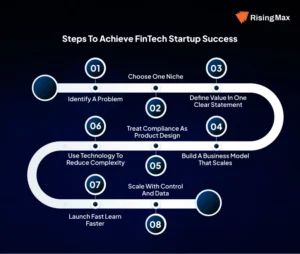
Building a FinTech business requires strategic thinking as strong outcomes come from clear planning and the ability to adapt as markets and regulations change. Let’s discuss the roadmap, which explains what founders should do at each stage.
Identify a Problem
FinTech works only when it removes friction from risk management or compliance. The problem should not waste time, increase cost or block access to financial services. Founders should confirm that users actively search for a solution and are ready to pay for it. Early validation through real conversations prevents building unused products.
Choose One Niche
Trying to solve many problems at once weakens focus. Successful FinTech startups start with one niche such as payments, RegTech or lending. This makes compliance simpler and messaging clearer. Once trust and usage grow, expansion becomes safer and faster.
Define Value in One Clear Statement
Users must quickly understand why the product exists when you deploy it. The value should be clear, such as faster onboarding, lower fees or better risk control. Security and transparency are not optional in FinTech. They are core to winning user trust.
Build a Business Model That Scales
Revenue should grow with usage. Subscription fees or interest margins should support long term growth. Founders should track CAC, LTV and churn from the start. A strong FinTech business model protects the company during market shifts.
Treat Compliance as Product Design
Compliance failures end startups. KYC, AML and data protection should be built into workflows from day one. Automation reduces manual errors and audit risk. This approach also lowers cost as the platform scales.
Use Technology to Reduce Complexity
- Cloud infrastructure allows fast scaling without high upfront cost.
- APIs help connect banks, partners and platforms.
- AI improves fraud detection, credit scoring and decision speed.
- Automation keeps operations lean as volume grows.
Launch Fast Learn Faster
Develop and launch an MVP app because early launches reveal real usage patterns not assumptions. Growth should focus on retention and repeat usage not just signups.
Scale with Control and Data
Expansion should follow proven demand. Product changes must be driven by user behavior and revenue data. Startups that scale carefully build durable trust and long term value.
Monetization Strategies for FinTech Startups
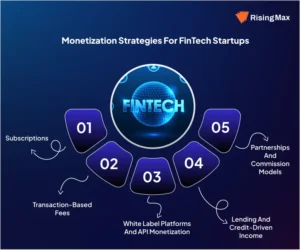
Selecting the right monetization approach plays an important role in building a sustainable FinTech business. Strong revenue models are those that align profitability with user trust and compliance requirements. Many successful FinTech businesses begin with one core problem and expand into additional revenue streams as their platform grows.
Subscriptions
FinTech solutions that provide modern features, automation or insights usually incorporate subscription pricing. Tiered plans allow startups to serve both individual users and enterprises while generating predictable recurring income.
Transaction-Based Fees
You can charge a per-transaction fee on trade transfers or any lending activities and their tenure. Also, you can increase this fee gradually as your platform scales. This model is best for neobanks and financial marketplaces.
White Label Platforms and API Monetization
Many FinTech startups monetize by offering their technology as infrastructure to other businesses. Through white-label ready-made solutions and API access startups can earn steady B2B revenue while expanding their ecosystem.
Lending and Credit-Driven Income
Digital lending platforms generate revenue through interest margins, processing fees and credit related services. This model is widely used in peer to peer lending and embedded credit solutions.
Partnerships and Commission Models
Collaborations with banks and investment providers open more revenue channels. Startups earn commissions or fees based on referrals by distributing third-party financial products or advertising them. These partnerships help diversify income.
Conclusion
The FinTech sector continues to expand as technology reshapes how people save, invest, borrow, and make payments. The top FinTech business ideas discussed in this guide highlight where real demand exists and where long term value can be created through secure, scalable, and user-focused solutions. Founders who focus on solving one clear financial problem and build with compliance and trust at the core are best positioned to create sustainable and high growth fintech companies.
As competition increases, execution and technology partnerships become critical. From digital wallets and neobanks to RegTech and AI-driven platforms, success depends on choosing the right development partner. RisingMax is your go to fintech app development company for all types of FinTech solutions, helping startups and enterprises turn strong ideas into secure, scalable, and market ready financial products.

FAQs
How can I start a fintech business?
Starting a fintech business requires identifying a specific market need, obtaining the necessary licenses and regulations, developing a robust business model, creating technology solutions, and partnering with financial institutions or investors.
What are some examples of fintech business ideas?
Some fintech business ideas include:
- Peer-to-peer lending platforms
- Digital wallets
- Robo-advisory services
- Blockchain-based payment systems
- Mobile banking apps
- Insurtech solutions.
Is the fintech industry profitable?
Yes, the fintech industry is highly profitable, with a rapidly growing market for innovative financial solutions, especially in areas like mobile payments, digital lending, and cryptocurrency.
How do I ensure my fintech business idea is eco-friendly?
To make your fintech business eco-friendly, you can focus on reducing paper-based processes, implement energy-efficient servers, promote digital transactions, and encourage eco-conscious business practices within your operations.
Why is it important to have a secure platform for my fintech business?
Security is critical in fintech because sensitive financial data and transactions are involved. A secure platform helps build trust with users, protects against cyberattacks, and ensures compliance with financial regulations.
How can I attract investors to my fintech business?
To attract investors, you should present a clear business plan, showcase the scalability and potential growth of your idea, demonstrate how your fintech solution addresses an unmet need, and provide solid financial projections and market research.
What are the regulatory challenges in starting a fintech business?
Regulatory challenges include obtaining licenses for operating in the financial space, complying with anti-money laundering (AML) and know-your-customer (KYC) requirements, and adhering to data protection laws like GDPR, depending on the region.
How does blockchain technology benefit a fintech business?
Blockchain technology offers benefits such as enhanced security, faster transactions, reduced costs, and transparency, making it particularly useful in fintech for applications like payments, lending, and smart contracts.
What is the future of the fintech industry?
The future of fintech looks promising with advancements in AI, blockchain, and machine learning. The industry is expected to continue growing, offering more personalized services, expanding into emerging markets, and improving financial inclusion worldwide.
What does “unicorn” mean in fintech?
A “unicorn” in fintech is a startup valued at $1 billion or more, often due to its innovative financial technology. Examples include companies like Stripe.