

People are buying cars online faster than ever. About 80% of car buyers begin their search on the internet. Experts anticipate that the global online car buying market will grow to USD 836.4 billion by 2034. These numbers show high demand and long term growth.
As a result, platforms like Autotrader have become strong business models. They connect buyers and dealers in one place. Users compare prices, check vehicle details and contact sellers without visiting numerous showrooms. At the same time, dealers get qualified leads and better visibility for their inventory. That’s why, in today’s time many businesses and startups are looking to build a car marketplace.
So, if you have the same plan, the main question that might arise is: How much will it cost to develop a car marketplace like Autotrader? The total investment depends on platform type, features and other factors. The range extends from $8,000 to $35,000.
This guide explains every cost factor required, the process to build, features, and much more to enter the booming market.
Table of Contents –
- Why Develop Car Marketplace Platform like Autotrader
- How a Car Marketplace App Like Autotrader Works
- Process to Build a Car Marketplace Platform Like Autotrader
- How Much Does It Cost to Create a Marketplace App Like Autotrader
- Factors Influencing Cost to Build a Car Marketplace Platform Like Autotrader
- Features of a Car Marketplace like Autotrader
- Revenue Models
- Challenges of Building a Car Marketplace Platform Like Autotrader
- Future Trends Analysis
- Top 5 Marketplace App Development Companies
- Conclusion
- FAQs
Why Developing a Car Marketplace Platform Like Autotrader Is Profitable
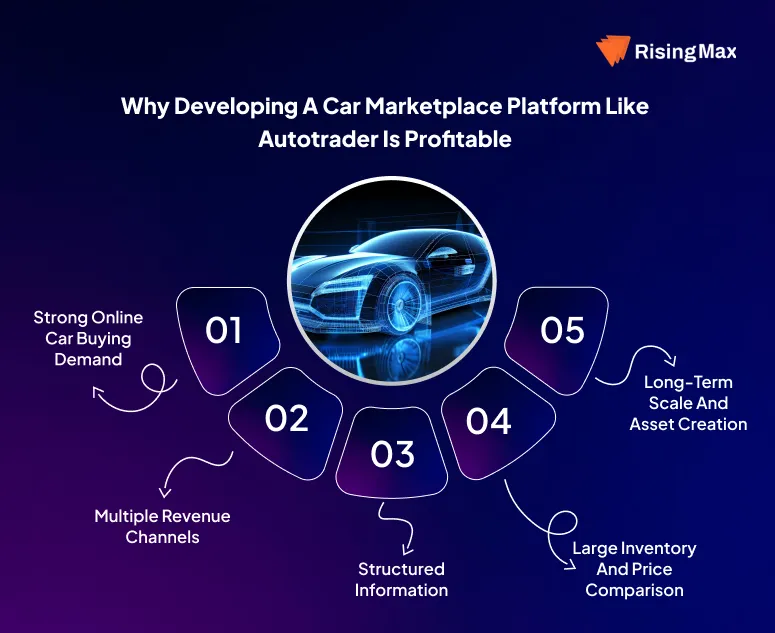
Car marketplace platform development offers significant benefits now due to various factors and a thriving market, as a report indicates that about 30% of people intend to purchase their next car online.
Strong Online Car Buying Demand
Car buyers now search online before making a decision about any car purchase. They check model details, compare prices, read ratings and shortlist vehicles. If you build a car marketplace app, then it would capture users at this early research stage.
Demand is supported by:
- High smartphone usage
- Digital payment adoption
- Easy access to vehicle data
- Need for price comparison
When buyers return to your platform for research, it increases traffic consistency and lead flow.
Multiple Revenue Channels
A vehicle marketplace app supports more than one income stream. This structure improves financial stability and growth.
Revenue can come from multiple streams like:
- Dealer subscription plans
- Featured vehicle listings
- Pay per lead model
- Commission per sale
- Insurance and auto loan partnerships
This approach makes recurring income.
Structured Information
Vehicle transactions involve large payments. Buyers need verified and complete information. An online car selling platform comes with easy listings with mileage, ownership history and details.
Seller verification systems and review modules reduce fraud risk. Clear data increases buyer trust and increases conversion rates as well.
Large Inventory and Price Comparison
A car marketplace platform like Autotrader aggregates listings from multiple dealers and individual sellers. Buyers can view new cars, used cars, certified vehicles and premium models in one system.
Side-by-side comparison helps improve price discovery. Sellers compete on pricing and vehicle condition. Higher listing volume means better marketplace liquidity and boosts the position of your platform.
Long-Term Scale and Asset Creation
The online car buying market is growing at a CAGR of 8.80% and this growth supports sustained digital expansion in the automotive sector.
As the user base increases, your platform should incorporate vehicle history, financing calculators and dealer management tools.
All these factors indicate why investing in car marketplace app development is the right move in 2026 and can increase your business ROI.
How a Car Marketplace App Like Autotrader Works
A car marketplace app connects buyers and sellers through a structured digital process. The system manages listings search and transactions within one platform.
Sellers Add Vehicle Inventory
The process begins when dealers or individual sellers register and upload vehicle information. The platform structures this data into standardized fields such as model year, mileage, price and condition.
Once approved the listing goes live and becomes searchable in the car marketplace.
Buyers Search and Discover Vehicles
Buyers sign up and enter the platform with a requirement. They can apply filters like budget and more. The system will then use search logic to show matching results from the database.
This stage connects buyers with available inventory inside the online car marketplace.
Evaluation and Shortlisting
After viewing results, buyers open detailed listing pages. They review specifications, images and pricing. Some may compare multiple vehicles before making a choice using the compare checkbox, which lets the buyer compare 3-4 cars at once.
At this stage, the car marketplace helps users move from browsing to serious consideration.
Direct Interaction Between Buyer and Seller
Once interest is confirmed, the buyer contacts the seller through in-app messaging or lead forms. The seller gets an inquiry inside the dealer dashboard.
Discussion may include price discussion or test drive coordination.
Transaction Support
If both parties agree on the same terms, the platform may support the option of booking payments or payment processing based on the model.
An advanced car marketplace app can also incorporate vehicle history checks and document validation to reduce the number of fraud risks.
Financing Options and Deal Closure
In many car marketplace platforms like Autotrader, buyers can obtain vehicle loans or evaluate insurance plans directly within the app.
After financing approval and payment confirmation, the deal is finalized. The platform records the transaction and updates the listing status.
Process to Build a Car Marketplace Platform Like Autotrader
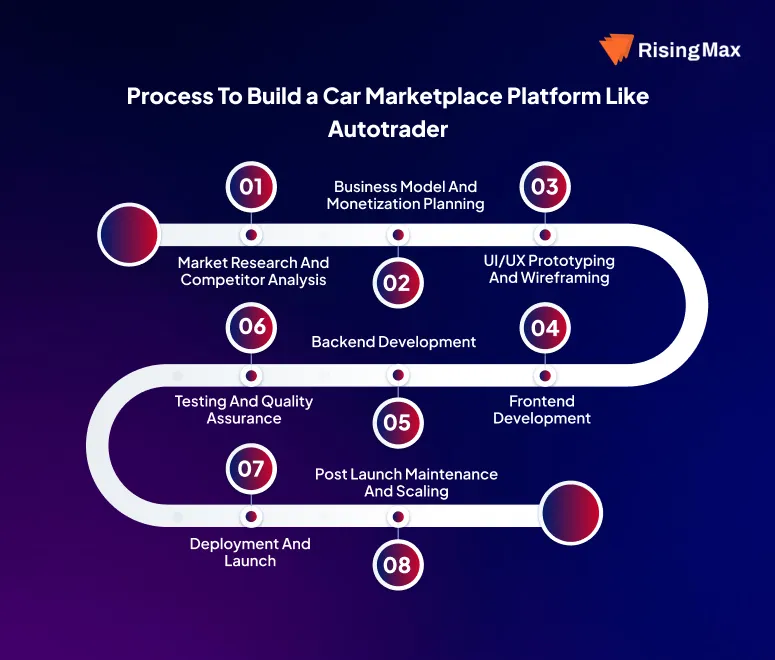
Moving forward, now, let’s discuss the process to develop a car marketplace like Autotrader to help you better understand what happens in each phase.
Market Research and Competitor Analysis
The first stage is where the analysis of the market gap and validation of the demand for your automotive marketplace platform is done. It focuses on knowing user behavior, pricing expectations and competitive positioning.
- What the car marketplace will solve
- Identify weaknesses in existing solutions
- Analyze user reviews and dealer feedback
- Assess regulatory and compliance factors
Business Model and Monetization Planning
Before actual development begins, the revenue structure should be clearly defined, including how you want to generate revenue from the platform. The monetization model helps know what the feature priorities and platform architecture are.
- Select subscription commission or hybrid revenue model
- Define dealer onboarding and pricing tiers
- Plan featured listing and advertising modules
- Align monetization with long term scalability
UI/UX Prototyping and Wireframing
The next phase involves converting business requirements into a visual structure. It outlines how users will interact with the car marketplace app and how easily they can apply filters, among other features.
- Design user journey for buyers and dealers
- Create wireframes for listing search and dashboard
- Build clickable prototypes for validation
- Ensure responsive layout for web and mobile
Frontend Development
Next is frontend development to transform approved designs into functional interfaces. It ensures smooth user interaction across devices.
- Develop responsive web or mobile interfaces
- Implement search filters and listing views
- Connect frontend components with APIs
- Optimize loading speed and performance
Backend Development
After the frontend, the backend engineering powers the core logic of the vehicle marketplace platform. It handles data storage, authentication and system rules.
- Design structured database for vehicle data
- Build account and role management modules
- Develop listing approval and moderation logic
- Create dealer dashboard and admin panel
Testing and Quality Assurance
After developing a car marketplace like Autotrader, the next step is quality validation to ensure the marketplace platform operates without functional or security issues.
- Conduct functional testing for all modules
- Validate search logic and filter accuracy
- Perform load and stress testing
- Execute security vulnerability checks
Deployment and Launch
Next, the marketplace is deployed, which moves the platform from staging to live production environment, where users can actually use it.
- Configure cloud hosting and server setup
- Deploy backend services and database
- Publish mobile apps to app stores
- Set up monitoring and analytics tools
Post Launch Maintenance and Scaling
After launch, the focus changes to the performance of the car marketplace and feature updates from time to time.
- Monitor uptime and server performance
- Scale infrastructure as traffic increases
- Release updates and performance improvements
- Analyze user behavior and engagement data
This structured marketplace development process guarantees your car marketplace is built for stability and long term expansion. Moreover, partner with a marketplace app development company to help you build the best solution.
How Much Does It Cost to Create a Marketplace App Like Autotrader
The cost to develop a modern marketplace platform like Autotrader depends on project scope, technical architecture and development timeline. Below is a complete cost breakdown based on different estimation factors.
Cost Based on Complexity
Marketplace platform complexity defines feature depth, integrations and backend logic. A simple vehicle listing app will cost less than a full automotive marketplace platform with dealer dashboards and payment systems.
Estimated Cost by Complexity
| Complexity Level | Scope | Estimated Cost (USD) |
| Basic Platform | Listings search filters messaging | $8,000 – $15,000 |
| Moderate Platform | Dealer panel payments analytics | $15,000 – $25,000 |
| Advanced Marketplace | AI search, financing APIs, CRM integration | $25,000 – $35,000 |
If you begin with MVP app development which means working on core marketplace functionality, then the cost may range somewhere between $10,000 and $18,000. As additional integrations and automation functionalities are added the complexity and expense increase.
Cost Based on Development Stage
Each car marketplace app development phase contributes separately to the total investment. Let’s discuss the cost division based on the different phases of development.
Estimated Cost by Development Phase
| Development Stage | Estimated Cost (USD) |
| Research & Planning | $1,000 – $2,000 |
| UI/UX Design | $3,000 – $10,000 |
| App Development | $6,000 – $17,000 |
| Testing & QA | $3,000 – $8,000 |
| Deployment | $2,000 – $5,000 |
| Maintenance & Updates | 10-15% of the total cost annually |
If your total app development cost is $15,000, then the UI/UX design cost will roughly cost between $3000 to $4,000.
Cost Based on Hourly Rates of Developers
App developer expertise influences the total car marketplace app development estimate. Senior engineers and automotive app developers charge higher rates than junior developers.
Estimated Developer Hourly Cost
| Role | Key Contribution | Hourly Rate (USD) |
| Project Manager | Scope planning, sprint execution, delivery control | $40 – $100 |
| Business Analyst | Requirement mapping, feature documentation, workflow planning | $30 – $80 |
| UI UX Designer | Wireframes user journey interface design | $25 – $70 |
| Mobile App Developer | iOS, Android, or cross platform development | $35 – $110 |
| Backend Developer | API development, database architecture, system logic | $40 – $120 |
| QA Engineer | Functional testing, performance validation, bug tracking | $25 – $75 |
| Security Specialist | Data encryption, compliance risk assessment | $60 – $120 |
A project handled mainly by a team of 3-4 developers, then it may cost around $10,000 to $15,000.
Factors That Influence the Cost to Build a Car Marketplace Platform Like Autotrader
The total cost of car marketplace app development depends on various factors. Each factor directly affects the budget and long term maintenance of your car marketplace like Autotrader.
Platform Type
Platform choice defines frontend effort, backend exposure and testing scope of car marketplace app. Businesses may start with a web marketplace and later expand to mobile apps.
| Platform Type | Coverage | Development Effort | Cost Impact |
| Web Platform | Buyer portal, dealer dashboard, admin panel | Moderate | Medium |
| Mobile App | iOS, Android or cross-platform | Moderate to High | Medium to High |
| Web + Mobile | Unified ecosystem across devices | High | High |
Multi-platform deployment increases API load testing and maintenance effort.
UI/UX Design Complexity
Another factor that affects the cost is Interface depth, which impacts both design hours and frontend development time. Basic listing layouts require less effort than highly interactive dashboards.
Custom UI elements such as filters, quick search suggestions, vehicle comparison and map based browsing increase the platform complexity. A smooth UX flow helps with better engagement and reduces drop-off rate which impacts conversion performance.
Feature Set and Functional Requirements
Feature depth defines backend architecture and database design. Core marketplace functionality like account management, vehicle listing and messaging. Also, modern automotive marketplace features may include AI vehicle recommendations, payment processing, dealer analytics, financing modules and CRM integration.
Larger feature sets require stronger backend logic and extended testing cycles which increases the cost as well.
Third-Party API Integrations
Modern vehicle marketplace platforms connect with external systems to expand service coverage.
Common integrations include payment gateways, vehicle history APIs, insurance providers, loan eligibility systems, SMS services and map APIs. Each integration requires configuration testing and monitoring which increases total development effort.
Development Timeline
Delivery schedule influences resource allocation and sprint planning. Shorter timelines require parallel development streams which increase monthly resource cost.
| Platform Scope | Timeline Range | Cost Effect |
| MVP car marketplace | 3–4 Months | Lower |
| Scaled feature platform | 5–7 Months | Medium |
| Enterprise automotive marketplace | 8–12 Months | Higher |
Structured phase based delivery helps manage cost distribution.
Development Team Location and Structure
Team geography impacts hourly billing rates. North America and Western Europe typically have higher cost structures than Eastern Europe or Asia.
Team structure options include in-house hiring, outsourcing to a specialized car marketplace app development services provider or hybrid collaboration. Each structure changes overhead cost management complexity and delivery speed.
Engagement Model
The engagement model defines how you contract and pay the development team. This has a direct effect on budget control and flexibility.
| Engagement Model | Best For |
| Fixed Price Model | Clearly defined scope of MVP development |
| Time and Material Model | Evolving requirements feature expansion |
| Dedicated Development Team | Long term automotive marketplace scaling |
For early stage MVP software development a fixed scope model helps manage initial investment. For continuous feature expansion a dedicated team model provides better scalability.
Security, Compliance, and Data Protection Requirements
Car marketplace platforms manage user identity and transaction records. Security architecture includes encrypted databases, secure authentication, fraud detection and compliance alignment.
Higher security layers increase backend engineering and audit effort.
Hosting Infrastructure and Scalability Needs
Cloud infrastructure supports listing storage image hosting API handling and traffic management.
Low traffic platforms operate on basic cloud instances. High-growth automotive marketplace systems require load balancing, auto scaling, CDN support and database optimization.
Infrastructure design influences both upfront setup cost and recurring operational expense.
Core & Advanced Features of a Car Marketplace like Autotrader
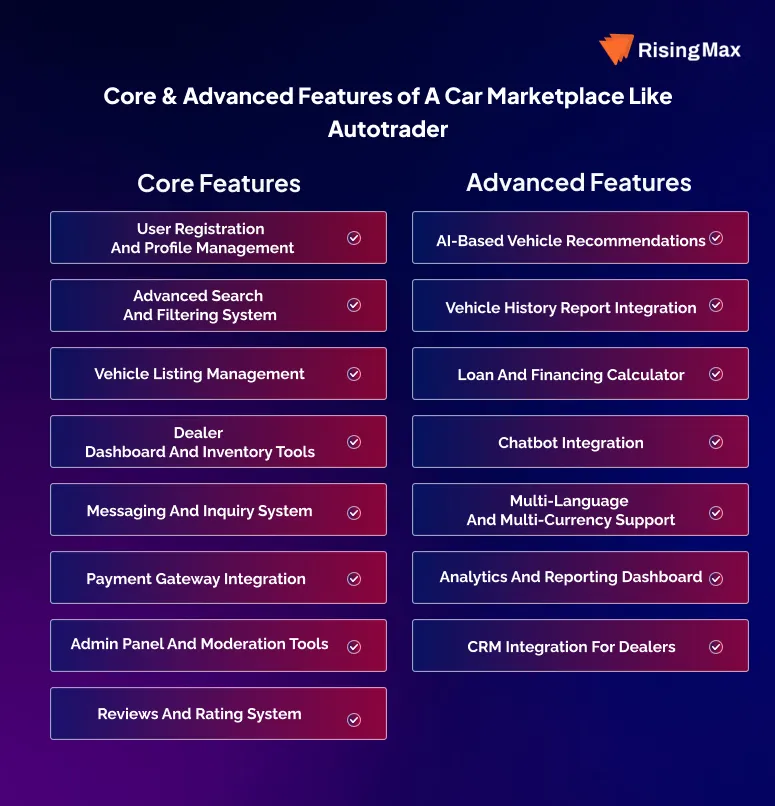
While developing a car marketplace like Autotrader, which has 26M+ unique visitors per month, requires a feature set that is easy to use and reliable for both buyers and sellers.
Core Features (Must-Have Functionalities)
User Registration and Profile Management
Users need to create an account to buy or sell cars. The car marketplace should allow you to sign up with your email or phone. Users need to update their profile details and view past activity.
Advanced Search and Filtering System
Search is the main feature of a car marketplace app like Autotrader. Users visit the platform to find cars that match their budget and needs. The system should allow filters for price, location, and other aspects. Easy to apply filters reduce search time and improve user satisfaction.
Vehicle Listing Management
Sellers need a simple way to post cars. The platform should allow them to add vehicle details, upload images and other details in a smooth way. Sellers must also be able to edit or remove listings whenever they want.
Dealer Dashboard and Inventory Tools
Another feature that is important is a dashboard that gives dealers the option to check everything in one place. It should show active listings, fresh inquiries and status of all listings. This tool helps dealers stay organized and reply to buyers on time.
Messaging and Inquiry System
Your car marketplace should be built so buyers can easily contact sellers without leaving the platform. The system should support direct messages or forms. It should also notify sellers when a new message comes.
Payment Gateway Integration
Platforms like Autotrader allow booking payments for a vehicle at $99. A secure payment system helps with collecting booking fees. Users can check payment status in the marketplace directly.
Admin Panel and Moderation Tools
Admins manage the entire platform. The admin panel should allow user control, listing approval, and removal of false posts. It should also provide reports on platform activity. This control keeps the marketplace safe and reliable.
Reviews and Rating System
Buyers trust feedback from other users. The car marketplace should have the feature of ratings and written reviews. Verified feedback helps buyers judge sellers’ past interactions with users. A rating system supports fair and open trade.
Advanced Features
AI-Based Vehicle Recommendations
The platform can suggest cars based on user search history and saved listings. This helps users find cars that match their interests. Smart suggestions increase engagement and lead flow.
Vehicle History Report Integration
Add a feature where users can check past ownership, accident records and service data through third party sources. Clear history data reduces risk and builds trust.
Loan and Financing Calculator
Many buyers look for loan support when they are purchasing a car. A loan tool can help users check monthly payment and interest cost. The system may also connect with finance partners. This makes purchase planning easier.
Chatbot Integration
Live chat allows quick replies between buyers and sellers. An AI chatbot integration in the marketplace can answer basic questions and guide users. Quick response reduces delay.
Multi-Language and Multi-Currency Support
If the platform serves users in different regions, language and currency options help improve access. With a feature of switching language and currency, your car marketplace will support global reach.
Analytics and Reporting Dashboard
Platform owners need data to track growth. A reporting dashboard can show user visits, lead count, and sales data. These insights help improve strategy and platform performance.
CRM Integration for Dealers
Dealers may use CRM systems to manage leads. Integration allows lead sync and follow up tracking. This helps dealers close more sales and manage customer records in one place.
Revenue Models You Can Integrate a Car Marketplace Platform Like Autotrader
A car marketplace platform requires a clear revenue structure. Income should support operations and future upgrades. Most successful car marketplaces like Autotrader combine more than one revenue model to create a stable cash flow.
Subscription Plans for Dealers
Platforms charge dealers a fixed monthly or yearly fee. In return, dealers can list their vehicles and access advanced features and dashboards. Plans may change based on listing and other features.
Key subscription plans include:
- Basic and premium plan tiers
- Fixed listing limits per plan
- Access to dealer dashboard tools
- Priority customer support
Featured Listings and Promotions
Dealers usually need better visibility for certain cars. You can charge an extra fee to promote these kinds of listings. Featured vehicles appear higher in search results and attract more views.
Promotion options may include:
- Top placement in search results
- Highlighted listing badge
- Homepage banner placement
- Limited time promotional boosts
Vehicle Booking
Platforms like Autotrader charge a $99 fee to book a car. You can also integrate this revenue model to get a fixed and steady income when a user wants to book a car in advance from the dealer.
This revenue model includes:
- Fixed booking fee
- Advance reservation option
- Fully or partially refundable
- Instant booking conformation
Challenges of Building a Car Marketplace Platform Like Autotrader
A car marketplace platform manages various listings and other aspects in one system. Each area brings some operational challenges.
Managing Fraud and Fake Listings
Open platforms attract misuse. Some sellers may upload cars they do not own. Others may post the same vehicle many times to gain attention.
To control this, your car marketplace should:
- Verify phone number and email
- Limit duplicate listings
- Use manual review for value vehicles
- Track unusual posting
Data Accuracy and Vehicle Verification
Car buyers always look for the right information when booking a vehicle like model year and ownership count. Irrelevant or false data leads to disputes between buyer and seller.
The platform should:
- Make key fields compulsory
- Lock format for price
- Allow document upload for proof
- Restrict edits after inquiry starts
Handling Growth and System Load
As listings grow, search requests increase. Each filter action pulls data from the server. High traffic without proper setup can slow search results.
To handle load, the platform must:
- Use scalable cloud hosting
- Optimize database queries
- Cache popular searches
- Monitor server usage
Maintaining Lead Quality for Dealers
Dealers judge the car marketplace by lead quality. If most inquiries are casual or fake, dealers reduce listing in the marketplace.
The system should:
- Filter repeat spam accounts
- Track user intent signals
- Limit automated form abuse
- Provide lead source tracking
Future Trends in Car Marketplace Platforms
Technology will shape the next phase of car marketplace platforms. Future systems will focus on automation and verified data. Below are trends that are likely to influence automotive marketplace development in the coming years.
AI-Driven Search
Future car marketplace may need AI integration to study user behavior. These systems could analyze search history and price range. The goal will be to improve listing accuracy and buyer matching.
Example: If a user repeatedly searches for compact SUVs under a budget of $15,000, the system may automatically suggest similar vehicles on the home screen.
Blockchain for Vehicle Records
Blockchain development could support secure storage of ownership and service records. This may reduce disputes and improve transparency in used car transactions.
Example: A buyer may view a tamper proof history of previous owners before confirming the purchase.
Cloud Native Architecture and Microservices
Future car marketplace platforms may adopt deeper cloud-based systems. Microservices could allow each function such as search, messaging, and payments, to scale independently.
Example: During high traffic periods, only the search system may scale up while other modules continue normal operation.
Real Time Data Processing
Upcoming systems may process listing and user data in real time. Dealers could receive live updates about views and inquiries.
Example: A dealer may adjust vehicle pricing on the same day after noticing a drop in listing engagement.
Integration of Vehicle Data Systems
Connected vehicles may share real time data such as mileage or service alerts. Marketplaces could integrate this data into listings for higher accuracy.
Example: A listing may show verified mileage data pulled from the vehicle system.
Voice Search and Smart Device Integration
Voice-based search may grow as smart device usage increases. could support voice commands for vehicle discovery.
Example: A user may search for cars through a voice assistant without typing filters manually.
Advanced Fraud Detection Systems
Car marketplace may use predictive models to find suspicious behavior. Automated monitoring could decrease fake listings and spam accounts.
Example: If a seller uploads multiple listings with similar details across locations, the system may flag the account for review.
Top 5 Marketplace App Development Companies
Let’s discuss the top 5 marketplace app development companies known for building web and mobile marketplace platforms.
1. RisingMax
RisingMax is a top marketplace app development company that builds web and mobile platforms. Their team of marketplace app developers focuses on architecture, cloud deployment and custom feature development for an online marketplace.
2. Techugo
Techugo is a mobile app development company that delivers mobile and web marketplace solutions across various industries. The company offers end-to-end marketplace development services from product strategy and UI design to development and post-launch support.
3. Canadian Software Agency
Canadian Software Agency provides custom marketplace and software development services. The company works with businesses that need tailored marketplace platforms with secure backend systems and modern user interfaces.
4. Appinventiv
Appinventiv develops large scale mobile and web marketplace platforms. The company supports product planning, design, engineering, and enterprise grade deployment for global clients.
5. InvoZone
InvoZone builds custom marketplace applications using modern development frameworks. The company offers dedicated development teams and focuses on scalable and secure platform delivery.
Conclusion
Car buying has changed and moved online. Most buyers now search and contact sellers on the internet before they visit a dealer. This change creates a high chance for businesses that want to develop a car marketplace platform like Autotrader.
Focus on simple search, clear listings, and secure payments. Add advanced features after launch with phase-wise expansion. Choose revenue models like featured listings or pay-per-lead to build income.
Also, work with an experienced marketplace app development company, so you can reduce risk and speed up launch. With the right approach, your car marketplace can grow into a strong and stable online business.
FAQs
Q1. How much does it cost to build a car marketplace like Autotrader?
Ans. The cost to develop a car marketplace platform typically ranges between $8,000 and $35,000, depending on complexity, features, integrations, and platform type (web, mobile, or both). A basic MVP may cost around $10,000–$18,000, while an advanced marketplace with AI search and financing integrations may reach $25,000–$35,000.
Q2. How do car marketplace platforms like Autotrader make money?
Ans. Most platforms use a hybrid monetization model:
- Dealer subscriptions
- Featured listings
- Pay-per-lead
- Booking fees
- Commission per sale
- Financing & insurance partnerships
Q3. What is the biggest challenge in building a car marketplace?
Ans. The biggest challenge is liquidity, which means balancing enough buyers and sellers at the same time. Without strong dealer onboarding and marketing, even a technically perfect platform can fail due to low listing volume or poor lead quality.
Q4. How do I attract dealers to list their cars on my platform?
Ans. Your car marketplace should offer:
- High-quality buyer leads
- Transparent pricing
- Dealer analytics dashboard
- Promotional visibility options
- Low initial onboarding cost
Q5. How do car marketplaces compete with established players like Autotrader?
Ans. New platforms compete with marketplaces like Autotrader by:
- Targeting underserved niches (EVs, local markets, budget cars)
- Offering lower dealer fees
- Providing faster lead response tools
- Adding AI-based vehicle matching
- Building better user experience
Q6. What is the minimum viable product (MVP) for a car marketplace?
Ans. An MVP should include:
- User registration
- Vehicle listing system
- Search & filters
- Messaging/inquiry system
- Admin moderation panel
Q7. How do I ensure trust between buyers and sellers?
Ans. Trust can be built in your car marketplace through:
- Verified seller badges
- Vehicle history integration
- Reviews & ratings
- Secure messaging
- Fraud detection monitoring
- Clear listing standards
Q8. What legal considerations should I know before launching?
Ans. Legal considerations you may need:
- Terms & conditions
- Privacy policy (data protection compliance)
- Secure payment processing
- Consumer protection compliance
- Dealer agreements
Q9. How much ongoing maintenance does a car marketplace require?
Ans. Maintenance typically costs 10–15% of total development cost annually and includes:
- Server hosting
- Security updates
- Bug fixes
- Feature enhancements
- Performance optimization
Q10. How long does it take to develop a car marketplace platform?
Ans. Car marketplace development time depends on scope:
- MVP version: 3–4 months
- Mid-level marketplace: 5–7 months
- Enterprise-grade platform: 8–12 months