
In Feb 2019, the POTUS (Mr. Donald Trump) issued an executive order for the American AI initiative, advocating larger investment in the AI sector and emphasizing the importance of focusing on areas such as construction and building management to develop smart cities and a modern ecosystem.
In the landscape of modern urban development, an intelligent building is defined by its use of advanced technology to achieve efficient management, ensure occupant safety, and promote the rational use of resources. Radio Frequency Identification (RFID) serves as a key technology within smart buildings, acting as a primary driver for innovation in both security and resource management. As a wireless sensor technology, it automatically identifies people or objects via radio waves, creating an omnipresent link between physical building components and backend digital systems.
| Table of Contents |
|---|
| 1. Introducing RFID |
| 2. What is RFID System |
| 3. RFID System Application Scenarios |
| 4. Advanced Integration: RFID with Web, AI, etc. |
| 5. RFID Implementation Challenges |
| 6. Real-World Use Cases of RFID |
| 7. Conclusion |
| 8. FAQs |
Replacing Barcodes with RFID in Smart Buildings
The transition from traditional identification methods (i.e., use of barcodes) represents a significant technological leap. While barcode systems have been a standard way to manage facilities, they are inherently fragile; paper barcodes are easily damaged or worn.
Additionally, barcodes require a direct line-of-sight, as any obstacle between the code and the laser scanner can interrupt communication.
In contrast, RFID tags are highly robust and capable of functioning in challenging practical conditions, such as environments covered in dust or grime. Beyond durability, RFID offers non-contact access and the unique capability for repetitive data rewrites, allowing information to be updated dynamically as maintenance or location needs change.
What is an RFID System and Its Key Characteristics
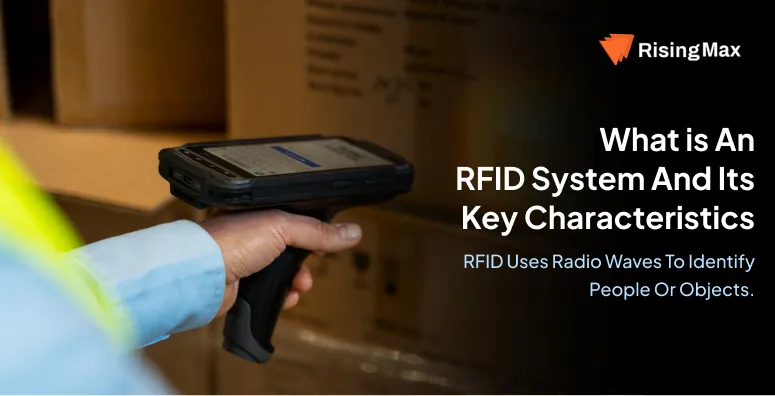
A complete RFID system is constructed from three core elements that work in sync to bridge the physical and digital environments. The three elements are mainly RFID labels (tags), readers, and back-end systems.
Now let’s understand each component one by one.
RFID Labels and Tags: These components serve as the data carriers of the system. Each tag contains a microchip capable of storing significant amounts of information, such as a Unique Identifier (UID) and specific user data. Internally, the tag consists of a microprocessor for data storage and an antenna for receiving and sending signals; most tags used in these environments are passive, meaning they are battery-free and powered by the electromagnetic field produced by the reader.
RFID Readers (Transceivers): The reader acts as the communication hub, emitting radio signals through an antenna. When a tag enters the reader’s field, it is activated, allowing the reader to read or write data to the chip without requiring a direct line of sight. For smart building applications, these can range from desktop HF readers used for data writing to portable devices attached to tablet PCs for mobile maintenance.
Back-end Systems: Once the reader acquires data from a tag, the information is transferred to a computer system for processing. In modern facilities management, this often involves a web-based three-tier architecture consisting of a storage tier (for maintenance history and facility info), application logic (system modules), and a presentation tier (the user interface).
Key Technical Characteristics
RFID technology offers several distinct advantages over traditional systems like barcodes, specifically tailored to the needs of complex building environments.
Non-contact Identification: One of the most significant benefits is that users do not need to make physical contact with the reader to verify their identity. This characteristic improves entry efficiency and the overall user experience, particularly in high-traffic areas where it avoids human error and delays associated with manual scanning or physical keys.
Remote Reading Capabilities: RFID systems, especially those operating in the UHF (Ultra High Frequency) band, are capable of long-distance identification. This makes the technology ideally suitable for large structures such as modern office buildings, schools, and hotels, where wide-area coverage is necessary for tracking assets or personnel across expansive floors.
Dynamic Data Storage: Unlike barcodes, which are static and fragile, RFID tags allow for repetitive read/write access. This enables the real-time update of information, providing powerful technical support for dynamic management. Building managers can use this to maintain up-to-the-minute maintenance records directly on equipment tags or track the shifting locations of personnel and assets throughout the facility.
Related Read | Automating Quality Control using Computer Vision and AI
RFID System Application Scenarios for Building Optimization
Personnel and Security Management
Radio Frequency Identification (RFID) technology is essential for managing the flow of individuals within a smart building, providing a seamless link between physical access and digital security protocols.
Access Control – Visitors and occupants are equipped with smart cards or key fobs containing embedded RFID chips that act as their digital identity. As an individual approaches a controlled entrance, an RFID reader automatically recognizes and verifies their credentials without requiring physical contact. This non-contact identification process significantly improves entry efficiency, particularly in high-traffic environments, while eliminating the human errors and delays common with manual security checks.
Multi-Factor Authentication (MFA) – To address the vulnerabilities of traditional systems like standalone access cards or passwords, which are susceptible to theft or breaches, smart buildings utilize layered authentication. By integrating RFID with biometric fingerprint technology and PIN-based keypads, the system ensures a higher security hierarchy.
In this configuration, a user might first scan their RFID card, followed by a fingerprint scan that the microcontroller compares against a secure database. And then the access is only granted if both factors match, effectively mitigating the risk of identity fraud and unauthorized entry.
Emergency Response and Safety
In critical situations such as fires or earthquakes, RFID technology transitions from an access tool to a life-saving personnel positioning system.
Real-time Positioning – Building managers can use the RFID ecosystem to maintain an up-to-the-minute understanding of personnel distribution across different floors and zones. This data allows safety teams to guide evacuations more effectively by identifying the density of people in specific areas.
Identifying Trapped Individuals – Perhaps most importantly, RFID tracking enables rescuers to quickly determine if individuals are trapped in dangerous or restricted areas, allowing for targeted search-and-rescue operations.
Resource and Asset Tracking
Efficient building management requires the precise oversight of physical assets to ensure operational continuity and cost control.
Equipment Location and Usage – By attaching RFID labels to internal assets, such as cleaning tools, maintenance equipment, or laboratory instruments, managers can keep precise records of their exact location and usage history.
Loss Prevention – This real-time visibility prevents the common phenomenon of lost or unused tools, ensuring that valuable resources are always available when needed for building repairs or servicing. Furthermore, it improves the quality of data transfer between maintenance workers, as every interaction with an asset is digitally recorded.
Energy and Space Management
RFID data serves as a foundation for resource optimization, helping building managers reduce costs and maximize the utility of the physical structure.
Energy Savings – The RFID system can be queried to determine the real-time occupancy of various zones, such as conference rooms or entire floors. Based on this data, the building’s management system can automatically adjust HVAC (heating, ventilation, and air conditioning) and lighting. For example, when a room is detected as vacant, the system can switch off utilities, thereby minimizing energy wastage and lowering utility costs.
Space Utilization – Managers collect and analyze data on how different areas, such as lounge zones and meeting rooms, are utilized over time. This analysis allows for the reallocation of building resources; if data reveals that certain floors or rooms remain vacant for long periods, they can be converted to other uses to better serve the building’s occupants.
Also Read | How RAG and MCP Help Reduce AI Hallucinations?
Advanced Integration: RFID with Web, AI, and IoT
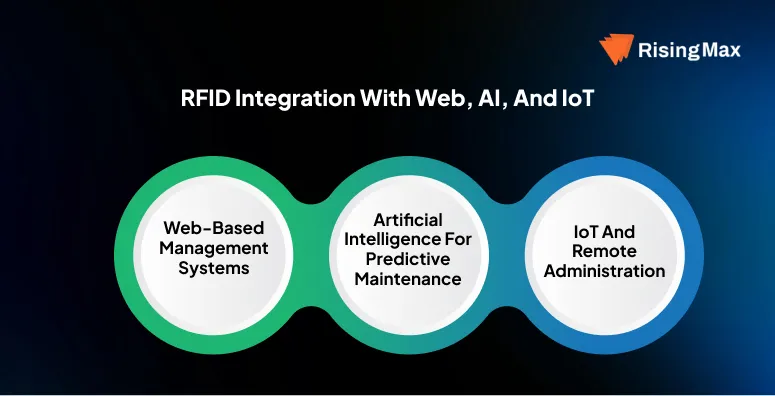
The integration of Radio Frequency Identification (RFID) with web-based platforms, Artificial Intelligence (AI), and the Internet of Things (IoT) transforms smart building management from a reactive process into a proactive, globally accessible operation.
Web-Based Management Systems
Modern smart buildings utilize a three-tier architecture to manage maintenance data and facility status through a centralized web system. This architecture is divided into three functional layers:
Storage Tier: This serves as the system’s foundation, housing a single database for basic facility information, detailed maintenance history, and vendor data.
Application Logic Tier: This layer contains the core system modules and manages database connections, acting as the bridge between raw data and the user.
Presentation Tier: The user interface allows managers to interact with the application logic layer. By utilizing platforms like ASP.NET, these systems can be executed via the Internet on web pages, allowing managers to monitor building status from any platform, including PCs, smartphones, and PDAs. This ensures that maintenance data is updated in real-time, preventing duplicate work and allowing for the visualization of data through statistical graphs accessible from anywhere.
Artificial Intelligence for Predictive Maintenance
AI integration allows building managers to move beyond simple “periodic” maintenance schedules toward active malfunction prevention.
Fuzzy Neural Networks (FNN): This technology combines fuzzy logic, which models human-like approximate reasoning in uncertain environments, with artificial neural networks that store and process information through learning algorithms.
Forecasting Lifetime: The prediction module uses FNN to analyze accumulated maintenance records and identify complex relationships between influencing factors (like temperature or usage frequency) and the remaining lifetime of building components.
Malfunction Prevention: By estimating when a part is likely to fail, the system allows for timely inspections and repairs before a breakdown occurs, significantly reducing unexpected downtime and extending the service life of building assets.
IoT and Remote Administration
With IoT technology, we can connect the hardware of the building to the software, which can be controlled through remote administration.
Wi-Fi and Smartphone Integration: Top-tier security systems are typically designed to connect to Wi-Fi networks, enabling occupants and managers to control building settings from anywhere in the world using their mobile devices.
Control of Non-Security Devices: Beyond locking doors or viewing cameras, these systems provide a central hub for “non-security” equipment. Users can remotely operate smart thermostats and smart plugs, allowing for the remote control of any electronic device in the house.
Operational Efficiency: This remote access allows for the adjustment of lighting and climate systems based on real-time needs, which leads to reduced utility costs and enhanced living conditions for occupants.
RFID Implementation Challenges and Technical Considerations
Environmental Impact on Performance
The effectiveness of RFID systems in a smart building is heavily influenced by the physical environment, particularly regarding signal integrity and physical durability.
Managing Signal Interference – The presence of metallic surfaces is one of the most significant challenges for RFID applications because metal reflects radio signals. Experimental data indicate that placing an RFID tag directly onto metal is inappropriate; however, maintaining a small distance (even 2 cm) can restore successful reading. Similarly, electromagnetic waves emitted by nearby electrical appliances, such as personal computers, can disrupt radio communications. To avoid this interference, a minimum clearance of at least 3 cm is typically required between the RFID components and the running appliance.
Resilience Against Dust and Grime – Unlike traditional barcodes, which are easily broken or rendered unreadable by surface damage, RFID tags are highly robust. Experiments have demonstrated that dust and grime have little to no effect on the effective reading range of RFID tags, making them ideal for the practical, sometimes harsh maintenance environments found in large-scale facilities.
Security and Privacy Vulnerabilities
As smart buildings become increasingly linked through IoT technology, they become more vulnerable to security breaches, necessitating advanced protection protocols.
Addressing Tag Cloning – Basic RFID communication often lacks encryption, which presents a notable risk of illegal tag replication or cloning. Traditional methods like standard access cards and passwords have shown significant limitations in reliability, as they are easily compromised or stolen.
Robust Security Protocols – To mitigate these risks, modern systems implement industry-grade AES-128-bit encryption, ensuring all data exchanges are secure and traceable. Advanced technologies such as Secure Dynamic URLs (SDM) prevent replay attacks by generating a unique, encrypted URL for every scan. Furthermore, the use of tamper-evident labels, which reveal a “VOID” mark if altered, prevents the unauthorized transfer or reuse of tags. Layering these technologies with biometric factors, such as fingerprints, creates a high-security hierarchy that significantly reduces the possibility of unwanted access.
Cost vs. Long-Term Value
Implementing a comprehensive RFID infrastructure requires a careful evaluation of immediate expenses against future gains.
Upfront Hardware Investment – Establishing an intelligent building environment necessitates significant initial investments in hardware, such as readers, specialized tags, microcontrollers, and the supporting network infrastructure.
Long-Term Operational Efficiency – Despite high starting costs, the long-term benefits are believed to outweigh the initial investment. RFID systems drive value by reducing operational time through the elimination of manual data entry errors (typos) and by providing real-time tracking of assets and personnel. Furthermore, the ability to perform predictive maintenance reduces the frequency of unexpected breakdowns and malfunctions, extending the service life of building components and ensuring a higher level of occupant safety and satisfaction.
Real-World Use Cases of RFID in Smart Building Management
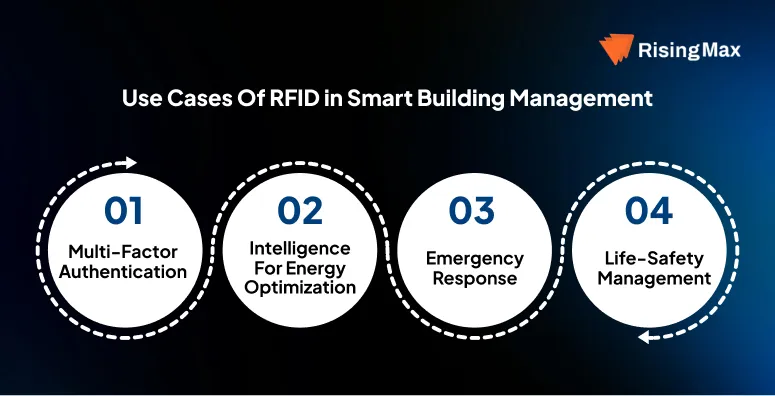
Case 1. Intelligent Access Control with Multi-Factor Authentication for Zero-Trust Buildings
One of the most transformative applications of RFID in smart buildings is the implementation of intelligent, non-contact access control integrated with multi-factor authentication (MFA). In this model, RFID-enabled smart credentials act as the first layer of identity verification, enabling seamless and rapid movement of occupants through high-traffic entry points without physical interaction. This significantly reduces congestion, eliminates manual verification errors, and enhances user experience.
For high-security zones such as data centers, research labs, financial departments, and building management control rooms, RFID is combined with biometric authentication and PIN validation to establish a zero-trust security architecture. Access is granted only when all identity factors are verified against the backend system in real time.
Beyond security, the system continuously generates spatial access logs that can be analyzed for behavioral patterns, compliance reporting, and anomaly detection. This transforms access control from a static security function into an intelligent, data-driven building management tool that strengthens both operational transparency and risk mitigation.
Case 2. Real-Time Occupancy Intelligence for Energy Optimization and Sustainable Building Operations
RFID-driven occupancy detection provides a powerful foundation for dynamic energy management in intelligent buildings. By identifying the real-time presence of occupants across floors, rooms, and functional zones, the building management system can automatically regulate HVAC, lighting, and ventilation based on actual usage rather than fixed schedules.
In large commercial buildings where energy consumption is heavily influenced by fluctuating occupancy, this approach leads to substantial reductions in electricity usage and operational costs. Vacant meeting rooms can automatically switch to power-saving mode, underutilized floors can operate with minimal environmental conditioning, and peak-load demand can be intelligently distributed.
From a sustainability perspective, this use case directly contributes to green building certifications and ESG performance metrics. The continuous stream of occupancy analytics also enables long-term space utilization planning, allowing facility managers to redesign layouts, consolidate unused areas, and convert low-value zones into high-productivity environments. As a result, RFID becomes a strategic enabler for both environmental responsibility and financial efficiency.
Case 3. RFID-Based Emergency Response and Life-Safety Management System
In emergency scenarios such as fires, earthquakes, or security threats, RFID infrastructure shifts from an operational technology to a life-safety system. By maintaining a real-time digital map of occupant distribution, building operators and first responders gain immediate visibility into which zones are occupied, which evacuation routes are being used, and where individuals may still be located.
This capability enables targeted evacuation strategies instead of generic alarm-based responses. Safety teams can prioritize high-density areas, assist mobility-impaired occupants, and prevent rescue personnel from entering already cleared zones. Most critically, the system can identify individuals who remain inside restricted or hazardous locations, dramatically improving search-and-rescue efficiency and reducing response time.
In complex environments such as hospitals, airports, high-rise commercial towers, and university campuses, this level of situational awareness can directly save lives. Furthermore, all movement data recorded during the event can be used for post-incident analysis, compliance reporting, and future evacuation planning, making the building progressively safer over time.
Conclusion
The integration of RFID in smart building management marks a transformative shift in facility management, evolving from simple tracking into the digital backbone of intelligent building ecosystems. By bridging the gap between physical infrastructure and digital oversight, RFID enables a seamless security hierarchy when layered with biometric multi-factor authentication and web-based IoT platforms. This integration allows for extensive remote administration, providing real-time visibility that enhances both occupant safety and asset protection.
Furthermore, the integration of Artificial Intelligence, specifically Fuzzy Neural Networks, enables buildings to adopt predictive maintenance, allowing managers to forecast component lifecycles and prevent malfunctions before they occur. While technical challenges like signal interference and initial hardware costs persist, the long-term dividends in energy savings and operational efficiency justify the investment. Ultimately, RFID acts as a vital catalyst, transforming static structures into responsive, sustainable environments that prioritize resource optimization and human well-being.
Continue Reading | AI System Development for ADHD Diagnosis
FAQs for RFID In Smart Building Management
Q1. Why is RFID superior to barcodes for building maintenance?
Ans. Barcodes are fragile and inefficient. They require a direct line of sight to function and are easily rendered unreadable by physical damage. RFID tags are robust, supporting non-contact identification even when covered in dust or grime. Unlike barcodes, RFID tags allow for repeated data updates, enabling managers to update maintenance records directly on the tag in real time.
Q2. Can RFID technology actually prevent security breaches?
Ans. Yes, but only when layered. While basic RFID can be vulnerable to cloning, top-tier systems utilize multi-factor authentication, combining RFID cards with biometric fingerprint scans and PIN-based keypads. This security hierarchy ensures that if a card is stolen, unauthorized access is still blocked by the biometric requirement.
Q3. How does RFID assist in emergency evacuations?
Ans. During fires or earthquakes, RFID provides real-time personnel positioning. This allows managers to see the exact distribution of people across floors, guide them to safety, and, critically, identify trapped individuals in high-risk zones who might otherwise be missed.
Q4. Can RFID signals be blocked by metal or electronics?
Ans. Yes, signal interference is a real challenge. Metal reflects radio waves, making it difficult to read tags placed directly on metallic surfaces; however, maintaining a small clearance (at least 2 cm) typically restores functionality. Nearby electrical appliances, such as PCs, also emit electromagnetic waves, requiring a minimum distance of 3 cm to ensure stable communication.
Q5. Is RFID for smart buildings worth the high initial cost?
Ans. The long-term value outweighs the upfront hardware investment. While readers and microcontrollers require initial capital, the system drastically reduces operational time by eliminating manual data entry (typos) and preventing duplicate maintenance tasks. Additionally, preventing equipment loss and unexpected malfunctions provides a significant data dividend.
Q6. How does RFID technology reduce building energy costs?
Ans. RFID systems track real-time area occupancy. When the system detects that a conference room or an entire floor is vacant, it can automatically switch off lighting and HVAC systems. This prevents energy wastage in unoccupied spaces, directly lowering utility bills.
Q7. What frequency band is best for large-scale buildings?
Ans. UHF (Ultra High Frequency) bands are best suited for large structures such as modern office buildings, schools, and hotels. This is because UHF systems offer remote reading, enabling long-distance identification and authentication without requiring the user to be near the reader.
Q8. How does AI integrate with RFID for maintenance?
Ans. Smart buildings use Fuzzy Neural Networks to analyze the data collected by RFID readers. By learning from maintenance records, these AI modules can forecast the remaining lifetime of building components, allowing managers to replace parts before they fail rather than following a rigid, and often inefficient, calendar schedule.
Q9. Can I manage my building’s RFID system from a smartphone?
Ans. Absolutely. Modern systems use a three-tier web architecture (storage, application logic, and presentation) that is accessible via the Internet. This allows authorized personnel to monitor security cameras, lock/unlock doors, and check facility status from any platform, including PCs, smartphones, and tablets.
Q10. Are RFID tags susceptible to hacking or cloning?
Ans. Standard, unencrypted tags are at risk, but smart buildings mitigate this with advanced encryption protocols. Systems often use AES-128-bit encryption and Secure Dynamic URLs (SDM), which generate a unique, encrypted URL for every scan to prevent replay attacks. Tamper-evident VOID labels also make unauthorized tag removal immediately visible.
Q11. How does RFID solve the problem of lost tools in facilities management?
Ans. By attaching RFID labels to cleaning equipment and maintenance tools, managers can keep precise records of asset location and usage. This visibility eliminates the common problem of tools being left in the wrong departments or sitting unused, ensuring resources are always available for repairs.
Q12. Do dust and grime affect the performance of RFID readers?
Ans. No. Experiments confirm that dust and grime have little effect on the effective reading range of RFID tags. This makes the technology far more reliable than optical systems for the practical maintenance environment, where equipment often gets dirty.
Q13. What happens if a person’s RFID card and fingerprint don’t match?
Ans. In a multi-factor setup, if either the RFID identifier or the fingerprint scan fails to match the database, the system triggers a refusal notice. An LCD screen typically displays ACCESS DENIED or Rejected, and the entry mechanism remains locked while the system logs the suspicious activity.