
Key Takeaways –
- Mobile app development cost in Canada ranges from CAD 8,000 to CAD 1,000,000+, driven primarily by app complexity, compliance requirements, and platform strategy.
- Frontend and backend engineering together account for 60%+ of total development cost, making architecture and early technical decisions the single biggest cost lever.
- Canada offers one of the strongest cost-to-quality ratios globally by balancing senior engineering talent, regulatory readiness, and predictable delivery—especially when using hybrid or agency-led models.
- The most cost-efficient apps are built using MVP-first scoping, cross-platform frameworks, reusable components, and phased rollouts—while budgeting 15–20% annually for post-launch maintenance.
- Cost optimization is achieved through lifecycle thinking, not budget cutting.
Investing in Canadian app development isn’t just about local reach and providing a seamless experience; it is about gaining a competitive edge in the fastest-growing tech hub on the continent. Such an approach by entrepreneurs is quite valid these days, given market trends. It is worth noting that Canada is one of the fastest-growing mobile application markets in North America, with over 1.23 billion app downloads in 2023.
Moreover, 80% of Canadian consumers access the internet primarily through mobile devices, making apps a convenient way to access their favourite services. But developing an app that delivers a truly integrated, seamless experience is a complex and sometimes costly process.
As per Clutch studies, investing in Canadian app development isn’t just about local reach; you’re building in the fastest-growing tech hub on the continent.
The good news is that you can optimize costs if you know exactly where the app development costs go.
In this article, we have broken down the complete cost of mobile app development in Canada. Additionally, we have also covered how much it costs to hire mobile app developers in Canada!
Moreover, according to the 104% paradox (104% of the total 41.6 million population), the multi-device culture now pushes the demand for having an integrated, cross-platform compatible app, which further increases the cost of developing an app.
Mobile App Development Cost in Canada: Real Benchmarks and Market Data
Before we go any further, let us take a look at the market data and present benchmarks regarding the app development cost in Canada. These benchmarks will help you to ideate the average price of making an app in 2026.
According to recent data collected by Clutch, the average cost of app development is CAD 1,24,367 ($90,780.11) with an approximate timeline of about 11 months to complete the project. Based on these estimates, here are the quick estimates about the mobile app development cost in Canada –
| App Type | Estimated Cost in CAD |
| Cost to develop a basic app (MVP) | CAD 8,000 – 40,000 |
| Standard business app | CAD 40,000 – 120,000 |
| Advance App (AI Features Integrated) | CAD 120,000 – 300,000 |
| Enterprise-grade platform | CAD 300,000 – 1,000,000 |
Canada vs US vs Offshore – a quick comparison
| Region | Typical hourly (senior dev) | Typical project (mid-complexity) |
| Canada | CAD 80-150 / hr (city & seniority dependent). | CAD 40k-120k for standard business apps. |
| United States | USD 100-250 / hr (top markets & senior contractors). | USD 60k-300k+ for comparable apps. |
| Offshore (SE Asia / Eastern Europe) | USD/CAD 20-70 / hr (wide range by skill & region). | USD/CAD 15k-80k for MVPs and many production apps, large savings but variance in quality & delivery model. |
As shown in the table, Canada sits between the higher US rates and the variability in delivery quality of Offshore teams, making it an ideal region for mobile app development for startups and enterprises. Though offshore teams provide development at lower rates, they require stronger product management, more precise specifications, and more QA to avoid scope creep and rework.
App Development Cost Trends (2024 to 26) & What Does It Mean to Business Owners?
In recent years, we have seen substantial growth in AI and ML models. While these models have introduced new development approaches, such as low-code/no-code, business leaders are also working to integrate AI/ML into their apps to deliver an even more seamless experience.
We have analyzed the cost trends in two aspects,
- What’s increasing the cost, and
- What’s reducing the cost
Factors That Are Increasing the Cost of App Development
- Integrating LLMs or custom machine learning models adds CAD 20k to 100k to the overall project cost. Additionally, after the integration, the business must budget for the monthly recurring cost to keep the model operational.
- Data has become a new currency, and regulations have become stricter. Spending on security audits and encrypted architecture is up by almost 20% of the existing cost.
- Apps that process data on the device (rather than in the cloud) to reduce latency require more specialized and expensive engineering, thereby increasing costs.
Factors That Are Reducing the Cost of App Development
- Modern app development frameworks such as Flutter and React Native allow building apps for multiple platforms with a single codebase. These frameworks can help business owners save up to 40% of the initial cost.
- With AI assistants such as GitHub Copilot, developers can now work faster. Therefore, the hours required to develop standard features are decreasing.
- Gartner predicts 70% of new enterprise apps will use low-code tools for parts of their stack by 2026, significantly lowering costs for internal business tools.
Therefore, businesses now need to focus on value-intelligent development instead of feature-heavy development. Moreover, with the introduction of cloud features (server, hosting, etc), continuous AI/ML model refinement, and repeated OS updates, one can expect higher maintenance costs (typically 15-20% of the initial build cost annually).
(Positive and Negative) Implications of Market Trends on Mobile App Development in Canada
The evolving tech frontier, though, offers convenient ways to develop an app while also increasing complexity, which in turn increases development and testing efforts.
Below are some of the worth-mentioning implications that business owners shall notice,
- The addition of on-device or server-side ML features increases development complexity, thus pushing the average budget up.
- For sectors such as health, fintech, and related data-sensitive apps, you may need to obtain higher compliance standards, such as PIPEDA or PHIPA, which further increase planning and QA costs.
- To optimize the budget, Canadian firms opt for a hybrid development model (local PM/design with offshore development teams) to balance cost and product quality.
- Canada’s app ecosystem is expanding (forecast growth through 2027), which tightens senior talent supply and pushes rates modestly higher.
- If your roadmap includes advanced AI, real-time features, or strict compliance, plan 20–40% higher than a “standard” app quote to account for extra architecture, QA, and risk mitigation.
App Development Cost Breakdown – How Much Does Each Development Phase Cost?
The best way to understand the cost of app development is to understand its development stages. Knowing how much each stage costs helps you ballpark the overall cost and allocate capital accordingly.
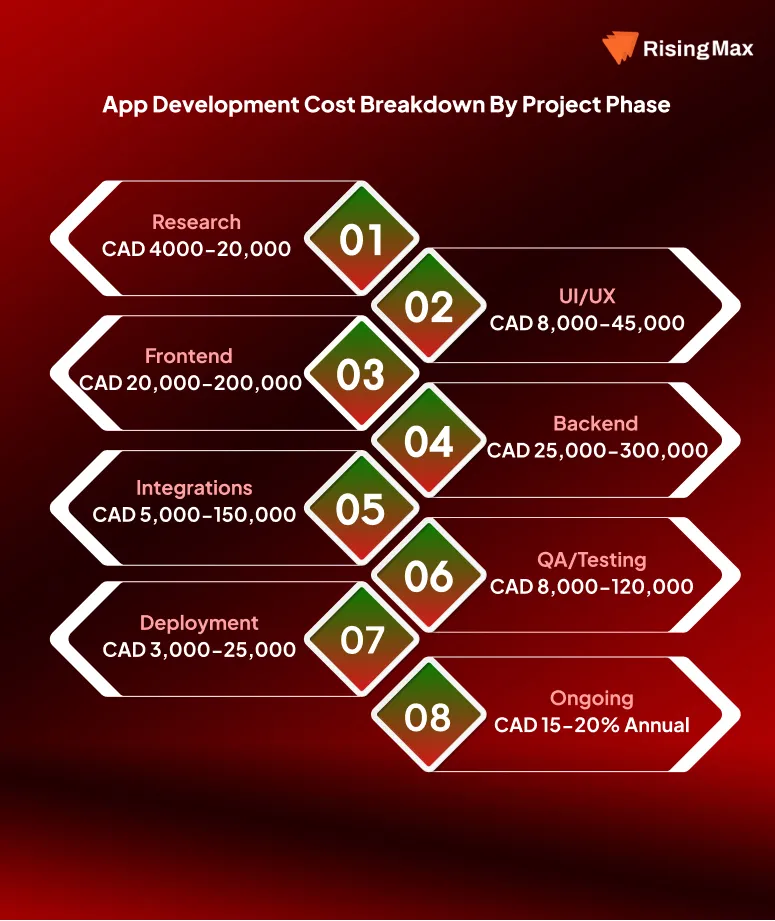
Before we dive into each stage, let’s review the associated costs.
| Development Phase | Cost Share (%) | Estimated Cost Range (CAD) | What’s Included |
| Discovery & Planning | 5% – 10% | CAD 4,000 – 20,000 | Market research, requirement analysis, technical feasibility, and roadmap creation |
| UI/UX Design | 10% – 15% | CAD 8,000 – 45,000 | Wireframes, user flows, prototyping, visual design, usability testing |
| Frontend Development | 20% – 30% | CAD 20,000 – 200,000 | Mobile UI implementation, animations, platform-specific components (iOS/Android) |
| Backend Development | 20% – 30% | CAD 25,000 – 300,000 | APIs, database architecture, business logic, server-side development |
| Third-Party Integrations | 5% – 15% | CAD 5,000 – 150,000 | Payment gateways, maps, CRMs, analytics, cloud services |
| QA & Testing | 10% – 15% | CAD 8,000 – 120,000 | Manual & automated testing, security testing, performance optimization |
| Deployment & App Store Launch | 3% – 5% | CAD 3,000 – 25,000 | App store submission, compliance checks, CI/CD setup |
| Post-Launch Support & Maintenance | 15% – 25% (annual) | CAD 10,000 – 200,000 / year | Bug fixes, updates, performance monitoring, scalability support |
Now that you have an estimate of the cost share for each developmental stage, let’s briefly outline what each stage entails. You shall note that the frontend and backend development covers more than 60%. This is one of the reasons most Canadian app development companies use a hybrid model to help you stay within budget without compromising quality.
*Editorial Note – We have analyzed our data and experience of more than 13 years in app/software development to create the cost estimation in this guide. Stakeholders and product owners should note that these are average cost estimates. Actual costs vary project to project. Therefore, we encourage you to speak with our experts for further clarity on your project.
1. Discovery and Planning
Expected Timeline – 2 to 4 weeks
Cost – CAD 4,000 to 20,000
The research part is the foundation step of any app development life cycle (ADLC). In this stage, stakeholders, product owners, project managers, and developers come together to discuss the key details of the project, such as:
- What needs to be developed
- Why does it need to be developed
- How it should be developed
Product hypotheses are framed to define user personas, behavioral flows, use cases, and core features, using methodologies such as Jobs-to-be-done or Lean Canvas modeling. Since this phase outlines an actionable plan (including developmental methods) to be followed during the ADLC, it helps stakeholders ballpark the budget allocation.
2. UI/UX Design
Expected Timeline – 2 to 3 weeks
Cost – CAD 8,000 to 45,000
This phase starts with creating low-fidelity wireframes and progresses to high-fidelity interactive wireframes. This phase operates at the intersection of human-computer interaction (HCI), cognitive psychology, and system constraints, ensuring that user intent is efficiently mapped to system responses with minimal friction.
Once the user journey is mapped out and design tokens are completed, the design goes under feedback to solve the friction points before writing even a single line of code.
The UI/UX Design phase establishes the contract between users and the system, and between designers and engineers. Well-executed UI/UX design reduces frontend ambiguity, accelerates development velocity, minimizes rework, and improves long-term product adoption.
3. Frontend Development
Expected Timeline – 8 to 10 weeks
Cost – CAD 20,000 to 200,000
The Frontend Development phase is where the validated UI/UX specifications are translated into functional, performant, and platform-compliant client-side code. Developers build the client-side version of the application and ensure the design is responsive and adaptive to different screen sizes without layout thrashing or reflow performance penalties.
By the end of the frontend development phase, the application’s client layer (what users see on their screen) functions as a robust interaction engine, capable of rendering complex interfaces, managing real-time user interactions, and synchronizing reliably with backend systems.
High-quality frontend engineering directly impacts user satisfaction, performance perception, and overall product reliability, making this phase a critical determinant of an application’s market success.
4. Backend Development
Expected Timeline – 4 to 6 weeks
Cost – CAD 25,000 to 300,000
Frontend development is responsible for creating the client-side layer of the application, while backend development focuses on creating the server-side logic. The backend includes data orchestration and business logic layers that handle communication between client-side requests and the app’s backend.
A well-developed backend system reliably processes requests, enforces business rules, and manages data flows across the ecosystem. Strong backend engineering ensures system stability, performance under load, and long-term extensibility, making it a critical determinant of application robustness and operational success.
4.1 Third-Party Integrations
Expected Timeline – 1-2 weeks
Cost – CAD 5,000 to 150,000
Third-party integrations enable businesses to add functionality such as payment gateways, user authentication, and messaging services. In this phase, the cost depends directly on the service you choose. Usage of third-party integrations may also add to the maintenance cost, as you might need to pay for the annual usage.
Third-party integrations are a great way to add specific features to your application without having them developed from scratch.
5. QA and Testing
Expected Timeline – 2 to 4 weeks
Cost – CAD 8,000 to 120,000
Once the application is fully developed, it moves to the testing team, which conducts rigorous testing using both automated and manual methods.
The QA and Testing phase is a systematic validation layer that ensures the application is functionally correct. The QA testers flag non-functional performance benchmarks, security expectations, and user experience standards before release.
Additionally, QA testers match the developed application against the PRD (product requirement document) to verify that the output is built as per the intial discussion. QA acts as a cost-containment and risk-reduction mechanism rather than a cost center. Insufficient testing often results in scope rework, delayed releases, and architectural compromises that inflate long-term maintenance costs.
6. Deployment and App Store Launch
Expected Timeline – 1 to 2 weeks
Cost – CAD 3,000 to 25,000
After the testing phase, the app enters production using the CI/CD pipelines. This phase is highly operational and compliance-driven, requiring precise coordination between engineering, QA, DevOps, and product teams to ensure that the release is stable, secure, and aligned with platform distribution requirements.
Technically disciplined deployment and launch processes, therefore, serve as both a risk mitigation layer and a cost optimization mechanism, ensuring that development investment translates efficiently into market-ready software.
A well-executed deployment and launch strategy reduces expensive post-release firefighting, minimizes app store rejections, and accelerates user acquisition by ensuring a smooth first impression. Conversely, poorly managed deployments can lead to emergency fixes, revenue loss, and reputational damage.
Also, while launching the app on the app stores, you might need to pay additional costs. For example, to launch your app on the Google Play Store, you may need to pay a one-time fee of $25. Similarly, on the Apple App Store, you will be required to pay $99 annually.
7. Post-Launch Support and Maintenance
Expected Timeline – Ongoing
Cost – 15-20% of the total cost
Unlike development phases that focus on feature creation, post-launch support emphasizes system sustainability, operational resilience, and continuous improvement. Post-launch support covers the application’s total cost of ownership and typically accounts for 15-20% of the total cost.
While it introduces ongoing operational expenses, it also protects the initial development investment by extending application lifespan, maintaining performance, and enabling revenue growth.
App maintenance typically includes fixing bugs that may arise after production, updating APIs, and addressing any new compliance requirements.
App Development Cost by Platform (iOS, Android, Cross-Platform)
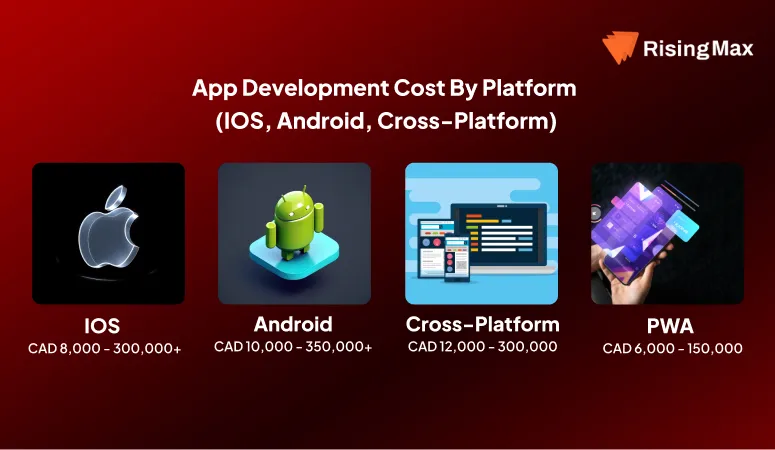
Another essential factor that impacts the cost of app development is the platform for which you are building your app. Generally, apps fall into two categories –
- Native
- Cross-platform
- PWA (Web Apps)
Native apps are developed for one specific platform, such as Android or iOS. These apps are designed to deliver peak performance with a smooth UX and to use complete device resources. Since one codebase allows you to deploy an app on only one specific platform, you need multiple codebases to launch your app on multiple platforms. Thereby directly increasing the cost by 2 fold.
While cross-platform apps can be deployed using a single codebase, they are a suitable option for apps that are not performance-heavy.
How Much Does It Cost to Develop an iOS App in Canada?
To develop an iOS app, it may cost around CAD 8,000 to CAD 300,000. The cost is generally lower for building an app for the Apple ecosystem due to the integrated ecosystem and fewer screen sizes. However, iOS developers may command higher hourly rates due to their technical proficiency.
Average hourly rate of hiring iOS app developers in Canada –
- Junior (0-2 yrs): CAD 30 – 50/hr
- Mid-Level (3-5 yrs): CAD 50 – 70/hr
- Senior (5+ yrs): CAD60 – 100+/hr
Additionally, Apple has a much stricter approval process, which can add to the revision times, thereby increasing the cost.
Here’s an estimated breakdown of how much iOS app development costs in Canada, as per various app complexity levels.
| iOS App Complexity | Typical Use Case | Key Features Included | Estimated Cost (CAD) | Development Timeline |
| Simple iOS App (MVP) | Startup validation, internal tools | Basic UI, limited screens, static content, simple APIs, Apple sign-in | CAD 8,000 – 40,000 | 1.5 – 3 months |
| Mid-Complex iOS App | Business apps, marketplaces, SaaS apps | Custom UI/UX, backend APIs, user authentication, payments, push notifications | CAD 40,000 – 120,000 | 3 – 6 months |
| Advanced iOS App | AI-driven, data-heavy, enterprise apps | AI/ML features, real-time data, third-party integrations, and advanced security | CAD 120,000 – 300,000 | 6 – 10 months |
Preferred tech stack for iOS app development –
- Programming Language – Swift, Objective-C
- Development Environment – XCode
- UI Toolkit – SwiftUI, UIKit
- Framework and Libraries – iOS SDK, SwiftData
- Build Automation – Gradle
- DevOps and Testing – Xcode Cloud, Fastlane, Jenkins, XCTest, Appium
- Backend and Infra – Node.js, Python(Django), Ruby(Ruby on Rails), Java(Spring Boot), MongoDB, PostgreSQL, MySQL, SQLite, AWS, GCP, Microsoft Azure, Firebase
How Much Does It Cost to Develop an Android App in Canada?
Developing an app for the Android ecosystem is much complex than the iOS app. Android app developers need to optimize their apps for a wide range of OS versions and screen sizes across devices.
Average hourly rate of hiring Android app developers in Canada –
- Junior (0-3 years): CAD $40–$80/hour
- Mid-level (3-5 years): CAD $80–$120/hour
- Senior (5+ years): CAD $120–$180+/hour
The device fragmentation present in the Android ecosystem leads to longer development time, especially in the testing phase. Moreover, due to frequent updates in the Android OS versions, developers need to update the app accordingly. These updates add to the post-launch/maintenance cost.
Here’s an estimated breakdown of how much Android app development costs in Canada, as per various app complexity levels.
| Android App Complexity | Ideal For | Key Features Included | Estimated Cost (CAD) | Development Timeline |
| Simple Android App (MVP) | Startup validation, internal tools | Basic UI, limited screens, simple APIs, Google sign-in, local database | CAD 10,000 – 45,000 | 1.5 – 3 months |
| Mid-Complex Android App | Business apps, marketplaces, SaaS platforms | Custom UI/UX, backend APIs, user authentication, payment gateways, push notifications | CAD 43,000 – 140,000 | 3 – 6 months |
| Advanced Android App | AI-powered, data-intensive, enterprise apps | AI/ML integration, real-time sync, third-party APIs, enhanced security, cloud scalability | CAD 130,000 – 350,000 | 6 – 10 months |
Preferred tech stack for Android app development –
- Programming Language – Kotlin, Java
- Development Environment – Android Studio
- UI Toolkit – Jetpack Compose, XML Layouts
- Framework and Libraries – Android SDK, Android Jetpack
- Build Automation – Gradle
- DevOps and Testing – Xcode Cloud, Fastlane, Jenkins, XCTest, Appium
- Backend and Infra – Node.js, Python(Django), Java(Spring Boot), MongoDB, PostgreSQL, MySQL, SQLite, AWS, GCP, Microsoft Azure, Firebase
How Much Does It Cost to Develop a Cross-platform App in Canada?
To develop a cross-platform app in Canada, it may take around CAD 12,000 to CAD 300,000. Cross-platform apps are a great option if you want a faster and cost-effective solution for your app, as you can deploy your app on multiple platforms with just a single development effort.
Here’s an estimated breakdown of how much cross-platform app development costs in Canada, as per various app complexity levels.
| Cross-Platform App Complexity | Best Suited For | Key Features Included | Estimated Cost (CAD) | Development Timeline |
| Simple Cross-Platform App (MVP) | Startups validating ideas on iOS & Android | Shared codebase, basic UI, limited features, API integration | CAD 12,000 – 50,000 | 2 – 3 months |
| Mid-Complex Cross-Platform App | Business apps, SaaS, marketplaces | Custom UI/UX, backend APIs, authentication, payments, push notifications | CAD 40,000 – 120,000 | 3 – 6 months |
| Advanced Cross-Platform App | AI-powered, data-heavy platforms | AI/ML integration, real-time sync, third-party services, high scalability | CAD 120,000 – 300,000 | 6 – 9 months |
Preferred tech stack for cross-platform app development –
- Frontend Frameworks and Languages – Flutter, React Native, .NET MAUI, Ionic
- Backend Technologies – Node.js, Python, Java
- Cloud Services – AWS, GCP, Azure
- Database – MySQL, PostgreSQL, MongoDB, Firebase Firestore
Depending on the programming language and the technical proficiency of the developers. Here’s a rough estimate of their hourly rates,
- React Native App Developer Hourly Rate – CAD 35 – 140+/hr
- Flutter App Developer Hourly Rate – CAD 30 – 75+/hr
How Much Do Progressive Web Apps Cost?
The cost to develop a progressive web app (PWA) in Canada is around CAD 6,000 to CAD 65,000, depending on the app’s complexity. PWAs are built on HTML, CSS, JS, and run on a browser, thus eliminating the need for development for any specific platform. The cost for building PWAs is usually 50-60% less than that of platform-specific native apps.
| PWA Complexity | Best Use Case | Key Features Included | Estimated Cost (CAD) | Development Timeline |
| Basic PWA | Content-driven apps, MVPs, internal tools | Responsive UI, offline access, basic caching, push notifications | CAD 6,000 – 25,000 | 1 – 2 months |
| Mid-Complex PWA | Business apps, eCommerce, SaaS platforms | Custom UI/UX, backend APIs, authentication, payments, advanced caching | CAD 22,000 – 70,000 | 2 – 4 months |
| Advanced PWA | Enterprise portals, high-traffic platforms | Real-time data, advanced security, cloud scalability, analytics integration | CAD 65,000 – 150,000 | 4 – 6 months |
App Development Cost by App Complexity and Features – Niche-Specific Cost Estimates
Each mobile application is built around a unique user story.
Different functional category, whether analytics-driven, authentication-centric, transactional, or hardware-integrated, introduces distinct developmental constraints such as state management, concurrency handling, data throughput optimization, encryption standards, fault tolerance, and horizontal scalability. These factors may also add to the overall budget beyond the average budget.
Additionally, regulated domains like FinTech and healthcare impose mandatory compliance frameworks (e.g., PCI-DSS, HIPAA/PHIPA), requiring secure data pipelines, audit logging, access control enforcement, and third-party security validation, all of which materially impact development timelines and budgets.
Author’s Note – Prioritize what your audience truly needs, and remember, simplicity is the ultimate sophistication. A company specializing in app development for startups can help you get the ball rolling at this stage.
Basic / MVP App Development Cost
Basic or MVP apps are built to validate ideas quickly with minimal features. These apps focus on core user journeys, limited screens, and lightweight backend logic, ideal for startups testing market fit or enterprises prototyping internally.
Real examples of basic/MVP apps –
- VarafeSale
- Kik
- Eva (cooperative)
- AskforTask
- EventMobi
| Aspect | Details |
| Key Features | Core screens, basic UI, simple APIs, limited backend logic |
| Complexity Level | Low |
| Timeline | 1.5 – 3 months |
| Cost Range (CAD) | 8,000 – 40,000 |
Data-Driven & Analytics App Development Cost
Data-driven apps rely heavily on backend architecture, dashboards, data visualization, and real-time or batch data processing. Costs increase due to analytics pipelines, performance optimization, and scalability requirements.
Real examples of data-driven and analytics apps –
- Tableau
- Microsoft Power BI
- Looker
- Mint
- Plaid
- Stripe Sigma
- Google Analytics
- AWS IoT Analytics
- Snowflake
| Aspect | Details |
| Key Features | Dashboards, data visualization, APIs, reporting engines |
| Complexity Level | Medium to High |
| Timeline | 4 – 7 months |
| Cost Range (CAD) | 60,000 – 180,000 |
Authentication-Based App Development Cost
These apps revolve around secure user identity management. Complexity depends on authentication layers such as MFA, OAuth, role-based access, and compliance with privacy regulations.
Real examples of Authentication-Based apps –
- Okta
- Auth0
- Duo Security
- LastPass
- Microsoft Entra ID
| Aspect | Details |
| Key Features | Login/signup, OAuth, MFA, RBAC, session management |
| Complexity Level | Medium |
| Timeline | 3 – 5 months |
| Cost Range (CAD) | 40,000 – 100,000 |
Social Media & Community App Development Cost
Social and community apps require real-time interactions, content feeds, notifications, moderation tools, and scalable infrastructure to handle user-generated content and engagement spikes.
Real examples of social media and community apps –
- Discord
| Aspect | Details |
| Key Features | Feeds, chat, media uploads, likes, comments, notifications |
| Complexity Level | High |
| Timeline | 5 – 9 months |
| Cost Range (CAD) | 100,000 – 250,000 |
eCommerce App Development Cost
eCommerce apps combine transactional workflows with inventory management, payment processing, and performance optimization. Costs scale with integrations, custom checkout flows, and security requirements.
Real examples of eCommerce apps –
- Shopify
- Amazon
- Walmart
- Etsy
- eBay
| Aspect | Details |
| Key Features | Product catalog, cart, payments, order tracking, CMS |
| Complexity Level | Medium to High |
| Timeline | 4 – 8 months |
| Cost Range (CAD) | 60,000 – 180,000 |
On-Demand Service App Cost
On-demand apps require real-time matchmaking between users and service providers, location tracking, scheduling engines, and push notifications—making them backend-intensive.
Real examples of on-demand service apps –
- Uber
- Lyft
- DoorDash
- Uber Eats
- TaskRabbit
| Aspect | Details |
| Key Features | Real-time matching, GPS tracking, bookings, payments |
| Complexity Level | High |
| Timeline | 5 – 9 months |
| Cost Range (CAD) | 80,000 – 220,000 |
Marketplace (Multi-Vendor) Apps Cost
Marketplace apps introduce additional complexity through vendor onboarding, commission logic, payouts, dashboards, and dispute management—often requiring enterprise-grade backend design.
Real examples of marketplace apps –
- Airbnb
- Upwork
- Fiverr
- Etsy
- Booking.com
| Aspect | Details |
| Key Features | Vendor profiles, commissions, payouts, admin dashboards |
| Complexity Level | High |
| Timeline | 6 – 10 months |
| Cost Range (CAD) | 120,000 – 300,000 |
IoT & Hardware-Integrated App Development Cost
IoT apps integrate with physical devices, sensors, and firmware, requiring real-time data sync, device provisioning, and fault tolerance, significantly increasing engineering effort.
Real examples of IoT and hardware-integrated apps –
- Tesla App
- Google Home
- Fitbit
- Philips Hue
- Ring
| Aspect | Details |
| Key Features | Device integration, real-time sync, dashboards, alerts |
| Complexity Level | High |
| Timeline | 6 – 12 months |
| Cost Range (CAD) | 120,000 – 300,000+ |
Healthcare & HIPAA / PHIPA-Compliant Apps Cost
Healthcare apps demand strict compliance, secure data handling, audit trails, and encryption. Compliance engineering and validation significantly influence overall cost.
Real examples of Healthcare and HIPAA/PHIPA compliant apps –
- Epic MyChart
- Cerner HealtheLife
- Telus Health
- athenahealth
- Amwell
| Aspect | Details |
| Key Features | EHR integration, encryption, access logs, compliance |
| Complexity Level | High |
| Timeline | 6 – 10 months |
| Cost Range (CAD) | 120,000 – 280,000 |
FinTech & PCI-DSS Compliant Apps Cost
FinTech apps are among the most complex due to financial regulations, security audits, transaction handling, and fraud prevention mechanisms. Costs reflect enterprise-level risk management.
Real examples of FinTech and PCI-DSS compliant apps –
- Koho
- Wealthsimple
- Borrowell
- Nuvei
- Trulioo
| Aspect | Details |
| Key Features | Secure payments, KYC, fraud detection, audit logs |
| Complexity Level | Very High |
| Timeline | 6 – 12 months |
| Cost Range (CAD) | 150,000 – 300,000+ |
Here are Clutch estimates about how much each app type cost as per market standards,
“Want to know more about how much app development companies charge to build the type of app you want to build specifically? This table breaks down what businesses can expect to pay for an app based on what market the app is targeting.

If You Are Hiring App Developers, These are Hiring Models Options You Have!
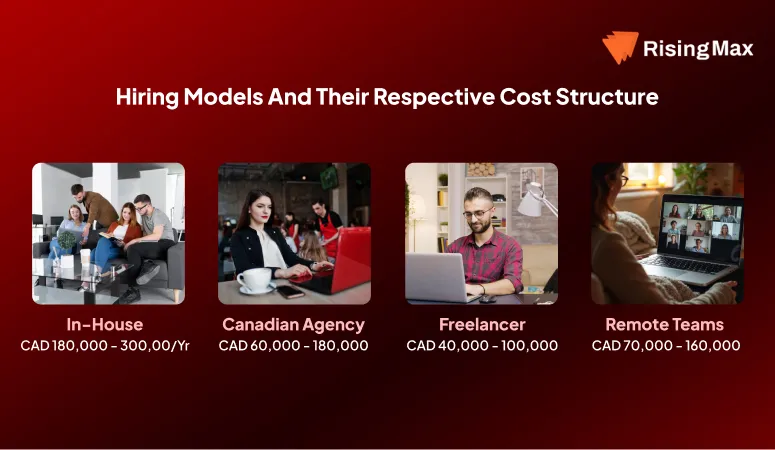
Depending on the project and organizational goals, there are a few hiring models, each with its own advantages and disadvantages. Choosing the right hiring model needs critical considerations regarding delivery accountability, risk distribution, operational overhead, and long-term scalability.
Hiring models you can choose from –
- In-House Team
- Outsourcing to a Canadian Agency
- Freelancers
- Dedicated Remote Teams
An in-house team offers maximum control but has fixed costs and incurs overhead costs apart from the base salary. Alternatively, freelancers and remote teams offer speed and flexibility but vary in governance and IP risk.
However, the most cost-effective hiring model is the one that minimizes the rework, attrition, and security complaints from the beginning and ensures faster time-to-market.
In the following table, we have analyzed each model along with the estimated cost and when to choose them.
| Hiring Model | Estimated Cost (CAD) | Cost Structure Explained | Control | Risk | Best For |
| In-House Team | 180,000 – 300,000 / year | Salary + 20–30% overhead (benefits, taxes, tools, idle time) | Very High | Low delivery risk, high financial lock-in | Enterprises, long-term core products |
| Outsourcing to Canadian Agency (Our Offering) | 60,000 – 180,000 (project-based) | Fixed-price or blended hourly model with QA, PM, DevOps included | High | Low | Regulated apps, fast go-to-market |
| Freelancers | 40,000 – 100,000 | Hourly (CAD 40–80/hr), fragmented roles, no delivery ownership | Low | High | Prototypes, short-term tasks |
| Dedicated Remote Teams (Another model we offer) | 70,000 – 160,000 | Monthly per-resource pricing, long-term engagement | Medium–High | Medium | Scaling startups, evolving roadmaps |
For most startups and mid-market companies in Canada, outsourcing to a Canadian agency or hiring a dedicated remote team delivers the best cost-to-outcome ratio. Outsourcing to Canadian agencies offers predefined SLAs (Service Level Agreements), QA pipelines, and expertise in Canadian compliance readiness. Though the hourly rates may appear higher but the overall TCO (Total Cost of Ownership) is lower due to reduced rework and faster releases.
How Much Does Hiring Mobile App Developers Cost in Canada?
Given the hiring model, the hourly rates for app developers are another cost factor. Also, the region where you are hiring developers determines the price.
When it comes to calculating the hourly cost, below are the factors that play cost-determining roles –
- Developer Seniority & Skill Density
- Platform & Technology Stack
- App Complexity & Feature Coupling
- Compliance & Security Requirements
- Location & Talent Market Dynamics
- Engagement Model & Contract Structure
Canada’s mature tech ecosystem favors senior, product-oriented engineers, which elevates cost but significantly reduces technical debt and delivery risk.
Hourly Rates of Developers Across Various Cities in Canada
Developer rates vary by city due to talent concentration, cost of living, startup density, and enterprise demand. The “Golden Triangle” commands premium pricing, while Ottawa offers a balance of government-grade engineering talent at moderate cost.
Note that these are the average costs of junior, mid-level, and experienced developers. Since cost also depends on app complexity, it is best advised to contact a Canadian app development agency for the most accurate cost estimations.
| City | Hourly Rate (CAD) | Why It Costs This Much |
| Toronto | 80 – 150 | Largest tech hub, fintech & enterprise dominance |
| Vancouver | 75 – 140 | Strong SaaS, AI, and startup ecosystem |
| Montreal | 60 – 120 | Cost-efficient talent, strong AI & mobile expertise |
| Ottawa | 65 – 125 | Security-focused, government & enterprise engineers |
7 Key Factors That Influence Mobile App Development Cost in Canada
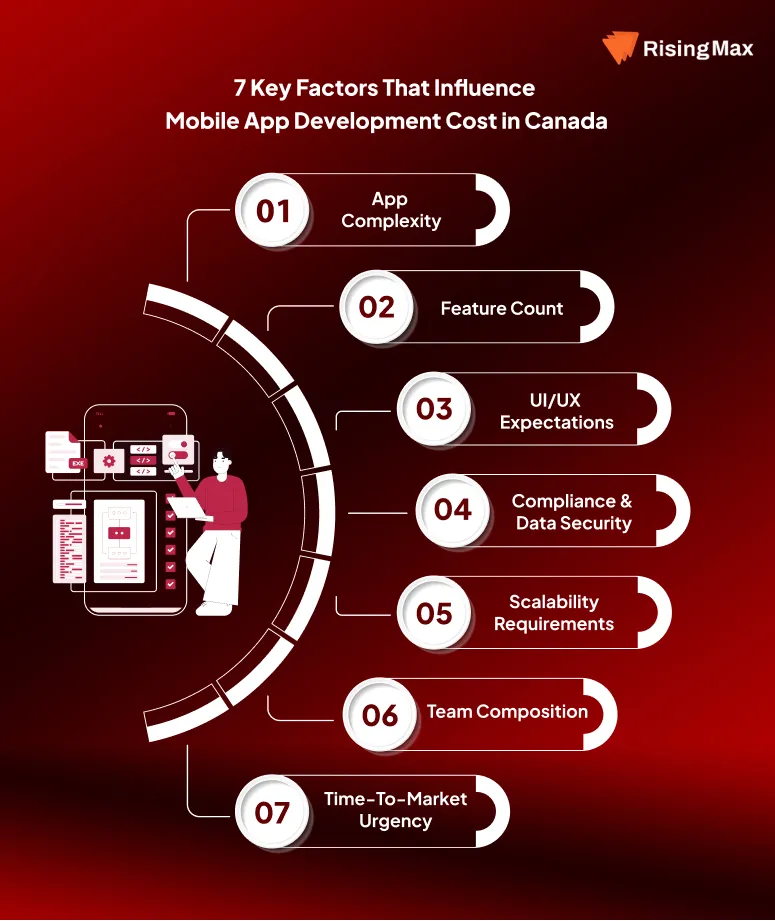
The cost of mobile app development in Canada is influenced by a combination of technical, operational, and regulatory factors rather than just the hourly rates. The rich tech expertise offered by the golden triangle increases the cost, but also promises to offer architectural depth, quality benchmarks, and delivery expectations.
Here are the critical factors that influence the cost of app development.
- App complexity
- Feature count
- UI/UX expectations
- Compliance & data security
- Scalability requirements
- Team composition
- Time-to-market urgency
App Complexity
App complexity is the primary cost driver, as it directly impacts system architecture, development effort, and testing scope. A basic application with limited workflows and minimal backend logic can rely on straightforward architectures, whereas complex apps require multi-layered systems, advanced state management, asynchronous processing, and robust error handling.
Feature count
Cost does not increase linearly with the number of features. The addition of each new feature requires dependencies across frontend, backend, APIs, and data models, increasing integration and regression risk.
For enterprises, keeping scalability in mind while developing and integrating new features proves to be a sustainable option, although it might increase the upfront cost initially.
UI/UX expectations
UI/UX plays an important role not only in building the cost but also in the app’s success.
- Advanced UI/UX involves,
- custom interaction patterns,
- motion design,
- accessibility compliance,
and design system implementation rather than static screens.
Translating these designs into performant, reusable frontend components requires senior frontend engineers and iterative design-validation cycles. Higher UX maturity increases initial development cost but significantly improves user adoption and retention.
Compliance & data security
Compliance and data security requirements are especially impactful in Canada due to strict data protection expectations and industry regulations. Engineering for compliance adds cost through additional design, implementation, testing, and documentation efforts.
However, developing a fully compliant application can save you from legal exposure, app store rejection, or even costly post-launch remediations.
Scalability Requirement
Scalability requirements influence both architecture and infrastructure cost. Apps designed for limited usage can rely on simpler backend setups, while applications targeting rapid growth or enterprise adoption must be built with horizontal scaling, load balancing, and fault tolerance from day one.
This increases initial cost but prevents expensive architectural rewrites as user demand grows.
Team composition
Team composition also significantly affects cost structures in Canada. Projects staffed with senior engineers, solution architects, and dedicated QA specialists command higher rates but deliver higher-quality, more predictable outcomes.
Time-to-market urgency
Finally, time-to-market urgency has a direct cost impact due to compressed timelines and parallelized workflows. Accelerated delivery often requires larger teams, overlapping phases, increased automation, and reduced tolerance for rework.
While this approach increases short-term cost, it may be strategically justified for market-driven launches, competitive positioning, or investor commitments.
Hidden Factors You Might’ve Missed
App maintenance & updates: Ongoing maintenance costs accrue from bug fixes, performance tuning, dependency updates, and feature refinements required to keep the app stable and competitive post-launch.
OS compatibility upgrades: Every major iOS or Android release can trigger mandatory code refactoring, UI adjustments, and regression testing to maintain platform compliance and avoid runtime failures.
Security patches: Continuous security patching is required to address newly discovered vulnerabilities, update encryption libraries, and maintain compliance with evolving security standards.
Cloud hosting & DevOps: Infrastructure costs grow over time due to scaling requirements, monitoring tools, CI/CD pipelines, backups, and environment management needed for production reliability.
Third-party API pricing changes: External API providers often revise pricing, rate limits, or usage tiers, which can unexpectedly increase operational costs or force architectural changes.
App Store compliance costs: App stores enforce evolving review guidelines, privacy disclosures, and SDK policies, requiring ongoing updates, documentation, and resubmissions to avoid delisting or rejection.
How to Accurately Estimate Your App Development Cost
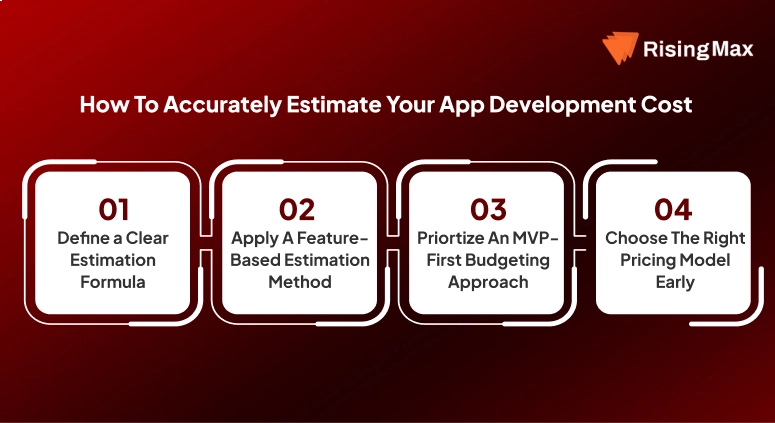
- Define a clear cost estimation formula
Map total cost as Development Hours × Role-Based Hourly Rates + QA + Infrastructure + Contingency to avoid guesswork.
- Apply a feature-based estimation method
Break the app into individual features, estimate effort per feature (frontend, backend, APIs, QA), and aggregate for realistic costing.
- Prioritize an MVP-first budgeting approach
Separate must-have features from enhancements to control initial spend and validate market fit before scaling.
- Choose the right pricing model early
Use fixed price for well-defined, low-ambiguity scopes and time & material for evolving products requiring flexibility.
How to Reduce App Development Cost Without Compromising Quality
App development cost can be reduced using architectural discipline, scope governance, and lifecycle thinking rather than budget cutting. High-quality applications achieve cost efficiency by minimizing rework, preventing technical debt, and optimizing development effort across the product’s lifespan.
Here are some of the strategies that can help you reduce the app development cost without compromising the build quality at all.
MVP Scoping Strategies
Instead of implementing full feature sets, teams isolate the core value proposition and design a Minimum Viable Product that validates key assumptions with the least engineering effort.
This involves decomposing features into critical user flows, deferring non-essential edge cases, and avoiding premature optimization. In MVP models, developers usually focus on developing 30% features that deliver 70% of the value, thus reducing the developmental hours, thereby reducing the cost.
Choosing the right tech stack
Choosing the right tech stack has a long-term impact on both development and maintenance costs. A well-aligned stack balances developer productivity, ecosystem maturity, and scalability requirements.
Technologies with strong community support, mature tooling, and proven performance characteristics reduce onboarding time, minimize bugs, and accelerate feature delivery.
The goal is to select technologies that are stable, well-documented, and appropriate for the projected scale of the application.
Phased rollout planning
Phased rollout planning allows teams to distribute cost across milestones instead of front-loading all development effort.
By releasing features incrementally, organizations can validate real-world usage, gather data, and adjust priorities before committing additional budget. This approach reduces the risk of building unused features and enables early revenue generation or user feedback to guide subsequent investments.
Reusable components
Reusable components significantly lower both development and maintenance costs when applied systematically. Component-driven architectures enable teams to build once and reuse across screens, platforms, or even multiple products.
This applies to UI components, backend services, and integration layers. Reusability reduces duplication, improves consistency, and accelerates future enhancements.
Long-term cost optimization
Long-term cost optimization is achieved by designing for maintainability from day one. This includes enforcing coding standards, implementing automated testing, and investing in scalable architecture early.
Proactive monitoring, performance tuning, and regular dependency updates prevent expensive production incidents and emergency fixes.
Common Cost Mistakes That Inflate App Budgets by 30 to 50% — Reality Check Checklist
- Overbuilding features instead of validating value
Building advanced features without real usage data leads to unnecessary frontend logic, backend complexity, extended QA cycles, and long-term maintenance overhead. Every unused feature adds a hidden cost in testing, deployment, documentation, and future upgrades. - Skipping or underfunding the discovery phase
Bypassing discovery results in unclear requirements, unstable architecture, and frequent scope changes during development—each change triggering code refactors, UI rework, and timeline extensions that rapidly compound costs. - Choosing the wrong hiring or engagement model
Selecting freelancers for complex systems or fixed-price contracts for evolving products often leads to misalignment, rushed decisions, and technical debt. The cost of fixing poorly engineered foundations far exceeds the savings from lower initial rates. - Ignoring scalability requirements early
Designing only for current users forces expensive architectural rewrites when traction grows, including database restructuring, API redesigns, and infrastructure migration—costs that could have been minimized with early scalability planning. - Underestimating compliance and data protection needs
Treating security and compliance as post-launch concerns leads to retrofitting encryption, access controls, audit logs, and policy updates—often requiring significant rework and re-testing across the entire system.
Wrap Up
As this research demonstrates, development costs in 2026 are influenced less by raw hourly rates and more by system complexity, regulatory exposure, platform fragmentation, feature setand long-term operational considerations.
Canadian app development typically costs around CAD 8,000 for MVPs to well over CAD 300,000 for AI-enabled, regulated, or enterprise-grade platforms, with an industry average of approximately CAD 124,000 over an 11-month delivery cycle. These figures reflect Canada’s mature engineering ecosystem, strong data protection standards (PIPEDA, PHIPA), and increasing demand for senior, product-oriented developers—factors that raise upfront costs but significantly reduce downstream risk.
For entrepreneurs and stakeholders, the critical insight is this: cost efficiency is achieved through architectural discipline, not feature compression. Investments in discovery, scalable backend design, robust QA, and compliance engineering materially lower rework, security exposure, and long-term maintenance costs. Conversely, skipping these foundations can inflate total budgets by 30–50% post-launch.
FAQs
Q1. How much does mobile app development cost in Canada in 2026?
Ans. Mobile app development in Canada typically costs CAD 8,000–40,000 for an MVP, CAD 40,000–120,000 for a standard business app, and CAD 120,000–300,000+ for complex or AI-driven applications. Costs vary based on architecture depth, compliance needs, and scalability requirements rather than screen count alone.
Q2. Why is app development in Canada more expensive than in offshore regions?
Ans. Canadian app development rates are 25–60% higher than offshore, but deliver stronger ROI due to senior engineering talent, security-first architecture, and compliance readiness.
Most Canadian projects reduce post-launch rework costs by 30–45% compared to low-cost offshore builds.
Q3. What is the average hourly rate for mobile app developers in Canada?
Ans. Mobile app developers in Canada charge CAD 80–150/hour, depending on expertise and specialization. Senior engineers, architects, and compliance-focused teams sit at the higher end, while junior or mixed teams fall lower.
Q4. How much does it cost to build an MVP app in Canada?
Ans. An MVP app in Canada typically costs CAD 8,000–40,000, covering discovery, core UX, essential backend logic, and basic QA. This range assumes limited third-party integrations and controlled feature scope focused on validation, not scale.
Q5. How much does enterprise-level app development cost in Canada?
Ans. Enterprise-grade mobile apps in Canada cost CAD 300,000–1,000,000+, depending on integrations, compliance, and scale. These budgets include advanced security, role-based access, audit logging, scalability testing, and long-term support planning.
Q6. What percentage of the total cost goes into UI/UX design in Canadian app projects?
Ans. UI/UX design typically accounts for 15–25% of total app development cost in Canada. Higher percentages reflect usability testing, accessibility compliance, and design systems—not just visual screens.
Q7. How much does backend development impact app development cost in Canada?
Ans. Backend development usually consumes 30–40% of the total project cost, as it includes APIs, databases, security, integrations, and scalability logic. Apps with real-time data, payments, or analytics often exceed this range.
Q8. How much should businesses budget for QA and testing in Canada?
Ans. QA and testing generally require 15–25% of the total app development budget. Projects with automation and performance testing cost more upfront but reduce post-launch defect costs by up to 40%.
Q9. How much does post-launch support cost for apps developed in Canada?
Ans. Post-launch support typically costs 15–25% of the initial development cost annually. This covers OS updates, bug fixes, security patches, performance tuning, and incremental enhancements.
Q10. Is cross-platform app development cheaper in Canada?
Ans. Cross-platform apps can reduce cost by 20–30% compared to building separate iOS and Android apps. However, apps with heavy native functionality or complex animations may see reduced savings.
Q11. How does compliance affect app development cost in Canada?
Ans. Compliance requirements can increase development cost by 10–30%, depending on data sensitivity and industry. This includes encryption, secure authentication, audit trails, and compliance documentation.
Q12. How much does third-party integration increase app development cost?
Ans. Each third-party integration typically adds CAD 3,000–10,000 to development cost. Payment gateways, identity providers, and analytics tools increase cost due to security and testing overhead.
Q13. How accurate are online app development cost calculators for Canada?
Ans. Online calculators are usually 30–50% inaccurate because they ignore architecture, security, QA, and compliance. Accurate Canadian cost estimation requires technical discovery and phased breakdowns.
Q14. How does time-to-market urgency impact app development cost in Canada?
Ans. Accelerated timelines can increase cost by 20–40% due to parallel development, larger teams, and reduced iteration cycles. Faster delivery often trades budget for speed rather than reducing total effort.
Q15. What is the biggest factor that increases mobile app development costs in Canada?
Ans. The biggest cost driver is app complexity, not platform choice. Complex workflows, integrations, security layers, and scalability requirements compound engineering effort across all phases.