
Key Takeaways
What You Need to Know –
- The biggest AI opportunities exist in the gap between rising AI budgets and slow enterprise execution.
- Most successful AI businesses focus on one narrow, revenue-first use case before expanding.
- Niche, industry-specific AI SaaS products outperform horizontal AI tools in adoption, ROI, and retention.
- Execution speed, data strategy, and go-to-market focus matter more than model accuracy at the early stage.
Important Facts to Note
- The global AI market is projected to reach $3.49 trillion by 2033, growing at a 30.6% CAGR.
- Nearly two-thirds of companies have not yet scaled AI, creating a large opportunity window for startups.
- Generative AI spending is expected to reach $644 billion in 2025 (Gartner).
AI can analyze large volumes of data and provide actionable insights—something which startups, MSMEs, and even enterprises can benefit from significantly. So, why not build an AI-based startup? Not only are the AI business ideas faster to execute, but they are also beginner-friendly.
But the question is: Are AI business ideas profitable?
A decade ago, this question could have been debatable. But the current market insights present an accurate, surprising answer. You will be surprised to know that the global AI market is valued at USD 390.91 billion in 2025, and is expected to reach USD 3,497.26 billion by 2033. That’s staggering growth at a 30.6% CAGR. Remarkable market expansion, right?
Moreover, as per McKinsey’s report, most organizations are in the beginner/testing stage when it comes to implementing AI. About two-thirds of respondents said their organizations have not yet begun scaling AI.
These reports present the ideal scenario entrepreneurs often seek.
While AI spending is accelerating globally, most businesses haven’t figured out how to monetize it yet—and that gap is where the next generation of startups will be built. The startups that launch in the next 12–24 months will define the market, while late entrants compete on price.
The Idea Behind AI Business Ideas
In one of our earlier articles, we discussed some amazing and practical business ideas. But with the evolution of AI, starting an AI-powered business has become easier and profitable than ever.
Let’s say you have an innovative idea about a business. Typically, analysis, structuring, development, implementation, and cost are the main hurdles founders face when executing their moonshot idea.
But what if all these phases could be automated and development costs minimized? What if your workforce worked around the clock without breaks, never getting tired, and still delivered quality work?
Yes, these are the new normal if you are building an AI business idea. However, to make the business successful, it is important that you have market knowledge and a practical plan. In this article, we have brought in-depth research about the various industries, trends associated, and rising demand to narrow down achievable million-dollar AI business ideas for startups in 2026.
This was a bit of a prelude; let’s talk business now!
Million-Dollar AI Business Ideas That Can Make Startups Successful in 2026
Among various AI-powered money-making opportunities, we have identified high-potential, low-risk business ideas with strong market demand that can be scaled easily.
Plus, you don’t have to be an MIT engineer to decode and implement these ideas. You can start with lean or no-code/low-code development, and even AI tools such as
| Tool | What can it do? |
| Validator AI | Startup idea validation using market signals |
| Notion AI | Product docs, roadmaps, MVP scope definition |
| Figma AI | UI generation, layout suggestions, design automation |
| Zapier AI | Workflow automation across 6,000+ apps |
| n8n | Open-source automation (self-hosted) |
| Jasper | Marketing content & ad copy |
| HubSpot AI | CRM, email, lead scoring |
| Azure OpenAI | Enterprise compliance-ready AI apps |
These AI tools can help you automate a large number of tasks in your business.
Here are the top AI business ideas that startups and entrepreneurs can invest in or launch in 2026 to earn in 7 digits.
- Build an AI-Powered Cybersecurity Application
- Creating an AI Fraud Detection Platform
- Develop an AI-First Healthcare Platform
- Create a Niche-Focused AI SaaS Product
- Offer AI-Led Business Automation Services
- Launch an AI Implementation Consulting Practice
- Launch a Custom AI Chatbot Development Agency
- Building AI-Powered Data Analytics Service
- Develop an AI-Driven Recruitment and Hiring Tool
- Start an AI Content Creation and Marketing Studio
- Build an AI Content Editing and Fact-Checking Tool
- Create an AI-Driven Graphic Design and Art Studio
- Design an AI-Enabled Smart Home Ecosystem
1. Build an AI-Powered Cybersecurity App
You might have come across a fairly new concept of vibe-coding! While AI is helping increase productivity in many ways, it is also creating loopholes and vulnerabilities. Moreover, attackers using LLMs can launch a phishing campaign at 95% lower cost, in minutes rather than hours.
Ironically, as AI gives creative thinkers an advantage in accelerating idea execution, it also aids attackers in supporting their campaigns. Modern threats such as polymorphic malware (a “shape-shifting” malware that can generate a new, unique version of itself every 15 seconds or so to evade signature-based detection) make manual detection nearly impossible.
These critical vulnerabilities require modern solutions. An AI-powered cybersecurity application detects, analyzes, and responds to threats by continuously monitoring network traffic, user behaviour, endpoints, and cloud systems. In the US, these platforms are critical for enterprises facing increasing ransomware, phishing, insider threats, and compliance requirements across regulated industries.
How to Build an AI-Powered Cybersecurity App?
To develop an AI-assisted cybersecurity app like Darktrace, CrowdStrike Falcon, Vectra AI, and SentinelOne, startup founders can start by
- Collect telemetry from endpoints, networks, and cloud environments
- Train ML models to identify anomalies and malicious behavior
- Implement real-time threat detection and automated response actions
- Use behavioral analytics for insider threat detection
- Deploy with SOC 2, ISO 27001, and US cloud compliance standards
Talking about the business sustainability and monetization model, you can charge as per tiered subscriptions and SaaS pricing models. For enterprises, you can provide comprehensive cybersecurity features. Additionally, a usage-based pricing model can also be applied for alerts, logs, and data volume processed.
2. Creating an AI Fraud Detection Platform
As we discussed earlier, the increased volume of data is being generated in today’s digital landscape. It has become essential that users get the right and verified information. The rising demand for AI fraud detection is especially evident across the fintech industry.
An AI fraud detection platform, such as Stripe Radar, Sift, and Feedzai, can monitor transactions, user behaviour, and system activities in real time to identify any suspicious patterns. Such prevention platforms can be used to prevent financial or identity fraud.
How to Build an AI Fraud Detection Platform?
Here’s how to develop an AI fraud prevention platform,
- Collect and stream transactional and behavioral data from payment gateways, apps, and APIs
- Train machine learning models to detect anomalies, fraud patterns, and risk scores
- Use real-time decision engines to approve, flag, or block transactions instantly
- Implement explainable AI to justify fraud decisions for audits and compliance
- Deploy on SOC 2, PCI-DSS, and cloud-compliant US infrastructure
AI-backed anti-fraud platforms have huge demand in developed as well as developing nations worldwide. In leading tech markets such as the USA, these platforms are actively used by fintech companies, banks, e-commerce platforms (another profitable niche we will discuss later in this article), insurance providers, and even SaaS businesses. Thus, you can have a wide range of monetization options available to generate huge revenue.
You can charge per-transaction or implement volume-based pricing for payment platforms. Further, you can also sell licenses for enterprises and big tech companies.
With rising card-not-present fraud, identity theft, and regulatory scrutiny, AI-powered fraud detection platforms offer strong demand, high switching costs, and long-term enterprise contracts.
3. Develop an AI-First Healthcare Platform
Do you know AI imaging systems now detect diseases like breast cancer and lung nodules with 90-94% accuracy, while human specialists have an average of 65-78%. That’s the level of transformation that AI healthcare platforms are bringing.
The next AI business idea that startups should look for in the 2026 digital world is developing an AI-first healthcare platform. With intelligent LLMs and NLPs, autonomous agentic ecosystems can manage everything from early diagnosis to back-office revenue cycles. These smart healthcare platforms are designed to work alongside existing EHR/EMR systems, helping providers improve diagnostics, automate administrative workflows, personalize care plans, and reduce overall healthcare costs.
How to Build an AI-First Healthcare Platform?
To develop an AI healthcare platform like Tempus, Olive AI, Aidoc, and Health Catalyst, focus on –
- Integrating with US-standard EHR/EMR systems such as Epic, Cerner, or Allscripts using HL7/FHIR
- Apply AI models for clinical decision support, risk prediction, and patient triage
- Use NLP to analyze clinical notes, medical records, and physician documentation
- Build patient-facing portals for symptom checking, care recommendations, and follow-ups
- Deploy on HIPAA-compliant cloud infrastructure with strong data security and audit controls
The global healthcare system faces rising costs, clinician burnout, and increasing patient volumes. AI-first healthcare platforms directly address these challenges by improving care quality, reducing administrative overhead, and enabling data-driven treatment decisions.
4. Create a Niche-Focused AI SaaS Product
With technology evolving at such a rapid rate, the AI SaaS market has reached a tipping point. Integrating intelligent features into your SaaS products is no longer optional but essential. Therefore, the market presents ample opportunities to build a profitable business.
A niche-specific AI SaaS product targets a specific industry or business operation to solve a well-defined problem using AI automation and insights. Some of the common use cases of the domain-focused AI SaaS solutions are –
- Real Estate: AI that automatically extracts, scores, and monitors lease clauses to reduce legal risk and maximize renewal revenue.
- Healthcare Admin: An AI platform that automates insurance prior authorizations and predicts claim approvals to cut billing delays.
- Logistics and Supply Chain: AI SaaS that predicts delivery delays and dynamically optimizes routes to reduce fuel and last-mile costs.
- Legal Operations: An AI contract intelligence tool that reviews agreements against compliance playbooks and auto-flags risky clauses.
Some common examples are – Veeva Systems, Clari, Procore, and Toast.
How to Develop a Niche-Specific AI-SaaS Product?
Here’s what you need to do to build an AI-SaaS product,
- Identify a narrow industry pain point with repeat demand
- Build AI features tailored to domain-specific workflows
- Integrate with industry-standard tools and data sources
- Offer dashboards, automation, or copilots for daily operations
- Scale using a cloud-native, API-first architecture
Talking about the monetization models, you have various options such as tiered subscriptions, per-user pricing for teams, customizable enterprise plans for dedicated industry verticals, and other value-added AI modules for premium customers.
A study of the US market found that niche SaaS products outperform generic tools by delivering faster adoption, clearer ROI, and lower churn.
5. Offer AI-Led Business Automation Services
We have discussed multiple times how artificial intelligence proves to be more efficient when it comes to completing repetitive tasks. And now with GenAI on the horizon, automated predictive analysis and orchestration have become quite effective.
AI increases labor productivity by up to 40%, saving over 500 hours annually in finance departments alone. AI automation services typically automate functions across finance, operations, HR, sales, customer support, and compliance—reducing costs, improving accuracy, and accelerating execution at scale
UiPath, Zapier, and ServiceNow AI Automation are the leading examples of AI-led business automation service providers.
How to Launch AI-Led Business Automation Services?
You need a strong portfolio before you start providing automation services.
- Identify high-impact manual workflows across departments such as invoicing, onboarding, and reporting
- Combine AI models with RPA tools to automate decision-making and task execution
- Integrate automation with CRMs, ERPs, accounting tools, and cloud platforms
- Build AI agents for document processing, data extraction, and exception handling
- Deploy using secure, SOC 2-compliant infrastructure for US businesses
Businesses face rising labor costs, operational complexity, and pressure to scale efficiently. AI-led automation services directly address these challenges by improving productivity, reducing human error, and delivering measurable ROI.
6. Launch an AI Implementation Consulting Practice
AI adoption in businesses is gaining traction, as we know it, and hence creating opportunities for consulting services that can help implement AI to
- Identify high-impact use cases
- Selecting the right models and platforms
- Upgrading the legacy system with AI and ML models
Even the global AI consulting market alone is expected to cross the USD 90.99 billion mark by 2035. Companies often look for AI consulting services that can plan, develop, and deploy AI—aligned with their specific business goals.
Companies that are running profitable AI implementation consulting practices: Accenture AI, Deloitte AI Institute, Slalom, Boston Consulting Group, and Cognizant AI.
According to a recent McKinsey & Company report, nearly two-thirds of respondents say their organizations have not yet begun scaling AI across the enterprise. Thus, your potential clients to whom you can pitch your AI consulting service are mid-market companies, enterprises, and regulated industries adopting AI at scale.
How to Start an AI Implementation Consulting Practice?
If you are looking to start an AI-first leading business, here are a few tips to help you.
- Conduct AI readiness and data maturity assessments for client organizations
- Identify high-ROI AI use cases across operations, sales, support, and analytics
- Select and integrate AI models, APIs, and platforms into existing tech stacks
- Build production-grade AI workflows with monitoring, security, and governance
- Train internal teams and establish responsible AI and compliance frameworks
You can add multiple stable monetization models, including project-based consulting fees, AI optimization and support, outcome-based pricing, and others.
As of the current scenario, US companies are under pressure to adopt AI quickly but often lack in-house expertise to deploy it responsibly and at scale. An AI implementation consulting practice fills this gap by reducing risk, shortening time-to-value, and aligning AI investments with business outcomes. Thus making it a high-margin, repeatable service with strong enterprise demand.
7. Launch a Custom AI Chatbot Development Agency
AI chatbots are evolving into Agentic AI, capable of performing complex business workflows with minimal human input. Gen Z is the primary driver of the AI chatbot market, with 89% preferring AI chatbots over traditional support, while only 4% of Boomers share that preference.
This demographic split has opened new doors for entrepreneurs to explore the agentic AI chatbot market. A custom AI chatbot is a tailored conversational system designed to handle customer support, sales qualification, onboarding, internal helpdesk, or workflow automation.
Unlike generic bots, these chatbots are trained on company-specific data, integrated with internal systems (CRM, ERP, databases), and deployed across web, mobile apps, and messaging platforms to deliver accurate, context-aware responses. Some well-known examples to look for are:
- Intercom Fin (AI customer support chatbot for SaaS businesses), Drift (AI chatbots for B2B sales and lead qualification), and Tidio (AI chatbots for SMB websites and e-commerce)
How to Start a Custom Agentic AI Chatbot Development Agency?
To launch your own custom AI chatbot development company,
- Define chatbot use cases such as support, sales, HR, or operations
- Train large language models using company knowledge bases, FAQs, and documents
- Integrate with CRMs like Salesforce, HubSpot, or Zendesk
- Implement intent detection, fallback logic, and human handoff workflows
- Deploy securely with data privacy controls and SOC 2–aligned infrastructure
For revenue strategies, you can combine various streams such as monthly SaaS subscriptions, per-bot or per-channel pricing, enterprise contracts with custom training and integrations, setup and ongoing optimization fees. Custom AI chatbots reduce operational expenses, improve response times, and scale customer interactions without increasing headcount.
8. Building an AI-Powered Data Analytics Service
The debate over how data is the new currency has been in the air for quite some time. Precedence Research predicts that the data analytics market will reach USD 310.97 billion by 2034, growing at a 29.10% CAGR from 2025 to 2034. The primary driver of market expansion is the growing volume of data across industries, which requires AI/ML tools for analysis and data-driven predictions to improve forecasting accuracy.
An AI-powered data analytics service connects cloud data platforms such as Azure, AWS, CRMs, ERPs, and other SaaS tools to cluster the fragmented data and streamline it into one platform. It helps in delivering forecasting, anomaly detection, and even helps in decision intelligence.
Companies that are offering AI-enabled data analytics services: Databricks, ThoughtSpot, Palantir Foundry.
How To Build an AI-Powered Data Analytics Service?
To get started with the AI data analytics tool, you need to –
- Integrate the source of client data. It can be platforms like Snowflake, Salesforce, or BigQuery.
- Then use the ML models to automate the trend detection and analysis, as well as for detecting anomalies. Note that ML models will give you raw data only.
- By integrating the NLP (Natural Language Processing) models, you can present the raw reports into actionable insights.
Furthermore, you can implement user-friendly dashboards and ensure essential data-handling compliance before making your tool enterprise-ready.
Since such AI analytics tools are required across industries, you can target professionals across various business verticals. Also, monetization options are flexible for such services. You can opt for subscription-based, enterprise licensing contracts, usage-based pricing, or even charge for consulting services.
9. Develop an AI-Driven Recruitment and Hiring Tool
As the saying goes, solve a common man’s problem, and you have yourself a profitable business!
Do you know that AI-powered screening tools can reduce the time spent reviewing resumes by up to 75%? Even these AI hiring tools can save upto 87% of financial costs.
Recruiters often see hundreds of resumes throughout their day, given the ease provided by the hiring platforms such as LinkedIn and ZipRecruiter. Therefore, for the first part of the screening and to even assign a technical task, you can take the help of AI-powered recruitment and hiring tools.
To develop a successful AI recruitment and hiring tool, you can take inspiration from HireVue, Pymetrics, Eightfold AI, and iCIMS.
How to Develop an AI Recruitment and Hiring Tool?
Here’s a brief development plan for building an AI recruitment and hiring tool. For more details, you can contact our experts.
- Ingest resumes, job descriptions, and applicant data from ATS platforms
- Apply NLP models to match skills, experience, and role requirements
- Use predictive analytics to score candidates based on role fit and performance potential
- Integrate bias-detection and compliance safeguards into hiring workflows
- Connect seamlessly with ATS, HRIS, and calendar systems
Now comes the monetization part, you charge low prices per candidate for high-volume recruitment, or even go with the enterprise licensing. Also, you can add other value services like premium analytics and employer branding add-ons.
In the US market, these tools help companies reduce time-to-hire, improve hiring accuracy, and scale recruitment across competitive labor markets.
10. Start an AI Content Creation and Marketing Studio
Content and marketing are the backbone of brands. The rise of generative AI has completely changed the content creation and marketing strategies. A recent Gartner study forecasts that global GenAI spending will reach $644 billion in 2025, a 76% increase from 2024. Even as per John-David Lovelock (Distinguished VP Analyst at Gartner),
“Foundational model providers are investing billions annually to enhance GenAI models’ size, performance, and reliability. This paradox will persist through 2026.”
An AI content creation and marketing studio helps US businesses produce high-quality, on-brand digital content at scale using generative AI and automated optimization strategies. The studio delivers blogs, website copy, ads, social media posts, email campaigns, and visual assets while aligning content with SEO, conversion goals, and brand guidelines.
How to Start an AI Content Creation and Marketing Studio?
Here’s an outline to build an AI content marketing agency like Jasper, Copy.ai, Brafton, MarketMuse:
- Combine generative AI models with human editors to maintain brand voice and accuracy
- Build workflows for SEO content, paid ads, social media, and lifecycle marketing
- Integrate analytics tools to optimize content for traffic, engagement, and conversions
- Create reusable brand style guides and prompt frameworks for consistency
- Deploy content pipelines using CMS, CRM, and marketing automation platforms
Businesses compete aggressively for content visibility across search, social, and paid channels. With rising content costs and shrinking attention spans, AI-powered studios offer faster turnaround, predictable pricing, and measurable ROI. As for monetization strategies, you have subscription-based, campaign-based, and performance-based pricing. Also, several businesses offer tiered pricing for monthly content retainers.
11. Build an AI Content Editing and Fact-Checking Tool
Our next million-dollar business idea is about containing misinformation! Do you know the cost of misinformation and fake news is $78 billion? For an entrepreneur, it is the right opportunity to establish a credible business. The primary driver of market expansion is the surge in AI-generated content, which requires automated editing and fact-checking tools to ensure accuracy, compliance, and trust.
An AI-powered content editing and fact-checking service integrates with content sources such as CMS platforms, publishing tools, marketing software, and document editors to analyze written content in real time. It improves grammar, tone, and clarity while simultaneously verifying factual claims against trusted sources such as government databases, academic journals, and reputable news outlets.
Companies that are offering AI-enabled content editing and fact-checking services include: Grammarly, Writer.com, Originality.ai, Logically, and Trint.
How to Build an AI Content Editing and Fact-Checking Tool?
To get started with an AI content editing and fact-checking tool, you need to –
- Integrate content input sources such as Google Docs, WordPress, Notion, email platforms, or internal CMS systems.
- Then use large language models (LLMs) to perform grammar correction, tone refinement, and structural editing of the content. Note that LLMs alone may generate or overlook factual inaccuracies.
- By integrating retrieval-augmented generation (RAG) with trusted U.S.-based data sources, such as government APIs, news databases, and academic repositories, you can verify factual claims and flag unverifiable statements.
Furthermore, implement claim extraction, citation suggestions, and confidence scoring, along with a user-friendly dashboard and compliance checks, to make the platform enterprise-ready.
Monetization options are flexible for such services. You can offer subscription-based plans, enterprise licensing, per-document or per-check pricing, API access for publishers, or premium compliance-focused tiers for regulated industries.
12. Create an AI-Driven Graphic Design and Art Studio
The next business that has been added to our list is an AI-powered graphic design and art studio. The generative AI design market is exploding, and 2026 is a tipping point where GenAI design is entering enterprises.
An AI-driven graphic design and art studio uses generative AI models to create logos, brand assets, illustrations, social media creatives, advertisements, and digital artwork. Your design and art studio will provide a platform that combines human creative direction with AI-powered image generation, style transfer, layout design, and brand consistency enforcement, allowing businesses to produce professional visuals faster and at lower cost.
Companies that are offering AI-enabled graphic design and art services include: Canva, Adobe Firefly, Midjourney, DALL·E (OpenAI), and Figma AI.
How to Create an AI-Driven Graphic Design and Art Studio?
To get started with an AI-driven graphic design and art studio, you need to –
- Integrate generative image models such as diffusion-based models and text-to-image systems for creating illustrations, logos, and visual concepts.
- Then build prompt engineering and style-control layers to ensure brand consistency, layout accuracy, and repeatable visual outputs. Note that raw AI outputs often require refinement.
- By incorporating human-in-the-loop workflows and optional AI-assisted editing tools, you can elevate outputs to professional-grade designs.
Furthermore, implement asset management, export formats, licensing controls, and user-friendly design interfaces to make the studio enterprise-ready.
Visual content is required across nearly every industry. You can target startups, marketing agencies, e-commerce brands, content creators, real estate firms, and enterprise marketing teams.
To monetize and make your business profitable, you can offer subscription-based design plans, per-asset pricing, enterprise creative retainers, API access for automated design generation, or premium human-curated creative packages.
13. Design an AI-Enabled Smart Home Ecosystem
Agentic home assistants have upgraded from “command-and-respond” to autonomous agents. These intelligent assistants have also helped the smart home ecosystem transition to predictive orchestration (where homes make decisions for you instead of you setting the rules of automation).
An AI-enabled smart home ecosystem connects devices such as thermostats, lighting, security cameras, appliances, and voice assistants into a unified platform that learns user behavior and automates home operations.
Google Nest, Amazon Alexa Smart Home, and Apple HomeKit are some of the examples worth studying before building your own AI-integrated smart home ecosystem.
How to Design an AI-enabled Smart Home Ecosystem?
IoT and machine learning models can be combined to provide a seamless experience,
- Integrate IoT devices using standards like Matter, Zigbee, Z-Wave, and Wi-Fi
- Apply machine learning to learn household routines and optimize automation
- Build a centralized mobile app for monitoring, control, and real-time alerts
- Use edge AI for faster responses and improved privacy
- Ensure compliance with US data privacy and consumer IoT security guidelines
You can combine various revenue stream models to make this business profitable, such as:
- Hardware and software bundles with recurring subscription plans
- Monthly SaaS fees for advanced automation, security, or energy insights
- Partnership revenue with device manufacturers and utility providers
- Premium services such as AI-powered security monitoring or elder care
These systems focus on energy efficiency, home security, accessibility, and convenience, using AI to anticipate needs, reduce costs, and improve everyday living. Thus, with the rising energy prices and remote living trends, AI-assisted smart home solutions offer recurring revenue, strong brand loyalty, and long-term growth potential.
How To Implement A Million-Dollar AI Business Idea To Build A Successful Startup in 2026?
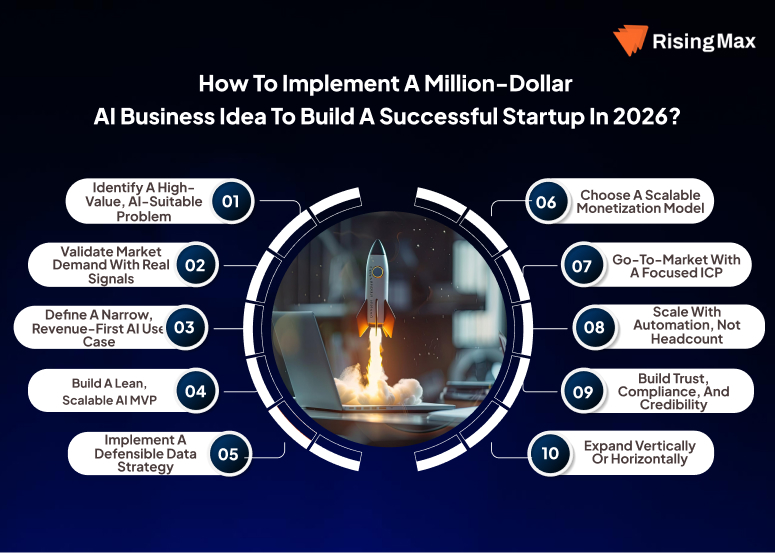
Building a million-dollar AI business is less about inventing new algorithms and more about solving high-value problems with scalable AI systems. The most successful AI business startups follow a structured execution path. They aim to combine domain insight, strong data strategy, and disciplined go-to-market execution.
Below is a proven step-by-step framework.
- Identify a High-Value, AI-Suitable Problem
- Validate Market Demand with Real Signals
- Define a Narrow, Revenue-First AI Use Case
- Build a Lean, Scalable AI MVP
- Implement a Defensible Data Strategy
- Choose a Scalable Monetization Model
- Go-to-Market with a Focused ICP
- Scale with Automation, Not Headcount
- Build Trust, Compliance, and Credibility
- Expand Vertically or Horizontally
Now, let us discuss each of the steps in detail. We will be covering the action plan that you need to execute and what each step demands from you as an entrepreneur.
Step 1: Identify a High-Value, AI-Suitable Problem
Start by targeting a problem where automation, prediction, or intelligence directly impacts revenue, cost, or risk.
Focus on problems that are:
- Repetitive, data-heavy, and decision-driven
- Expensive when done manually
- Already budgeted for in enterprises or SMBs
Examples
- Fraud detection in fintech
- Hiring inefficiencies in recruitment
- Manual reporting in operations
- Compliance checks in legal or healthcare
Thumb rule: If companies already spend money solving the problem, AI can make it a business.
Step 2: Validate Market Demand with Real Signals
Before building, validate demand using evidence, not assumptions.
Validation methods that work:
- Interview 15–30 target customers in the same role
- Analyze job listings to see where AI skills are in demand
- Study competitors’ pricing, churn complaints, and reviews
- Run landing page tests with a waitlist or demo CTA
You should validate:
- Who pays
- What outcome do they expect
- How success is measured
If buyers clearly articulate ROI, you’re on the right path.
Step 3: Define a Narrow, Revenue-First AI Use Case
Avoid building a “platform” early. Instead, launch with one clear AI outcome.
Good examples:
- “Reduce chargebacks by 40% using AI”
- “Cut hiring time by 50% using resume intelligence”
- “Automate 70% of customer support tickets”
Your AI should:
- Deliver one measurable KPI
- Integrate into existing tools (CRM, ERP, cloud apps)
- Require minimal behavior change from users
This clarity accelerates adoption and sales.
Step 4: Build a Lean, Scalable AI MVP
A million-dollar AI business starts with a focused MVP, not a full ecosystem.
Typical MVP stack:
- Pre-trained LLMs or ML models (fine-tuned later)
- Cloud infrastructure (AWS, Azure, GCP)
- Secure APIs and role-based access
- Analytics and monitoring from day one
Key priorities:
- Data quality over model complexity
- Explainability and logs for trust
- Security and compliance readiness
The goal is usable intelligence, not experimental AI.
Step 5: Implement a Defensible Data Strategy
Your long-term advantage is proprietary data, not the model.
Strong data moats include:
- Customer-generated behavioral data
- Industry-specific datasets
- Feedback loops that improve predictions
- Longitudinal data over time
Design your system so:
- Every interaction improves the model
- Data cannot be easily replicated
- Switching costs increase naturally
This is what turns AI startups into durable businesses.
Step 6: Choose a Scalable Monetization Model
Million-dollar AI businesses monetize based on value delivered, not features.
Common high-performing models:
- Subscription pricing (per user or per account)
- Usage-based pricing (per API call, document, or transaction)
- Enterprise licensing with annual contracts
- Hybrid: SaaS + implementation fees
Align pricing with:
- Cost savings
- Revenue uplift
- Risk reduction
If the ROI is clear, pricing resistance drops.
Step 7: Go-to-Market with a Focused ICP
Avoid selling to “everyone.” Start with one Ideal Customer Profile (ICP).
GTM strategies that work:
- Founder-led sales for early traction
- Content-led authority in a specific niche
- Partnerships with SaaS platforms or consultants
- Case studies on generic marketing
Keep in mind that your first 10 customers matter more than your first 10,000 users.
Step 8: Scale with Automation, Not Headcount
To reach seven figures, scale through systems, not services.
Scale efficiently by:
- Automating onboarding and deployment
- Productizing consulting workflows
- Using AI internally for support and ops
- Tracking CAC, LTV, churn, and model performance
This is where AI businesses outperform traditional software companies.
Step 9: Build Trust, Compliance, and Credibility
Enterprise and regulated markets demand trust.
Key trust signals:
- SOC 2 / ISO readiness
- Transparent AI decision logic
- Data privacy controls
- Human-in-the-loop workflows
Trust unlocks larger contracts and longer retention.
Step 10: Expand Vertically or Horizontally
Once product-market fit is achieved, expand strategically.
- Expansion paths:
- Same product, new industries
- Deeper features for existing users
- Adjacent AI use cases
- Geographic expansion
Scale only after your core use case is profitable and sticky.
Got Inspired, What’s Next? It’s Time to Cash In Your AI Business Idea!
AI is changing how we do business and the nature of customer interactions. The global AI market is at its peak right now, making now the right time to execute AI-powered business ideas. What unites every million-dollar AI business idea discussed in this article is not cutting-edge algorithms, but clear problem definition, defensible data, scalable monetization, and disciplined execution.
With no-code tools, pre-trained models, cloud infrastructure, and automation platforms readily available, founders no longer need massive teams or research labs to compete. What they do need is market insight, a narrow initial use case, and the patience to build trust and traction step by step. Start small, validate early, focus on ROI-driven outcomes
The question is no longer whether AI businesses can reach seven figures.
It’s whether you’ll build while the adoption curve is still steep—and before the window narrows.
Got an idea to discuss? Choose RisingMax as your development partner. We are the USA’s top AI Development agency!
FAQs
Q1. Are AI business ideas still profitable in 2026?
Ans. Yes, AI businesses are more profitable in 2026 than ever before. Enterprise AI spending is accelerating while most companies are still in early adoption stages, creating a large execution gap. Startups that solve high-cost, repeatable problems with AI achieve faster ROI and premium pricing.
Q2. What type of AI startup has the highest revenue potential?
Ans. AI startups with the highest revenue potential are those that reduce costs, increase revenue, or mitigate risk. Fraud detection, healthcare automation, cybersecurity, and enterprise AI SaaS outperform generic tools because buyers already have budgets allocated for these problems.
Q3. Do I need to build my own AI model to start an AI business?
Ans. No. Most successful AI startups do not build models from scratch. They use pre-trained models, APIs, and cloud AI services, focusing instead on data quality, workflows, integrations, and domain-specific intelligence.
Q4. How much capital is required to launch an AI startup in 2026?
Ans. AI startups can launch with under $50,000. No-code tools, open-source frameworks, and cloud infrastructure allow founders to build MVPs cheaply and validate demand before scaling.
Q5. Which AI business ideas are best for non-technical founders?
Ans. AI consulting, automation services, niche SaaS, and content studios are ideal for non-technical founders. These models prioritize problem discovery, client outcomes, and integrations over deep algorithm development.
Q6. What is the biggest mistake founders make when building AI startups?
Ans. Building platforms before validating a single high-ROI use case. Successful AI businesses start with one narrow outcome, integrate into existing tools, and expand only after achieving product-market fit.
Q7. How do AI startups create defensible moats if models are commoditized?
Ans. By owning proprietary data and workflow integration, not models. Customer behavior data, feedback loops, and industry-specific datasets create switching costs that competitors cannot easily replicate.
Q8. Are niche AI SaaS products better than horizontal AI tools?
Ans. Yes, niche AI SaaS products consistently outperform horizontal tools. They deliver faster adoption, clearer ROI, lower churn, and higher willingness to pay because they solve industry-specific problems.
Q9. How long does it take to reach $1M ARR with an AI business?
Ans. Well-executed AI startups can reach $1M ARR in 12 to 24 months. Enterprise pricing, usage-based models, and high contract values accelerate revenue compared to traditional SaaS.
Q10. What pricing models work best for AI startups?
Ans. Value-based pricing tied to outcomes works best. Subscription, usage-based, and enterprise licensing models perform well when aligned with cost savings, revenue growth, or risk reduction.
Q11. Is AI consulting still a scalable business model?
Ans. Yes, when consulting workflows are productized and automated. AI consulting becomes scalable by converting repeatable implementations into standardized services and SaaS-like offerings.
Q12. How important is compliance for AI startups in regulated industries?
Ans. Compliance is critical and often a growth accelerator. SOC 2, HIPAA, PCI-DSS, and explainable AI unlock enterprise deals, longer contracts, and higher trust in regulated markets.
Q13. What industries will adopt AI fastest by 2026?
Ans. Healthcare, fintech, cybersecurity, logistics, and HR will lead AI adoption in 2026. These industries face high costs, compliance pressure, and data-heavy workflows.
Q14. What should founders validate before building an AI product?
Ans. They must validate who pays, why they pay, and how success is measured. Customer interviews, pricing benchmarks, and ROI clarity matter more than model accuracy at the early stage.