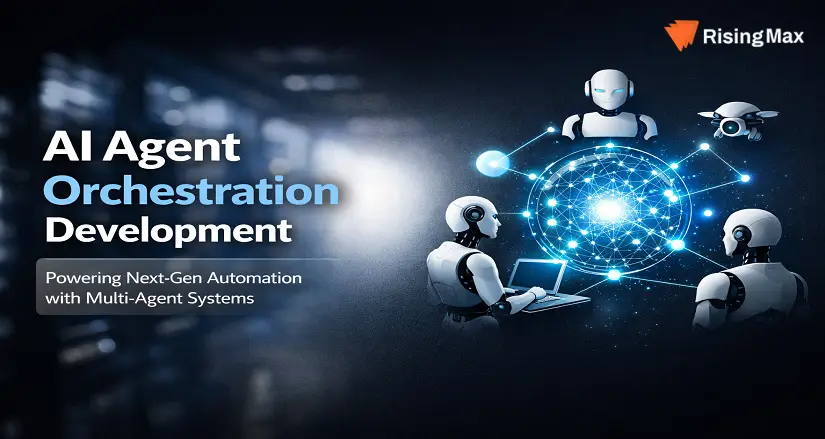
Artificial intelligence technology has grown significantly in the last few years, but the biggest change is happening now, where artificial intelligence is shifting from being isolated to being completely orchestrated intelligent systems. In the past, businesses used a single artificial intelligence model to perform a limited number of tasks, but it resulted in a fragmented system where tasks became bottlenecked. Today, businesses are moving to artificial intelligence agent orchestration development, where multiple artificial intelligence agents work together to perform a multi-step process.
This change is fueled by the growing necessity for automation that is not just intelligent but also adaptable and scalable. A multi-agent orchestration system provides an organization with the ability to distribute responsibilities among agents. This system consists of agents that are designed to perform a particular role, such as data processing, reasoning, execution, or monitoring.
In this ecosystem, agents are said to be operating within an adaptive agent network. This means that decisions are not static but are constantly changing through context, data, and real-time inputs. This enables businesses to move from automation to autonomy. The ability to orchestrate AI agents provides a competitive advantage to organizations. This enables organizations to streamline their operations and reduce inefficiencies in a constantly changing business environment.
Fundamentals of AI Agent Orchestration Development
Essentially, the development of AI agent orchestration is based on the idea of building systems that can integrate multiple AI agents in a coordinated and intelligent manner. The agents do not operate independently but are connected in a way that allows for a form of orchestration in a system.
The orchestration engine of the AI agents serves as the control system that ensures proper task allocation, efficient handling of task dependencies, and maximization of results. It constantly observes the system and evaluates its performance to make necessary adjustments to the workflow to enhance results. This coordination enables a set of individual agents to become a single system with a shared objective, hence enabling the handling of complex processes.
The key to the power of this approach is its modularity. Agents are independent entities, and their development, updation, and even replacement can be carried out separately without affecting the entire system. Thus, organizations can be more innovative and adapt to new requirements easily.
Core Components Driving AI Agent Orchestration Systems
A successful orchestration system is built on multiple interconnected components, each playing a critical role in ensuring efficiency, scalability, and reliability.
1. Communication Layer
The communication layer acts as the backbone for the entire orchestration system, facilitating communication between the agents in a well-structured manner. This enables the agents to communicate with each other effectively and thus prevents the misinterpretation of information exchanged between the agents.
This layer usually employs standardized messages, triggers, and synchronizers for effective communication between the agents. The absence of an effective communication layer would hinder the effective communication between the agents, even with the presence of the most sophisticated agents.
2. Task Management Engine
The task management engine is a key part of the workflow management system that handles the actual workflow by assigning tasks and managing the dependencies between tasks. The task management engine makes sure that the right task is delivered to the right agent at the right time.
One of the most powerful features of the task management engine is that it allows for the rerouting of tasks and the activation of fallback agents in the event of unexpected problems. For instance, the system can automatically reroute a task to another agent if the first agent is unable to complete the task.
3. Memory Architecture
Memory is an important component in facilitating intelligent behaviors in AI systems. Contemporary orchestration frameworks utilize AI agents with both short-term and long-term memory to improve decision-making capabilities.
Short-term memory is useful in providing context to an ongoing workflow, ensuring that tasks are performed consistently. Conversely, long-term memory is useful in storing data, allowing an AI system to learn and improve over time. This makes an AI system not only reactive but also adaptive and predictive.
4. Tool Integration Framework
For the AI agent to interact with external systems effectively, it needs the tool integration framework. This allows the AI agent with the tool to integrate with APIs, databases, CRMs, and many other systems within the enterprise.
This makes the AI agent not just a passive entity that only processes information but an active participant in the business process, making the tool integration framework a practical and useful tool for real-world applications.
5. Specialized Agent Design
With the increasing trend of domain-specific AI agents designed for a particular industry or domain, many organizations are shifting towards the use of such agents. These agents are trained with domain-specific data and provide more precise results for a particular domain.
For instance, a healthcare agent may be designed for patient data analysis, and a finance agent may be designed for risk assessment. These agents can be integrated into an orchestration system to provide precise business results.
Why Enterprises Are Rapidly Adopting AI Agent Orchestration Solutions
With the increasing complexity and data-intensive nature of business processes, traditional automation methodologies are no longer adequate. Organizations are now looking towards AI agent orchestration development to overcome such challenges and achieve higher levels of business efficiency.
One of the main reasons for this change is the ability to achieve rapid workflow generation. Rather than designing and implementing workflows manually, an organization can use an orchestration system to automate the creation of workflows. This reduces time-to-market significantly. This enables an organization to be more responsive to changing demands.
Another significant advantage is the improvement in the interoperability of AI agents. In most organizations, different systems tend to operate independently, which has made it difficult to achieve seamless integration between them. Orchestration, therefore, comes in to ensure effective communication and collaboration between AI agents.
Furthermore, it can help decrease the maintenance cost by introducing a modular architecture into the system. This allows the maintenance process to be more straightforward and flexible by not having to update the entire system, but rather updating or replacing an agent in the workflow.
Types of AI Agent Orchestration Models
AI orchestration systems can be designed using different models, depending on the level of control, scalability, and flexibility required.
Centralized vs Distributed Orchestration
| Aspect | Centralized Orchestration | Distributed Orchestration |
| Control | Managed by a single orchestration engine, offering clear visibility and governance | Decision-making is distributed across multiple agents for greater autonomy |
| Scalability | Can face limitations as system complexity grows | Highly scalable and suitable for large, dynamic environments |
| Flexibility | Moderate flexibility due to centralized control | High flexibility with adaptive decision-making |
| Risk | Higher risk due to a single point of failure | More resilient with decentralized operations |
| Use Case | Ideal for structured and predictable workflows | Best suited for complex, evolving systems |
Centralized orchestration offers simplicity and control, which is best used in well-defined processes, while distributed orchestration offers greater flexibility and high availability, which is best used in environments where conditions change frequently.
Advanced AI Agent Orchestration Patterns Driving the Future of Automation
As orchestration systems mature, new patterns are emerging that enhance their capabilities and expand their use cases.
- Hierarchical orchestration: In this model, a primary agent oversees the system and delegates tasks to subordinate agents. This structure provides clarity and control while enabling efficient task distribution.
- Event-driven orchestration: Agents respond to triggers or events in real time, allowing systems to adapt dynamically to changes. This pattern is particularly useful in scenarios requiring immediate action, such as fraud detection or system monitoring.
- Collaborative agent networks: Agents operate in a peer-to-peer structure, sharing information and working together to achieve common goals. This approach promotes flexibility and innovation within the system.
In addition to these established patterns, advanced concepts are gaining traction:
- Intentless orchestration, where systems proactively execute tasks based on context rather than explicit instructions
- Universal orchestration, enabling seamless integration across diverse platforms and tools
- LLM gateway orchestration, which optimizes access to multiple language models for improved efficiency and cost management
These innovations are shaping the future of AI, making orchestration systems more intelligent, autonomous, and versatile.
Key Capabilities of a Scalable AI Agent Orchestration Platform
A modern development strategy for an AI agent orchestration platform prioritizes flexibility, scalability, and user accessibility. One of the most disruptive aspects of a modern AI agent orchestration platform is its ability to build code-free AI agents. This enables non-technical users to take part in an organization’s automation projects.
Through the use of no-code + pro-code technologies, an organization can now enable both its non-technical users and developers. This helps speed up development, minimize skill requirements, and promote innovation.
Performance and Optimization Capabilities
To ensure consistent performance, orchestration platforms include advanced optimization features:
- Agent performance through agent tracing: Provides deep visibility into how agents operate, helping identify bottlenecks and inefficiencies.
- Dynamic load balancing: Ensures tasks are distributed evenly across agents, preventing overload and improving efficiency.
- Real-time optimization: Continuously adjusts workflows to optimize performance and reduce latency.
These capabilities ensure that orchestration systems remain efficient, reliable, and scalable even as they grow in complexity.
Core Architecture of a Multi-Agent AI Orchestration System
A well-structured architecture is considered to be the basis of any successful orchestration system, and this is what defines the efficiency of interactions between agents, data flows, and the overall robustness of a framework in real-world scenarios. A strong multi-agent orchestration system is one that is able to handle complexity while ensuring performance, scalability, and flexibility.
Multi-Tier Memory Architecture
Memory is not just an add-on; it is one of the key capabilities that determines the extent to which the system is intelligent and context-aware. A multi-tiered memory structure is required to enable the agents to hold, retrieve, and apply their knowledge at various stages.
- Short-term memory enables agents to maintain context during active workflows. This is essential for tasks that require continuity, such as conversations, multi-step reasoning, or sequential decision-making. Without short-term memory, agents would lose track of progress and produce inconsistent results.
- Long-term memory allows the system to store historical data, learned behaviors, and past interactions. This enables agents to improve over time, making decisions that are informed by previous outcomes rather than isolated inputs.
Technologies like vector search for RAG (Retrieval-Augmented Generation) are improvements to this architecture. This technology enables agents to retrieve relevant information instantaneously, which improves response quality as well as efficiency in making decisions.
Communication and Coordination Framework
The communication layer is responsible for making sure that all the agents are working in sync with each other, irrespective of their roles and positions within the system. It is the communication that enables the agents to become a cohesive and high-performing ecosystem.
This framework usually involves the use of a messaging system, event communication, and real-time synchronizing mechanisms. The management of communication between agents is essential for effective sharing and updating of information by the agents.
For large-scale systems, communication also needs to be optimized for performance. This means that latency needs to be reduced, message queues have to be handled effectively, and important messages have to be prioritized. An effective coordination framework not only boosts performance but also reliability and scalability.
Dynamic Task Management
Task management is the operational core of an orchestration system. It determines how workflows are executed, how tasks are assigned, and how the system adapts to changing conditions.
The orchestration engine continuously monitors tasks, evaluates progress, and adjusts workflows as needed. It has the ability to:
- Re-route tasks when an agent is unavailable or fails to complete their assignment
- Trigger fallback agents to ensure continuity and prevent disruptions
- Manage dependencies between tasks, ensuring that processes are executed in the correct sequence
This dynamic approach ensures that workflows remain flexible and resilient, even in complex and unpredictable environments. It also allows organizations to handle high volumes of tasks without compromising performance.
AI Engineering Tools and Platform Capabilities
The success of an orchestration system is heavily dependent on the tools and technology utilized to implement it. Modern AI engineering tools lay the groundwork for building efficient, scalable, and reliable orchestration platforms.
The tools available for this purpose include frameworks for building agents, APIs for integration, monitoring solutions for tracking performance, and testing solutions for validation, among others. This ensures developers have control over building sophisticated orchestration systems while ensuring scalability and performance.
Agent Platform Overview
Thus, a good agent platform provides a centralized environment for the entire lifecycle of AI agents. This includes the development, deployment, and optimization of the agents.
Moreover, a modern agent platform is built with modularity in mind, which allows organizations to add or modify agents without impacting the system as a whole. Also, these agent platforms provide integration with other enterprise tools, thereby ensuring smooth connectivity with other systems.
Finally, these agent platforms provide real-time visibility into the system’s performance, thereby enabling organizations to identify areas for improvement and hence optimize the system’s orchestration.
Security, Compliance, and Governance in AI Orchestration
As more autonomy and interconnectedness are built into AI systems, security and compliance are becoming more critical. This means that a robust system needs to be put in place to protect sensitive information, ensure compliance, and prevent unauthorized access.
AI Security, Compliance, and Governance are key components of any orchestration system. This ensures that agents are operating within a set scope, adhering to all organizational policies, as well as legal compliance.
Some of the key security components include encryption, access control, and monitoring. This helps to protect sensitive information from any potential breaches, ensuring a secure system.
Governance Best Practices
Effective governance goes beyond security; it ensures that AI systems operate ethically, transparently, and responsibly. This involves establishing clear guidelines and monitoring mechanisms to oversee agent behavior.
- Audit trails provide a record of all actions taken by agents, enabling accountability and traceability
- Explainability frameworks ensure that AI decisions can be understood and justified
- Continuous monitoring helps identify anomalies and prevent unintended outcomes
By implementing strong governance practices, organizations can build trust in their AI systems while minimizing risks and ensuring compliance with industry standards.
Step-by-Step Approach to Building an AI Agent Orchestration Platform
A structured approach needs to be developed to build an orchestration system, considering the complexity involved. A well-defined roadmap needs to be developed to build an efficient orchestration system.
Development Roadmap
- Define use cases and objectives: Start by identifying the specific problems you want to solve and the workflows you want to automate. Clear objectives provide direction and help prioritize development efforts.
- Design a scalable architecture: Plan the structure of your orchestration system, including agent roles, communication protocols, and memory architecture. This step is critical for ensuring long-term scalability.
- Select appropriate tools and models: Choose the right AI models, frameworks, and integration tools based on your requirements. This decision will significantly impact system performance and flexibility.
- Develop orchestration logic: Build workflows, define task dependencies, and establish communication protocols. This is where the core functionality of the system is implemented.
- Test and deploy: Conduct rigorous testing to identify and resolve issues before deployment. Once validated, deploy the system in phases to minimize risks and ensure smooth adoption.
Best Practices for Success
- Start with a minimum viable product (MVP) to validate your approach and gather feedback
- Use modular components to enable flexibility and easy updates
- Continuously monitor performance and refine workflows to improve efficiency
Following these best practices helps organizations reduce risks, accelerate development, and achieve better outcomes.
AI Agent Orchestration Development vs Strategic Consulting: Key Differences and Value
There are two ways to achieve orchestration: development or consulting. This depends on the needs of an organization.
When an organization decides to develop an AI agent orchestration platform, the main emphasis lies in creating a custom solution based on specific needs. This gives an organization complete control over the system, allowing it to implement highly specialized workflows.
At the same time, when an organization decides to use AI agent orchestration consulting services, they receive strategic advice. This helps an organization implement architectures, use specific tools, and even optimize existing systems. This option works best for organizations that are either new to orchestration or need to scale existing orchestration implementations.
Both approaches play a complementary role in ensuring successful adoption and long-term scalability.
Practical Use Cases of AI Agent Orchestration Across Industries
The orchestration of AI agents has already started to revolutionize various sectors by providing intelligent automation. This is because intelligent automation has been found to be extremely flexible.
In terms of customer care, an orchestration system helps multiple agents interact with customers. This improves the experience of customers. On the other hand, operational costs are reduced.
In terms of healthcare, an orchestration system helps in streamlining patient management, diagnostics, and treatment planning. This enables more informed decision-making by integrating data from multiple sources.
In terms of financial services, AI agents are used in various sectors such as fraud detection, risk analysis, and portfolio management. On the other hand, supply chain operations benefit from improved coordination, predictive analytics, and real-time insights.
Industry-Specific Impact
The ability to utilize domain-specific AI agents provides organizations the opportunity to tackle industry-specific challenges with precision. This is due to the fact that these agents are designed to work with industry-specific data and are optimized to achieve better results.
By combining these agents within an orchestration system, organizations can develop highly efficient and intelligent workflows.
Benefits of AI Agent Orchestration Development
The adoption of AI agent orchestration development services provides a wide range of benefits that go beyond traditional automation.
- Enhanced productivity: Automation of complex workflows reduces manual effort and increases efficiency
- Scalability: Modular architectures allow systems to grow without significant reengineering
- Cost reduction: Automation minimizes operational expenses and improves resource utilization
- Faster decision-making: Real-time insights enable quicker and more informed decisions
These benefits make orchestration a critical component of modern digital transformation strategies.
Key Challenges in AI Agent Orchestration Development and How to Overcome Them
Despite its advantages, AI orchestration comes with challenges that organizations must address to ensure success.
One of the major challenges is dealing with the complexity of multi-agent systems. As the number of agents increases, it is more difficult to manage them in a coordinated way, and hence better architecture and management tools are required.
Reliability and fault tolerance are another set of concerns. Systems have to be made in a way that failures do not impact the workflow. Another problem that might arise in the integration process is the integration of legacy systems.
Maintaining performance at scale is an ongoing challenge that requires continuous monitoring and optimization. However, with the right approach, these challenges can be effectively managed.
The Next Wave of AI Agent Orchestration: Innovations and Future Outlook
The future of orchestration is all about autonomy, intelligence, and accessibility. The future of orchestration systems is about building self-learning networks that can function independently in response to any changes in the environment without human intervention.
The emergence of universal orchestration frameworks will allow for easier integration across various platforms, while no-code AI development tools will become more accessible to non-technical people in the future.
As these trends continue to improve in the future, the power of orchestration systems will be enhanced to allow organizations to unlock new innovation and efficiency.
Accelerate Your AI Journey with RisingMax: Your Trusted AI Orchestration Partner
AI agent orchestration is becoming the foundation of next-generation enterprise automation systems. This is because it empowers organizations to transcend the boundaries of AI systems and develop connected systems that think, learn, and act.
The successful implementation of AI agent orchestration systems, however, requires more than the technical capabilities of AI systems; it requires expertise, strategic planning, and a deep understanding of AI system architectures. From developing scalable systems to ensuring effective integration and performance optimization, every step plays a vital role in the successful implementation of AI agent orchestration systems.
RisingMax, as a trusted technology partner, assists businesses in developing AI agent orchestration systems that are tailored to their specific requirements. Whether you are looking to develop AI agent orchestration systems to automate business workflows, enhance business efficiency, or create a future-ready AI system, RisingMax offers end-to-end solutions that deliver tangible business outcomes.
If you are looking to develop AI agent orchestration systems that are scalable, secure, and performance-driven, RisingMax can assist you in turning your vision into a reality sooner, smarter, and with greater impact.
FAQs
1. What is AI agent orchestration development?
AI agent orchestration development is the process of designing and managing systems that coordinate multiple AI agents to perform complex tasks collaboratively, ensuring seamless workflow execution and intelligent automation.
2. How does an AI agent orchestration system work?
It works through an orchestration engine that assigns tasks, manages communication between agents, and ensures proper execution using memory, tools, and decision-making logic.
3. What is a multi-agent orchestration system?
A multi-agent orchestration system is a framework where multiple AI agents work together, each handling specific tasks, while the orchestration layer coordinates their interactions and outputs.
4. Why is AI agent orchestration important for businesses?
It enables automation of complex workflows, improves efficiency, reduces manual effort, and allows businesses to scale operations with intelligent, adaptive systems.
5. What are the key features of an AI agent orchestration platform?
Key features include task routing, inter-agent communication, memory management, agent tracing, no-code and pro-code tools, and performance optimization capabilities.
6. What is the difference between AI orchestration and traditional automation?
Traditional automation follows predefined rules, while AI orchestration uses intelligent agents that can learn, adapt, and make decisions dynamically.
7. Can I build AI agent orchestration platforms without coding?
Yes, many modern platforms allow you to build and manage code-free AI agents using no-code or low-code tools, making it accessible to non-technical users.
8. What are AI agents with memory?
These are agents that can retain short-term context and long-term knowledge, enabling them to make more informed and consistent decisions over time.
7. How much does AI agent orchestration development cost?
The cost varies depending on complexity, features, number of agents, integrations, and whether you choose custom development or platform-based solutions.
8. Does RisingMax offer AI agent orchestration consulting services?
Yes, RisingMax provides expert consulting services to help businesses define strategies, design architectures, and optimize their orchestration systems for maximum efficiency.
9. How do you optimize performance in AI orchestration systems?
Performance can be optimized through agent tracing, load balancing, efficient communication protocols, and continuous monitoring and tuning.
10. Why choose RisingMax for AI agent orchestration development?
RisingMax offers end-to-end expertise in AI agent orchestration development, combining advanced architecture design, scalable systems, and industry-specific solutions to help businesses automate complex workflows efficiently.