Today’s Security Operations Centers face a paradox: more tools, more data, and more alerts than ever before, yet critical threats continue to slip through. Analysts are buried under thousands of daily notifications, most of which turn out to be noise. By the time a genuine threat surfaces, valuable response time has already been lost.
Traditional SOC models were built for a different era, one where networks had defined perimeters, attack surfaces were manageable, and a team of ten analysts could reasonably keep up with the threat volume. That world no longer exists. Today’s enterprise environments span cloud, on-premise, hybrid, edge, and mobile infrastructure simultaneously. The number of security events generated daily has grown into the millions. No human team, no matter how skilled, can keep pace.
This is where agentic security operations model development changes the equation. Instead of systems that simply alert, organizations are now deploying autonomous AI-driven agents that reason through threats, coordinate investigations, and execute responses independently. The shift from reactive monitoring to proactive, autonomous defense is no longer theoretical, it is being implemented across industries right now, and the gap between early adopters and those waiting on the sidelines is widening fast.
What Are Agentic Security Operations?
Before diving into architecture and implementation, it is worth defining what “agentic” actually means in the context of security operations.
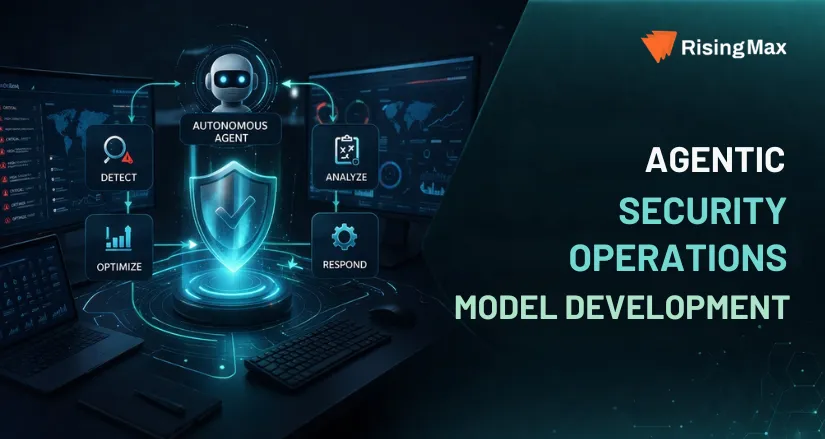
An agentic system is one in which AI models do not simply generate outputs in response to prompts, they plan multi-step tasks, use tools, make decisions, and take actions autonomously over extended periods. In the context of a SOC, this means an AI agent can receive a security alert, independently query threat intelligence feeds, correlate historical events, investigate affected endpoints, determine severity, draft a remediation plan, and with the right permissions execute containment actions, all without a human analyst directing each step.
This is fundamentally different from traditional security automation. Older SOAR (Security Orchestration, Automation and Response) platforms automate predefined playbooks. They are fast, but brittle if a threat does not match the playbook exactly, the automation either fails or escalates to a human. Agentic systems, by contrast, reason dynamically.
An autonomous SOC development company today builds these capabilities by layering multiple specialized AI agents under an orchestration framework creating a system where agents collaborate, delegate, and check each other’s work, much like a well-run human security team.
Why Traditional SOC Models Are Reaching Their Limits
To appreciate why the industry is moving toward agentic models, it helps to understand the specific failure modes of conventional SOC architecture.
- The average SOC receives tens of thousands of alerts per day, with false positive rates routinely above 40%. Analysts spend enormous time investigating events that turn out to be benign, which creates both burnout and blind spots.
- The global cybersecurity skills gap means most organizations cannot hire their way out of this. Entry-level analyst roles are increasingly difficult to fill, and experienced threat hunters command salaries that most mid-sized companies cannot sustain.
- Existing SOAR tools help, but they are fundamentally limited by the imagination of whoever wrote the playbook. Sophisticated threat actors specifically design their campaigns to break assumptions embedded in automation logic.
The solution is not more headcount or more tools, it is a fundamentally different operating model. This is why the autonomous multi-agent system development for security operations space has attracted serious investment and enterprise adoption over the past two years.
The Architecture of an Agentic SOC
Understanding what an agentic SOC looks like under the hood is essential for any organization evaluating this approach. At its core, the model involves three layers working together.
1. Specialized Agent Layer
Rather than one monolithic AI handling everything, an effective agentic SOC deploys purpose-built agents with specific roles:
- Triage Agent continuously ingests alerts from SIEM, EDR, and cloud security tools; scores them for severity; filters noise; and queues genuine threats for investigation.
- Investigation Agent takes a triaged alert and autonomously enriches it: querying threat intel, correlating with historical data, mapping to MITRE ATT&CK, pulling endpoint telemetry, and reconstructing the attack timeline.
- Threat Hunting Agent proactively searches for indicators of compromise across the environment based on emerging threat intelligence, even without an active alert.
- Response Agent drafts and, where authorized, executes containment actions: isolating endpoints, blocking IPs, revoking credentials, or quarantining files.
- Reporting Agent generates structured incident reports, compliance documentation, and post-mortem summaries automatically.
Each agent is fine-tuned for its domain. The triage agent is optimized for speed and recall. The investigation agent is optimized for reasoning depth and accuracy. The response agent is optimized for safe, auditable action execution.
2. Orchestration Layer
This is the brain of the agentic SOC orchestration system. This orchestrator controls how agents communicate with each other, which agent will be responsible for which task, how conflicts between agent conclusions are resolved, and when to escalate to a human analyst. An effectively designed multi-agent orchestration system will not only run agents in parallel, it will actually have agents collaborate with each other, share context, dispute each other’s findings, and create a shared understanding of the threat.
The orchestration layer also manages authorization boundaries. Not every action requires human approval, but some do. The orchestrator enforces these policies, ensuring that autonomous response never exceeds what the organization has explicitly authorized.
3. Human-in-the-Loop Interface
However, no matter how sophisticated the agentic SOC is, there is no replacement for human judgment in high-stakes decisions. The best agentic SOC implementations present a clear and easily readable display of what all the agents are doing, why they came to their decisions, and what they have done or are proposing to do. Analysts move from spending their day dealing with low-priority issues to only focusing on the issues that actually require human judgment.
This is the operational model that companies working with a specialized agentic development service are building toward not the replacement of human analysts, but the dramatic amplification of what each analyst can do.
Key Capabilities of a Production-Grade Agentic SOC Platform
When evaluating or building an agentic SOC platform development service, there are several capabilities that separate mature implementations from proof-of-concept deployments.
Real-time, continuous monitoring
The system must ingest and correlate data from endpoints, cloud workloads, network traffic, identity systems, email, and SaaS applications simultaneously. Siloed monitoring creates exactly the blind spots sophisticated attackers exploit.
Autonomous investigation with full audit trails
Every decision an agent makes must be logged with its reasoning, what data it looked at, what it concluded, and why. This is not just good practice; it is a compliance requirement in most regulated industries.
Dynamic playbook generation
Instead of relying on static, pre-written playbooks, advanced agentic systems can generate investigation and response plans dynamically based on the specific characteristics of the threat at hand. This is the capability that finally breaks the ceiling that traditional SOAR platforms hit.
Bi-directional tool integration
Agents must not only read from security tools but act through them by sending commands to EDR platforms, updating firewall rules, interacting with identity providers, and creating tickets in ITSM systems. A read-only agent can investigate but cannot respond.
Continuous learning and adaptation
The threat landscape evolves constantly. Production agentic SOC systems incorporate feedback loops learning from confirmed incidents, analyst corrections, and new threat intelligence so the system improves over time rather than degrading.
How Agentic SOC Development Differs from Traditional Security Automation?
Many security leaders encounter the term “agentic AI” and wonder how it is actually different from the automation they have already deployed. The distinction matters, and it is worth being precise.
Traditional security automation, whether in SOAR platforms, automated EDR responses, or rule-based SIEM correlation operates on if-then logic. Define a condition, define an action, execute when the condition is met. This works well for known, well-defined scenarios. It fails when threats behave in unexpected ways or when context matters.
Security operations model development using multiple AI-driven agents operates on a fundamentally different model. Agents reason about context. They evaluate competing hypotheses. They seek additional information when existing data is ambiguous. They communicate with other agents to build a richer picture. And they can propose novel response strategies for threat scenarios that no human analyst anticipated when writing the original automation rules.
A practical example: a traditional SOAR playbook might trigger on a specific malware signature and automatically isolate the affected endpoint. An agentic system, facing a zero-day exploit with no known signature, would observe anomalous behavioral patterns, correlate them with recent threat intelligence about a new attack campaign, map the behavior to relevant MITRE ATT&CK techniques, assess lateral movement risk, and propose a containment strategy all before a human analyst has even opened their laptop.
Building vs. Buying: What Organizations Need to Know
Organizations evaluating the agentic SOC space face a classic build-versus-buy decision, but with an important twist. Unlike most enterprise software solutions, this one involves rapidly evolving technology where the gap between leading implementations and lagging ones is widening quickly.
Building in-house gives organizations maximum control over data sovereignty, integration depth, and customization. But it requires rare expertise not just in cybersecurity, but in large language model engineering, multi-agent system design, and AI security. Most organizations do not have all three in abundance.
Buying from a platform vendor offers faster time-to-value but can create lock-in and may not accommodate the specific tool stack or compliance environment of every enterprise.
Partnering with a specialized development company offers a middle path working with a team that brings deep AI engineering expertise to build a custom agentic SOC architecture that integrates natively with existing infrastructure. This is the model that has gained the most traction among mid-to-large enterprises that want the control of a custom solution without the years it would take to assemble the engineering capability in-house.
Real-World Use Cases Driving Adoption
Financial services organizations are among the earliest and most aggressive adopters of agentic SOC architectures. The combination of regulatory pressure, high-value targets, and sophisticated threat actors creates an environment where the limitations of traditional SOC models are felt most acutely.
Healthcare providers are adopting agentic SOC models driven by the surge in ransomware targeting medical infrastructure and the severe consequences of system downtime. Autonomous investigation and containment particularly for lateral movement inside hospital networks has become a critical capability.
Technology companies with large cloud footprints are deploying agentic threat hunting agents that continuously look for misconfiguration exploitation, API abuse patterns, and supply chain compromise indicators across sprawling multi-cloud environments.
Government and defense contractors subject to FedRAMP and CMMC requirements are using agentic SOC platforms to maintain continuous compliance monitoring while simultaneously reducing the analyst headcount required to staff 24/7 operations.
Integration Considerations for Agentic SOC Deployment
Deploying an agentic SOC is not a greenfield project for most organizations. It must integrate with existing SIEM platforms, EDR solutions, ticketing systems, and identity providers. The integration architecture matters enormously, poorly integrated agents lack the context they need to reason effectively, and poorly integrated response capabilities create risk.
Key integration points typically include SIEM platforms for event ingestion, endpoint detection and response tools for telemetry and action execution, threat intelligence platforms for enrichment, identity and access management systems for credential-related response actions, cloud security posture management tools for cloud environment visibility, and ITSM platforms for incident documentation and workflow.
A thoughtfully designed agentic SOC orchestration service accounts for all these touchpoints from the start, rather than layering them on incrementally. The orchestration layer is also where data governance and access control policies are enforced ensuring that agents only access and act on data within their authorized scope.
Measuring Success: KPIs for Agentic SOC Performance
Organizations implementing agentic SOC models should track a specific set of metrics to evaluate performance and guide continuous improvement.
Mean Time to Detect (MTTD) measures how quickly the system identifies a genuine threat from the moment it begins. Mature agentic implementations consistently demonstrate MTTD reductions of 60 to 80 percent compared to analyst-led triage.
Mean Time to Respond (MTTR) measures the interval between detection and containment. Autonomous response capabilities can compress this from hours to minutes for well-defined threat categories.
False positive rate tracks how often the system flags benign activity as threatening. Reducing this metric directly improves analyst quality of life and reduces the risk of alert fatigue causing genuine threats to be overlooked.
Analyst escalation rate measures what percentage of events require human review. As the system matures and learns from feedback, this rate should decrease indicating that the agents are handling an increasing proportion of the threat volume autonomously.
Coverage breadth tracks how many of the organization’s attack surface areas are actively monitored by the agentic system. Gaps in coverage are gaps in protection.
The Road Ahead: Where Agentic SOC Is Going
The capabilities of agentic security operations systems are advancing rapidly, and the trajectory is clear. Within the next two to three years, several developments are likely to become mainstream.
Cross-organization threat sharing will allow agentic systems at different companies within the same industry vertical, for example to share anonymized threat intelligence in real time, creating a collective defense network that learns from every organization’s encounters simultaneously.
Predictive threat modeling will move agentic SOC systems from reactive and concurrent investigation toward anticipatory defense using historical attack patterns and threat actor behavioral models to identify likely attack vectors before they are exploited.
Deeper integration with DevSecOps will bring agentic security agents directly into software development pipelines, identifying and remediating vulnerabilities before they reach production rather than monitoring for exploitation after deployment.
Regulatory frameworks governing autonomous security systems will mature, giving compliance teams clearer guidance on how to document, audit, and validate the decisions made by agentic systems, a prerequisite for broader adoption in highly regulated industries.
For organizations that are serious about staying ahead of the threat landscape, the question is no longer whether to adopt agentic SOC architectures, but how quickly and how well.
Conclusion: The Autonomous SOC Is Not the Future It Is the Present
The transition from the traditional, analyst-driven SOC to an autonomous SOC powered by collaborating AI agents is already underway across every major industry. The organizations leading this transition are not doing so because it is a trend, they are doing so because the math of modern cybersecurity leaves them no other viable option. Alert volumes are too high, talent is too scarce, and threats are moving too fast for any purely human operation to keep up.
Agentic security operations model development offers a path to a fundamentally more capable, more resilient, and more efficient security operation one where human analysts focus on the highest-value work while autonomous agents handle the high-volume, time-critical tasks that have historically been the primary source of analyst burnout and missed detections.
Building that system well requires deep expertise in both AI engineering and security operations, the architecture of the multi-agent system, the design of the orchestration layer, the integration with existing security infrastructure, and the governance frameworks that keep autonomous action within authorized boundaries.
Why Choose RisingMax for Agentic SOC Model Development Service?
When it comes to building an autonomous, AI-powered Security Operations Center, the technology partner you choose defines the outcome. RisingMax brings together deep AI development expertise, proven multi-agent system architecture experience, and a practical understanding of enterprise security environments making it the right partner for organizations serious about building a SOC that actually works at scale.
- End-to-End Development: From architecture design to deployment and integration, RisingMax manages the full development lifecycle, giving you one accountable partner throughout.
- Custom-Built for Your Environment: No off-the-shelf solutions. Every agentic SOC system is built around your existing security stack, compliance needs, and specific threat landscape.
- Deep Multi-Agent AI Expertise: RisingMax brings proven experience building production-grade multi-agent AI systems applying battle-tested architecture patterns to every security operations engagement.
- Transparent & Auditable AI: Every agent decision is logged with full reasoning trails ensuring your autonomous SOC meets compliance requirements and remains fully explainable to stakeholders.
- Seamless Tool Integration: Native integration with your existing SIEM, EDR, cloud security, and ITSM platforms, no rip-and-replace, no disruption to current operations.
- Ongoing Support & Optimization: RisingMax doesn’t disappear after launch. Continuous monitoring, performance tuning, and system updates ensure your agentic SOC improves over time as threats evolve.
Frequently Asked Questions
Q1. What is Agentic Security Operations Model Development?
It is the process of building an autonomous SOC using multiple AI-driven agents that independently detect, investigate, and respond to cybersecurity threats without requiring human intervention at every step.
Q6. Does RisingMax build custom Agentic SOC platforms?
Yes, RisingMax develops fully custom agentic SOC systems tailored to your existing security infrastructure, compliance requirements, and threat environment from multi-agent architecture design to full deployment and integration.
Q2. How is an Agentic SOC different from a traditional SOAR platform?
SOAR platforms follow fixed, pre-written playbooks. An Agentic SOC reason dynamically it can handle novel threats, adapt to unusual environments, and generate response strategies that no static playbook could anticipate.
Q3. What are multi-agent orchestration platforms in security operations?
They are frameworks that coordinate multiple specialized AI agents triage, investigation, threat hunting, response ensuring they communicate, share context, and collaborate effectively rather than operating in isolation.
Q4. Is a fully autonomous SOC safe to deploy without human oversight?
No production-grade agentic SOC operates without human oversight. High-stakes decisions and edge cases always escalate to analysts. The goal is to free humans from repetitive triage work, not eliminate them from the process entirely.
Q5. How long does it take to build and deploy an Agentic SOC model?
Depending on infrastructure complexity and integration requirements, a production-ready agentic SOC typically takes three to six months to architect, build, and deploy with phased rollouts being the most common and risk-controlled approach.
Q7. Why choose RisingMax for Agentic Security Operations Model Development?
RisingMax combines deep expertise in multi-agent AI development and enterprise system integration to deliver production-ready autonomous security solutions built to scale, auditable by design, and aligned with your organization’s specific operational and compliance needs.