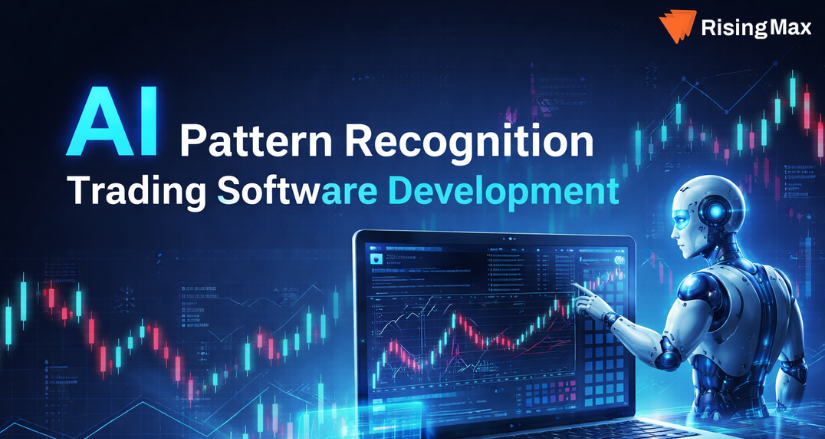
The financial trading market has seen a remarkable change in its structure due to the integration of artificial intelligence. The use of intelligent systems has been on the rise, as traders and financial institutions use these systems to analyze vast amounts of financial market information and identify patterns, which can be difficult to identify using conventional means. This has led to a rise in the requirement for AI Pattern Recognition Trading Software Development, as organizations look for ways to attain a competitive advantage in the market.
Market trends suggest a rapid increase in AI-based trading systems, driven by improvements in machine learning, big data, and cloud technology. According to market insights, algorithmic trading currently comprises a significant portion of global trade volume, and the use of AI-based pattern recognition is expected to increase in the coming years, especially in 2026. With the emergence of retail trading and the fintech revolution, companies are actively seeking ways to develop AI pattern recognition trading software.
Understanding AI Pattern Recognition Trading Software
AI Pattern Recognition Trading Software is a set of software applications that have the ability to recognize patterns, trends, and anomalies in existing and real-time stock markets. The patterns may include prices, candlestick patterns, volume, and technical indicators.
Unlike traditional software, AI uses learning and adapting abilities to new patterns in the stock markets. It uses machine learning to improve the quality of the predictions.
AI Pattern Recognition Trading is a term that focuses on the ability of computers to recognize patterns in the stock markets. The patterns are used to forecast the prices, identify trading opportunities, and minimize risks. Businesses often partner with an AI Development Company to develop the software with precision.
Data Collection and Processing for Trading Models
The backbone of any AI-based trading system is data. The ability to recognize patterns in data relies heavily on the quality and quantity of data being processed. The trading platforms process data from different sources, including stock exchanges, financial APIs, news platforms, and social media channels.
The data is then preprocessed to clean, normalize, and transform it into a more suitable format for analysis. This process is important in highlighting important details in the data.
The ability to process data in real-time is another important factor in AI systems. AI systems need to process data in real-time to provide important insights to traders. Therefore, efficient data handling is important to ensure that AI systems are responsive and provide accurate results in dynamic markets.
Designing AI Models for Market Pattern Detection
The development of AI models involves choosing the most appropriate algorithm and training them on historical data. Machine learning models such as regression, decision trees, support vector machines, etc., are often used to detect patterns.
The most effective models for analyzing time-series data are deep learning models such as CNNs and RNNs. These models are effective at detecting complex patterns that may be otherwise missed.
The training process involves feeding large amounts of data to the models to minimize prediction errors. Validation techniques such as backtesting are used to check the performance. Optimizations are performed to make the models adapt to market conditions.
Businesses seeking to create AI pattern recognition trading software often employ iterative development methodologies.
Related Blog – Stock Trading Application Development
Core Technologies Behind AI Pattern Recognition Trading Software
The development of AI trading software involves multiple advanced technologies working together. Below is a table outlining the key components:
| Technology | Description |
| Machine Learning (ML) | Enables systems to learn from historical data and improve predictions |
| Deep Learning | Uses neural networks to identify complex patterns in large datasets |
| Natural Language Processing (NLP) | Analyzes news, social media, and sentiment data |
| Big Data Analytics | Processes massive volumes of structured and unstructured data |
| Cloud Computing | Provides scalable infrastructure for real-time processing |
| APIs & Data Feeds | Integrates real-time market data from exchanges |
| Reinforcement Learning | Optimizes trading strategies through continuous feedback |
These technologies collectively support AI Pattern Recognition Trading Software Development, ensuring that systems are capable of handling dynamic and high-frequency trading environments.
Compliance and Regulatory Considerations in Trading Software
Developing AI-based trading software involves adhering to stringent regulatory norms. Financial markets are heavily regulated, and the primary reason is transparency, fairness, and security. Organizations have to follow guidelines set by regulatory bodies like the SEC, FINRA, and other international organizations.
Data privacy is a major issue, especially when dealing with sensitive financial information. The developers have to incorporate secure data storage and encryption techniques.
Furthermore, AI-based trading systems must be designed in a way that prevents manipulative practices. The use of AI has to be ethical. Transparency in AI decision-making is gaining more importance, especially in algorithmic trading.
Compliance not only involves adhering to regulations but also gaining the trust of users.
Challenges in Developing AI Trading Software
There are several complexities involved in the development of AI trading software. One of the complexities is the handling of a high volume of data in real-time. The accuracy and speed of the system are also crucial in AI trading software.
Another complexity in AI trading software is the training and optimization of the system. The financial market is volatile, and it is imperative that the system be able to adjust quickly in case of a change in the market. Overfitting and underfitting can also be a problem in AI trading software.
In AI trading software, it is also crucial to integrate several sources of data. The integration of several sources of data can be a complexity in AI trading software. The integration of several sources of data requires seamless communication between the integrated sources. The security of the system, as well as the chances of a data breach, is also a complexity in AI trading software.
Cost Estimation for AI Pattern Recognition Trading Software Development
The cost of developing AI trading software varies based on multiple factors such as complexity, features, and infrastructure requirements. Below is a cost breakdown:
| Component | Estimated Cost |
| AI Model Development | $20,000 – $30,000 |
| Data Integration & APIs | $10,000 – $30,000 |
| Frontend & UI/UX Design | $8,000 – $10,000 |
| Backend Development | $10,000 – $15,000 |
| Cloud Infrastructure | $5,000 – $7,000 |
| Testing & Deployment | $5,000 – $8,000 |
| Maintenance & Updates | Ongoing |
The total cost for AI Pattern Recognition Trading Software Development can range from $50,000 to $120,000 or more, depending on project requirements. Businesses often start with a minimum viable product to validate their concept before scaling.
Future Trends in AI Pattern Recognition for Trading
The future of AI trading software is shaped by ever-advancing technologies. One such trend in the future of AI trading software is the integration of advanced deep learning algorithms that can analyze multidimensional data more accurately.
Another trend in the future of AI trading software is the utilization of alternative data sources such as social media sentiment and global news. This would help in creating a complete picture.
Another such trend in the future of AI trading software is the automation process. This would involve AI handling end-to-end trading processes. This would also involve the utilization of explainable AI.
Another such trend in the future of AI trading software is the integration of blockchain. This would help in creating a more secure platform.
Thus, the future of AI Pattern Recognition for Trading would shape the future of financial markets.
Conclusion
AI-driven trading software is revolutionizing how financial markets operate by enabling faster, smarter, and more accurate decision-making. The integration of pattern recognition technologies allows businesses to uncover hidden insights and respond effectively to market changes. As demand for intelligent trading solutions grows, companies are increasingly investing in advanced development strategies to stay competitive.
Partnering with a reliable AI Development Company ensures that businesses can leverage cutting-edge technologies and build scalable, high-performance platforms. From data processing to model optimization, every aspect of development contributes to the success of the system.
In the coming years, the adoption of AI in trading is expected to expand further, driven by innovation and evolving market needs. Organizations that focus on building robust and adaptive systems will be well-positioned to capitalize on emerging opportunities in the financial sector.
FAQs
- How does reinforcement learning enhance AI trading strategies?
Reinforcement learning enables models to learn optimal trading actions through trial and error in simulated environments. It continuously improves strategy performance based on reward signals and market feedback. - What role do vectorized time-series models play in trading predictions?
They transform sequential market data into structured numerical formats for efficient pattern detection. This improves model accuracy in capturing trends, seasonality, and price dependencies. - How can latency impact AI pattern recognition trading systems?
High latency can delay trade execution and reduce the effectiveness of real-time predictions. Low-latency architecture ensures faster data processing and immediate decision-making. - Why is model explainability critical in AI-driven trading platforms?
Explainability helps traders understand how AI models generate predictions and signals.
It also ensures compliance with financial regulations and builds trust in automated systems. - How do ensemble learning techniques improve trading model performance?
Ensemble methods combine multiple models to reduce prediction errors and increase reliability.They enhance robustness by balancing the strengths and weaknesses of individual algorithms. - What is the significance of alternative data in AI trading systems?
Alternative data like news sentiment and social media provides additional market insights.
It helps models capture external factors influencing price movements beyond historical data.