
Ever thought that what if an ADHD diagnosis could be supported by measurable data and not just rely on observation and reported behavior? For many families, the assessment approach feels quite uncertain and sometimes inconsistent. Doctors use interviews, behavior checklists, school feedback and clinical evaluation to get to a conclusion and even with structured guidelines, results can differ between professionals.
Also, the CDC reports that about 11.4% of children in the US have been diagnosed with ADHD. This shows how common the condition is and why constant evaluation methods really matter now because an unclear diagnosis can impact a person’s progress, performance and everyday functioning.
This is where Artificial Intelligence enters the picture. AI system development for ADHD diagnosis can review speech transcripts, reaction times and behavioral signals to find any patterns associated with the condition. These systems do not replace clinicians, but they organize data, show measurable indicators and support evidence based decisions.
So, in this blog, we discuss how AI systems for ADHD diagnosis are developed, how validation is handled and much more.
What is ADHD (Attention-deficit/hyperactivity disorder)
ADHD is a neurodevelopmental condition that is defined by patterns of inattention, hyperactivity and impulsivity that impact the daily functioning of a person. The symptoms usually start developing from childhood and persist into adulthood and frequently affect performance or daily life. In ADHD, doctors follow medical guidelines before confirming a diagnosis.
Symptoms
Clinical diagnosis follows DSM-5 classifications. ADHD is categorized into three primary presentations based on dominant symptom patterns.
Core symptom domains:
- Inattention: Difficulty keeping focus, has difficulty in task organization and a habit of forgetting things
- Hyperactivity: Excessive movement, inability to remain seated and constant restlessness
- Impulsivity: Interrupting others, difficulty waiting and blurting out responses
In children, hyperactivity might be visible. In adults, inattention and executive dysfunction often become the dominant concerns.
Also Read: How Agentic AI in Clinical Workflow Can Solve $1 Trillion Coordination Burden
Evaluation Process
There is no particular laboratory test or imaging study that can identify ADHD. Diagnosis is based on behavioral assessment and clinical synthesis. Also, sometimes, people mistake this condition for anxiety or depression.
Standard evaluation components include:
- DSM-5 criteria review
- Clinical interview with patient
- Parent, teacher or partner rating scales
- Developmental and medical history review
- Functional impairment assessment across settings
- Screening for coexisting psychiatric or neurological conditions
For a diagnosis of ADHD, symptoms should have begun before the age of 12 and must cause real problems in at least two areas of life like at home, at school or at work.
How AI is Transforming ADHD Diagnosis
AI development is changing how ADHD assessments are done. Traditional diagnosis depends on interviews and behavioral observation. These methods are useful but can change every time based on who is reporting and who is evaluating.
AI systems add structured data analysis to this process. They do not replace doctors but help them by organizing large amounts of information and finding insightful patterns. Some research shows that machine learning models trained on brain data and behavioral signals have reached accuracy levels of 80% in distinguishing ADHD cases.
Machine Learning Enhances Diagnostic Accuracy
Machine learning works by analyzing large datasets and finding patterns that are constantly repeating in confirmed cases. In ADHD assessment, machine learning models can process:
- Cognitive test results
- Reaction times
- Behavioral rating scores
- Electronic health records
- EEG brain activity data
So, rather than reviewing symptoms one by one, the system evaluates all signals in one go. Also, research using EEG-based models has shown sensitivity levels reaching over 90% in some classification tasks.
As more clinical data is added, models continue to learn and improve. This decreases the chances of overlooking indicators or overemphasizing mild behaviors.
AI-Powered Behavioral Pattern Recognition
ADHD is defined more by repeated behavior patterns than isolated events. A short clinic visit may not fully reflect daily functioning.
AI systems can analyze behavioral signals at once like:
- Reaction speed during attention tasks
- Eye movement tracking
- Speech pauses and interruptions
Studies using video analysis and behavioral monitoring tools depict that AI integration can find subtle movement and attention patterns that are difficult to measure manually.
By combining these signals, the AI system finds trends over time. This helps clinicians know if the pattern aligns with ADHD or may be explained by another condition such as anxiety or sleep disturbance.
Predictive Analytics in Early ADHD Detection
AI models trained on ADHD cases that are confirmed can help detect early behavioral markers. These systems compare fresh patient data with large historical datasets.
This allows:
- Flag any initial warning signs
- Estimate risk probability
- Suggest structured evaluation
Also, multimodal AI systems that combine behavioral and neurological data have shown potential in early detection, especially in younger children.
Continuous Monitoring Through Intelligent Systems
ADHD symptoms change with time and in different environments. One evaluation may not show what the real difficulties might be.
AI-supported mobile apps and digital platforms can track:
- Focus duration
- Activity levels
- Medication response
- Behavioral consistency
This provides a clearer picture of symptom patterns and treatment response for clinicians, which is why AI medical diagnosis app development is quite important for today’s needs.
Also Read: AI Virtual Healthcare Assistant: Expanding Medical Sector Capabilities
How an AI-Based ADHD Assessment System Works
An AI-based ADHD diagnostic platform is built as a structured technical system. It includes data pipelines, processing engines, analytical models and secure deployment layers. Each component plays a specific role within the overall workflow.
Data Collection and Integration (Clinical Behavioral Cognitive)
The system begins with structured data intake. ADHD evaluation requires inputs from numerous environments. The platform should standardize and merge this information before doing any analysis.
Data streams include:
- Structured symptom checklists
- Cognitive task performance results
- Digital activity records from assessment apps
- Historical treatment and medication records
Raw inputs are transformed into machine readable formats, where data normalization guarantees consistency in different sources. Integration engines then combine these inputs into a unified dataset ready for model processing.
Natural Language Processing for Patient Interviews
Interview data is often unstructured. NLP modules convert these spoken or written responses into analyzable text features.
The system performs speech-to-text conversion if required, followed by text tokenization and semantic mapping. It extracts all the relevant clinical indicators like symptom level, references and functional impairment statements.
These structured text features are then passed into the analytical model.
Also Read: Decoding AI Voice Generator App Development Process for Better Efficiency
Computer Vision for Behavioral Observation
When video-based assessments are used, computer vision modules process recorded sessions for more clarity.
These modules can capture:
- Facial movement patterns
- Gaze tracking coordinates
- Micro-movement frequency
- Posture stability metrics
- Task interaction timing
Frame-by-frame processing converts movement into behavioral metrics. These metrics are stored as variables for model evaluation.
Machine Learning Models for Risk Assessment
The analytical core consists of trained classification or regression models. These may include decision trees, support vector machines or neural networks depending on system design.
Also, the model receives processed inputs from clinical cognitive language and behavioral modules. Then, it evaluates relationships between variables and generates a risk output.
The result is typically a probability score or categorical classification. The system may also include explainability layers that show which features influenced the output.
Cloud Infrastructure and Data Storage Architecture
All components operate within a secure infrastructure layer. Data is stored in encrypted databases with controlled access permissions.
Cloud development enables scalable computation, keeps backups and system monitoring. API layers allow integration with hospital record systems.
Step-By-Step AI Development Process for ADHD Diagnostic Systems
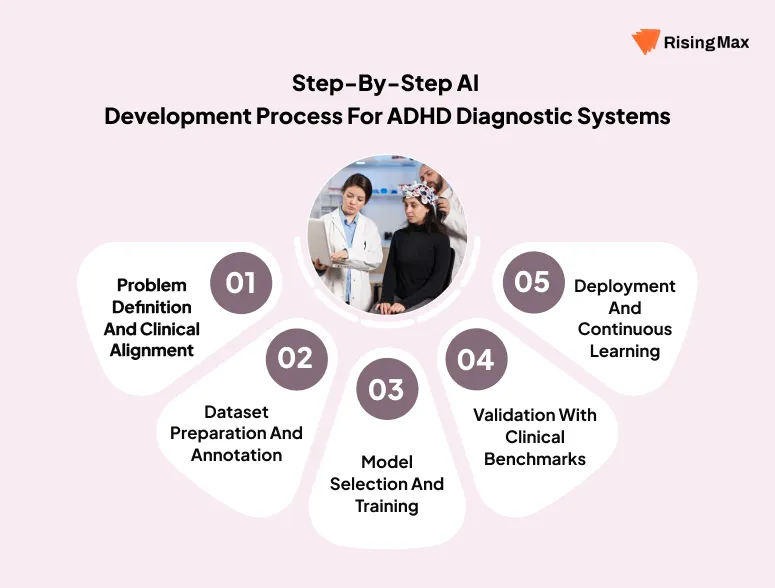
AI system development for ADHD diagnosis requires a step by step approach. Each phase should be balanced in terms of technical performance with clinical safety and compliance.
Problem Definition and Clinical Alignment
The process begins with a clearly defined objective. You should decide if the system will support early screening, subtype classification, or diagnostic assistance because undefined goals lead to unstable outputs.
Clinical alignment ensures the model reflects real diagnostic practice. This stage includes:
- Defining measurable indicators based on DSM criteria
- Identifying target users such as pediatric or adult clinics
- Setting acceptable error thresholds
- Establishing clinical use boundaries
Without clinician involvement at this stage, the system may perform technically well but fail in practical use.
Dataset Preparation and Annotation
High quality data determines model reliability. Raw clinical and behavioral data should be cleaned, standardized and formatted into structured inputs. Missing values and inconsistent records are corrected before training begins.
Each case should be properly labeled for better clarity. Balanced representation of ADHD and non ADHD cases is necessary to prevent prediction bias. Poor labeling at this stage directly affects model credibility.
Model Selection and Training
Then select a model and this choice should depend on the data type and system goal. Structured datasets may use classification algorithms, while signal or image based inputs may require neural networks.
Training includes:
- Splitting data into training and validation sets
- Optimizing model parameters
- Monitoring accuracy, recall and false positive rate
- Preventing overfitting through cross validation
Validation with Clinical Benchmarks
Before deployment, the AI model needs to be tested against datasets and compared with evaluation results. Validation aims on real world reliability and not laboratory performance.
Key validation checks include:
- Sensitivity and specificity balance
- False positives and false negatives impact
- Consistency across age groups
- Review by clinical experts
In some cases, formal clinical studies may be required before approval for medical use.
Deployment and Continuous Learning
In this stage, the AI system is deployed and requires integration with secure healthcare systems. The platform must comply with medical data protection laws and maintain full audit trails.
After launch, the system is monitored for performance issues. Updates are done through version tracking. Continuous improvement is possible, but changes should be documented and clinically validated before implementing.
To ensure regulatory readiness, organizations should collaborate with a top AI development company that knows healthcare standards and secure medical system deployment.
How AI Systems Connect with Hospitals and Clinics
An AI system for ADHD diagnosis must fit naturally into existing healthcare environments. It should work alongside current tools rather than creating extra steps for clinicians. Smooth integration helps with better adoption and practical use.
Electronic Health Record (EHR) Integration
The AI platform should connect directly with EHR systems so clinicians can access patient history and assessments in one place. Risk scores and diagnostic insights can be saved within the patient’s medical record. This decreases duplicate work and centralizes documentation.
Telehealth and Remote Assessment Capabilities
AI systems can be incorporated with telehealth platforms to support remote consultations. Online questionnaires and interview data can be processed during virtual sessions. This expands access to ADHD assessments for patients who cannot visit clinics.
API Development for Interoperability
APIs allow the AI system to communicate with hospital software and digital health platforms. Using standards such as HL7 and FHIR ensures structured and secure data exchange across systems.
Regulatory and Compliance Framework for AI-Based ADHD Diagnostic Systems
AI systems used in ADHD diagnosis work under medical regulation. When a platform impacts clinical decisions, it may qualify as Software as a Medical Device.
FDA and Medical Device Regulations
In the United States, the FDA regulates medical software that supports diagnosis. If the AI system provides risk scores, it may need a premarket submission.
AI developers should define the clinical purpose, target population and decision impact. The approval pathway varies based on system risk classification.
Data Protection Laws (HIPAA, GDPR)
ADHD diagnostic platforms process protected health information. In the US HIPAA regulation requires storage and encrypted data transmission.
In the European Union, GDPR mandates lawful data processing and data retention policies and it is mandatory to comply with these.
Clinical Trials and Validation Requirements
Before clinical adoption, the system should undergo validation. This may include retrospective testing on labeled datasets and prospective evaluation in live clinical settings.
Performance should be measured using error rate analysis and validation should show results that are consistent in all age groups and demographic segments. Clinical review panels often assess outcome reliability before approval.
Risk Management and Documentation
Regulators require complete technical documentation. This includes system architecture, training data sources, labeling process, validation metrics and update controls.
Risk management frameworks identify potential failure points such as false predictions or system downtime. Each risk must have a defined mitigation strategy.
Version control logs and change management records are essential for maintaining compliance and clinical accountability.
Cost of Developing an AI ADHD Diagnosis System
The development cost depends on system depth features and compliance level. A basic screening tool costs much less than a regulated hospital grade platform.
Estimated Cost by Complexity
| System Type | Estimated Cost |
| Basic screening app | $8,000 – $12,000 |
| ML-based diagnostic support | $12,000 – $20,000 |
| Multimodal system with NLP and behavioral tracking | $20,000 – $28,000 |
| Advanced multimodal clinical platform | $28,000 – $35,000 |
These ranges vary based on region, team structure and validation needs.
Key Cost Factors
Main factors that influence total AI development cost for ADHD diagnosis include:
- Feature scope and workflow depth
- Type of AI models used
- Data collection and labeling effort
- NLP or video analysis integration
- EHR and API connectivity
- Cloud setup and security layer
- HIPAA or GDPR compliance needs
- UI design and clinician dashboard
- Testing and validation cycles
- Ongoing maintenance and updates
Future Trends for AI-Driven ADHD Diagnosis System
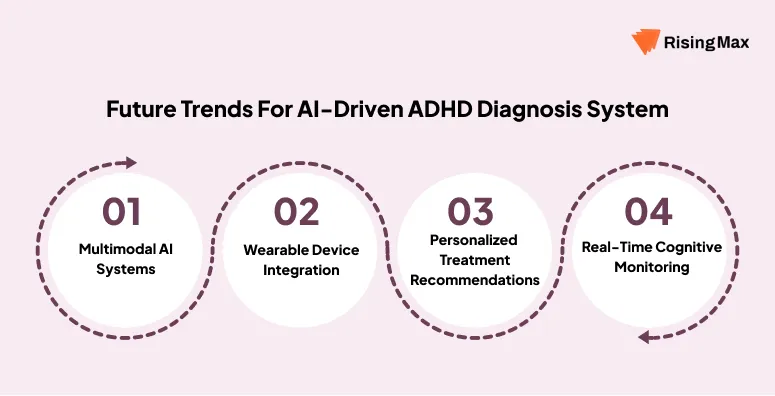
AI in ADHD care is still evolving. The next phase will focus on combining more data sources, improving tracking and supporting personalized care plans. The goal is not automation but smarter clinical support.
Multimodal AI Systems
Future systems will combine different types of data into one unified model. Instead of analyzing only test scores or only behavior logs the system will process everything together.
For example, a platform may combine interview transcripts and digital activity data to generate a risk profile. When multiple signals point in the same direction, the assessment becomes more stable.
Wearable Device Integration
Wearable device integration is anticipated to play a bigger role in ADHD monitoring. These devices can track movement, daily activity and sleep levels.
For example, a smartwatch can record restlessness patterns during school hours. This data can help clinicians know if symptoms are present for a long time or linked to lifestyle factors.
Personalized Treatment Recommendations
AI systems may move beyond diagnosis and support treatment planning. By analyzing previous patient outcomes, the system can identify which interventions worked best for similar cases.
For example, if patients with the same symptom pattern responded well to behavioral therapy before medication, the AI system can recommend that pathway for clinical review. The final decision remains with the doctor but the recommendation is data informed.
Real-Time Cognitive Monitoring
Future platforms may allow constant tracking of task performance through mobile apps. Short digital tasks can measure focus and response control regularly.
For example, a child may complete a two minute attention task each day through an app. The system tracks changes over time and alerts the clinician if performance drops significantly. This allows early adjustment of treatment plans instead of waiting for the next clinic visit.
Conclusion
In conclusion, ADHD diagnosis relies on clinical expertise but can change due to subjective interpretation and observation time. AI development brings structured analysis into this process and supports more consistent and measurable evaluations.
From model training and validation to healthcare integration and compliance, AI systems are built to assist, not replace clinicians. They organize complex clinical inputs into clear risk insights and support evidence based decisions.
To build a secure and regulation ready solution, it is important to partner with an experienced AI development company that knows healthcare standards and clinical validation requirements. With the right approach, AI can make ADHD assessment more reliable, accessible and structured across modern healthcare systems.
FAQs
Q1. How can AI help in ADHD diagnosis?
Ans. AI helps by analyzing structured data such as cognitive test results, behavioral patterns and interview responses. It identifies measurable trends that support clinicians in making more consistent decisions.
Q2. Can AI replace doctors in diagnosing ADHD?
Ans. No. AI is designed to assist clinicians, not replace them. The final diagnosis always remains a medical decision made by a qualified professional.
Q3. What type of data is required to build an AI ADHD diagnostic system?
Ans. Common data to build an AI-based ADHD diagnostic system includes:
- Clinical assessments
- Cognitive test scores
- Structured interviews
- Behavioral logs
- Medical history
Q4. How accurate are AI models for ADHD detection?
Ans. Research models have reported accuracy levels above 80 percent in controlled environments. However, real world performance depends on data quality validation and clinical oversight.
Q5. Is an AI-based ADHD diagnosis approved by regulatory authorities?
Ans. If the system influences medical decisions, it may require approval under medical device regulations such as FDA guidelines. Regulatory classification depends on system function and risk level.
Q6. How does AI reduce diagnostic errors?
Ans. AI reviews all structured inputs together instead of relying on isolated symptoms. This reduces inconsistency and supports balanced evaluation of evidence.
Q7. What is the cost of developing an AI ADHD diagnosis system?
Ans. Development costs typically range from $8,000 to $35,000, depending on complexity features, integration needs and compliance requirements.
Q8. How long does it take to develop an AI ADHD diagnostic platform?
Ans. A basic system may take 2 to 4 months, while advanced multimodal platforms with compliance validation may require 6 months or more.
Q9. Is patient data secure in AI-based systems?
Ans. Yes, if built correctly. The platform must follow regulations such as HIPAA or GDPR and include encryption, access control and audit logging.
Q10. Can AI systems integrate with hospital software?
Ans. Yes. Through APIs and standards like HL7 or FHIR, AI platforms can integrate with Electronic Health Record systems and telehealth tools.
Q11. What is multimodal AI in ADHD diagnosis?
Ans. Multimodal AI combines different types of data such as cognitive tests, interview transcripts and behavioral tracking, into one unified model for better assessment.
Q12. Can AI detect ADHD in adults as well as children?
Ans. Yes. AI systems can be trained on both pediatric and adult datasets. However, model training must reflect age-specific symptom patterns.
Q13. What are the main challenges in AI-based ADHD diagnosis?
Ans. Key challenges include data quality, regulatory compliance, bias mitigation, clinical validation and ensuring explainable outputs.
Q14. Why should I partner with an AI development company for this project?
Ans. You should partner with an experienced AI development company because they understand healthcare compliance, model validation, secure infrastructure, and system integration. This ensures that the platform is technically strong, clinically aligned, and ready for regulation.