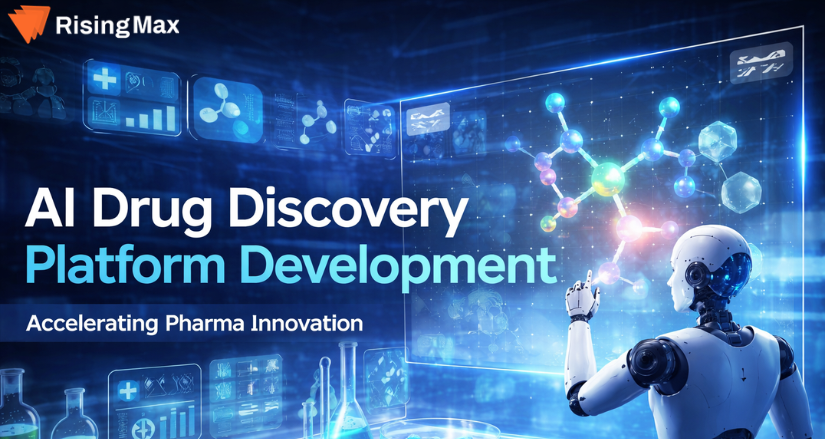
The pharmaceutical industry is witnessing a significant change with the integration of artificial intelligence technology into drug discovery processes. The conventional drug development process is considered to be lengthy and costly, taking more than a decade and billions of dollars to develop a single drug. This has created a strong need for AI Drug Discovery Platform Development services that can enable quicker decision-making processes for the development of drugs.
The market trends related to artificial intelligence in the pharmaceutical industry show that there is a rapid growth of investments in AI technology for drug development processes. Organizations are looking to develop drug discovery platforms using artificial intelligence technology to enable quicker decision-making processes for the development of drugs. They are looking to associate with a reliable AI Development Company to design drug discovery platforms that can enable quicker decision-making processes for the development of drugs.
How AI Platforms Are Transforming Drug Discovery Processes
The drug discovery process is being revolutionized by AI platforms that are automating and optimizing complex drug discovery processes. They are able to analyze large data sets, including genomic data, chemical structures, and clinical data, to uncover hidden patterns and insights.
The most important changes are in target identification. AI systems are able to analyze biological data to identify potential drug targets in a matter of seconds. Similarly, virtual screening technology helps to test thousands of compounds in a matter of seconds compared to traditional methods.
AI systems are also improving molecular designs by identifying potential interactions with different compounds. This reduces the need to conduct extensive laboratory testing and speeds up the process. In addition, predictive analytics helps to identify potential side effects early in the process, minimizing potential risks in later stages.
The integration of automation technology into drug discovery is further improving the process by minimizing human intervention and improving accuracy.
Core Technologies Behind AI Drug Discovery Platforms
The foundation of AI-driven drug discovery lies in a combination of advanced technologies:
| Technology | Description |
| Machine Learning (ML) | Identifies patterns in large datasets to predict drug behavior |
| Deep Learning | Uses neural networks for complex molecular analysis |
| Natural Language Processing (NLP) | Extracts insights from research papers and clinical data |
| Computer Vision | Analyzes biological images and molecular structures |
| Big Data Analytics | Processes vast amounts of biomedical data |
| Cloud Computing | Provides scalable infrastructure for simulations |
| Quantum Computing (Emerging) | Enhances molecular simulations and optimization |
These technologies work together to enable efficient AI Drug Discovery Platform Development, allowing researchers to explore new possibilities in drug design and testing.
Data Utilization and Predictive Modeling in Drug Development
Data plays a critical role in AI-powered drug discovery. Platforms rely on diverse datasets to train models and generate accurate predictions:
| Data Type | Application |
| Genomic Data | Identifies genetic targets for drug development |
| Proteomic Data | Analyzes protein interactions and functions |
| Chemical Data | Evaluates molecular structures and properties |
| Clinical Trial Data | Evaluates molecular structures and properties |
| Real-World Data | Provides insights from patient records and treatments |
Predictive modeling uses these datasets to simulate drug behavior and optimize compounds. Machine learning models can forecast how a drug will interact with the human body, reducing uncertainty and improving success rates.
Advanced analytics also enable personalized medicine by tailoring treatments based on individual patient data. This approach enhances the effectiveness of therapies and opens new avenues for innovation.
Integration of AI Platforms with Clinical Research and Trials
Platforms incorporating AI are being integrated into the research and trial processes in the clinical field. This allows for better patient selection, research design, and outcome predictions.
Using AI algorithms, patient data is analyzed to select suitable candidates for clinical trials, thus ensuring higher chances of successful trials. AI algorithms are also used to monitor patient responses in real-time, thus allowing researchers to make changes to the trials.
Another important aspect is the optimization of trials with the help of AI. Analyzing past data, AI platforms are able to predict problems and suggest ways to solve them.
Pharma companies working in association with an experienced AI Development Company ensures the seamless integration of AI platforms with existing research processes, thus ensuring a streamlined workflow.
Challenges in AI-Based Drug Discovery Platform Development
Despite its potential, several complexities are involved in developing AI-based drug discovery platforms. First, data quality and availability are important considerations. Incomplete data can affect predictions and model accuracy.
Secondly, the intricacies involved in human biology are another challenge in developing AI-based drug discovery platforms. The intricacies involved in human biology are so complex that it is difficult to accurately model all variables.
Lastly, regulatory compliance is another challenge in developing AI-based drug discovery platforms. AI-based drug discovery platforms are required to comply with several rules and regulations to ensure reliability and accuracy. These rules and regulations can prove to be time-consuming to comply with. In addition to these challenges, another challenge involves integrating legacy systems with AI-based drug discovery platforms.
Cost Estimation for AI Drug Discovery Platform Development
The cost of developing an AI drug discovery platform varies based on complexity, data requirements, and integration needs:
| Component | Estimated Cost |
| Data Collection & Processing | $10,000 – $15,000 |
| AI Model Development | $15,000 – $20,000 |
| Platform Development | $20,000 – $25,000 |
| UI/UX Design | $5,000 – $8,000 |
| Cloud Infrastructure | $10,000 – $20,000 |
| API Integration | $10,000 – $15,000 |
| Testing & Deployment | $5,000 – $10,000 |
| Maintenance & Updates | Ongoing |
Future Trends in AI-Driven Drug Discovery and Pharma Innovation
The future of AI in drug discovery will continue to depend on technological advancements. A major trend in the future of AI will be the use of generative AI, which will aid in the design of new drug compounds.
Another trend that will become more prominent in the future of AI will be the integration of quantum computing, which will improve the accuracy of molecular simulation. This technology has the potential of revolutionizing drug discovery since it will help solve complex problems.
Another trend that will become prominent in the future of AI will be the adoption of digital twins, which will improve the accuracy of treatment planning. Another trend that will become prominent will be the use of explainable AI.
Going forward, the future of AI will depend on the collaboration between pharmaceutical companies and an experienced AI Development Company.
Conclusion
AI is revolutionizing the pharmaceutical industry by introducing new and improved drug discovery processes. AI is making the drug discovery process faster and more efficient. The use of AI Drug Discovery Platform Development is no longer a choice, but a necessity, to enable organizations to stay ahead in this competitive and ever-changing environment.
To develop AI Drug Discovery Platform Development, organizations have to focus on innovation and scalability to leverage the true potential of AI in drug discovery.
As technology is progressing, the scope of AI in the pharmaceutical industry is growing, which is likely to introduce new avenues in the field of personalized medicine, helping to deliver better results. Working with a trusted AI Development Company is the key to helping organizations succeed in this complex environment.
FAQs
- How do generative AI models contribute to drug discovery?
Generative AI designs novel molecular structures based on desired properties.
It accelerates compound discovery by reducing reliance on traditional experimentation. - What is the role of knowledge graphs in AI drug discovery?
Knowledge graphs connect biomedical data to reveal hidden relationships.
They enhance target identification and improve decision-making accuracy. - How does federated learning support drug discovery platforms?
Federated learning enables model training without sharing sensitive data.
It ensures data privacy while improving model performance across datasets. - Why is explainable AI important in pharma applications?
Explainable AI provides transparency in model predictions and decisions.
It helps meet regulatory requirements and builds trust in AI systems. - How do AI platforms optimize clinical trial design?
AI analyzes historical data to predict outcomes and patient responses.
It improves trial efficiency by reducing risks and delays. - What impact does real-world data have on AI drug discovery?
Real-world data provides insights from actual patient experiences.
It enhances model accuracy and supports more effective drug development.