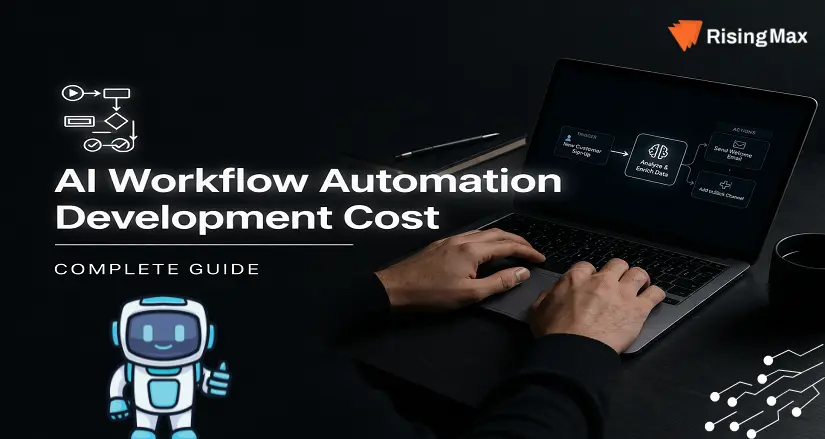
AI workflow automation is a strategic investment that helps businesses reduce operational costs and scale efficiently. Instead of manual processes, companies allocate budgets toward intelligent systems that automate workflows and improve productivity.
The cost of AI workflow automation development varies based on multiple factors, making it essential to understand key cost drivers before starting:
- Scope & Complexity: More workflows and dependencies increase costs
- AI Capability Level: Pre-built models cost less than custom or multi-agent systems
- Data Needs: Collection, processing, and storage impact pricing
- Infrastructure: Cloud computing and hosting add ongoing expenses
- System Integration: Connecting with existing tools raises development effort
- Maintenance: Continuous updates and optimization require long-term investment
Overall, AI workflow automation is not just an upfront expense but a long-term investment aimed at improving efficiency and maximizing ROI.
What is AI Workflow Automation Development?
AI workflow automation development refers to building intelligent systems that execute workflows with minimal human input, but from a cost perspective, it represents how businesses invest in smarter process execution rather than traditional automation tools.
Unlike rule-based systems, AI-driven workflows require budget allocation for decision-making capabilities, which directly impacts overall development pricing. The inclusion of autonomous agents, data-driven logic, and adaptive learning increases both the initial investment and long-term value.
Key cost-related elements involved in AI workflow automation development include:
- AI Agent Development: Creating autonomous agents (for tasks like query handling or data processing) adds to development costs depending on their capabilities and scale.
- Customization Level: Tailored agents for use cases such as fraud detection or compliance increase expenses compared to generic solutions.
- System Collaboration Architecture: Building interconnected workflows that communicate across multiple systems requires a higher development effort and cost.
- Low-Code / No-Code Platforms: Using platforms with drag-and-drop features can reduce development time and overall budget compared to full custom builds.
- Learning & Improvement Mechanisms: Systems designed to learn and evolve over time involve additional investment in model tuning and performance enhancement.
In essence, AI workflow automation development is not just about creating intelligent workflows; it is about strategically investing in systems that balance development cost with long-term operational efficiency.
AI Workflow Automation Development Cost Overview
AI workflow automation development cost is best understood as a tiered investment model, where pricing increases with system capability, scalability, and intelligence level. Rather than a fixed budget, businesses should evaluate cost across different solution tiers based on their operational needs.
Cost Tiers Breakdown
| Tier | Estimated Cost | Best Fit For | Key Inclusions |
| Basic Automation | $15,000 – $20,000 | Startups / small businesses | API-based workflows, limited automation logic and minimal integrations |
| Mid-Level Systems | $20,000 – $30,000 | Growing businesses | Multi-step workflows, system integrations and early-stage AI capabilities |
| Enterprise Solutions | $30,000 – $40,000+ | Large enterprises | Advanced AI agents, real-time processing, predictive models and high scalability |
Additional Cost Considerations
- Development Approach: Custom-built solutions require higher upfront investment but offer long-term flexibility and ownership.
- Team Location & Expertise: Costs vary significantly based on developer region and specialization level, directly affecting the total budget.
- Project Timeline: Longer development cycles increase resource utilization and overall expenditure.
AI Development Cost Estimation: Pricing Structure Explained
Pricing structure is essential for accurate cost estimation. Understanding different pricing models helps businesses plan budgets, control expenses, and align development with project goals.
Fixed pricing model (predictable but rigid)
- Best for projects with clearly defined scopes and timelines
- Offers budget certainty and reduced financial risk
- Any scope changes that are less flexible can lead to additional costs and delays
Hourly pricing model (flexible but variable cost)
- Suitable for evolving or research-driven AI projects
- Allows changes in requirements during development
- Requires strong project management to avoid cost overruns
Dedicated team model (strategic and scalable)
- Involves a full team of developers, AI engineers, and project managers
- Ideal for long-term and complex AI workflow automation projects
- Ensures better collaboration, continuity, and deeper product understanding
SaaS vs Custom Development (cost vs control trade-off)
SaaS solutions:
- Lower upfront cost and faster deployment
- Subscription-based pricing with limited customization
Custom development:
- Higher initial investment
- Full control over features, scalability, and data ownership
Infrastructure costs (ongoing and scalable)
- Includes cloud services, data storage, and computing resources
- Platforms like AWS, Azure, and Google Cloud charge based on usage
- Costs increase as data volume and system usage grow
Pre-trained models vs custom AI models (speed vs accuracy)
Pre-trained models:
- Faster implementation and lower cost
- Suitable for common use cases
Custom AI models:
- Higher development cost and time investment
- Better accuracy and alignment with specific business needs
Key Factors & Feature-Based Cost Breakdown of AI Workflow Automation Systems
Understanding AI workflow automation cost depends on how features influence development effort, scalability, and overall investment. Each component adds a measurable impact on the total budget.
Workflow Complexity & Core Features
The structure of workflows defines the base cost. Simpler flows are affordable, while multi-layered logic increases expenses. This layer contributes 20–30% of the total cost.
- Linear vs multi-step workflows
- Conditional logic and branching
- Parallel task execution
- Trigger-action configurations
AI Capabilities & Intelligent Features
The level of intelligence directly affects pricing. Advanced AI requires higher development and computing resources, contributing 40–60% of the total cost.
- Rule-based vs machine learning models
- NLP and predictive capabilities
- Autonomous agent functionality
- Custom AI model development
Data Processing & Automated Extraction
Data handling introduces costs related to accuracy, processing, and scalability. This segment accounts for 15–25% of the total cost.
- Structured and unstructured data handling
- Data cleaning and transformation
- OCR and document extraction
- Real-time data processing
UI/UX & Workflow Builder Features
User interface investments improve usability but increase development cost. This layer contributes 15–25% of the total budget.
- Drag-and-drop workflow builders
- Dashboard and visualization design
- Accessibility and responsiveness
- Low-code/no-code functionality
Integration & Extensibility
System connectivity and future scalability add to implementation costs, typically 10–20% of total investment.
- Third-party system integrations
- API development and management
- Custom connectors
- Scalability for future expansion
Collaboration, Reporting & Insights
Operational visibility and teamwork features require backend support, contributing 10–15% of cost.
- Workflow collaboration tools
- Version control systems
- Performance tracking
- Analytics and reporting dashboards
Infrastructure, Security & Compliance
Ongoing operational costs are driven by infrastructure and protection measures, ranging 15–30% of the total budget.
- Cloud hosting and storage
- Computing resources (CPU/GPU)
- Data encryption and access control
- Compliance with industry standards
Final Insight
The cost of developing an AI workflow automation system depends on strategic feature selection. Starting with essential components and scaling gradually ensures controlled spending while maintaining long-term value.
AI Workflow Automation Cost Across Industries
AI automation costs differ by industry due to regulatory demands, system complexity, data sensitivity, scalability expectations, and required performance standards.
- Financial Services: Costs are higher due to compliance-heavy development, advanced security layers, fraud detection accuracy requirements, and complex integration with legacy banking infrastructure.
- Public Sector: Pricing is influenced by large-scale deployment needs, budget limitations, high user volumes, and the requirement for reliable, scalable, and secure public-facing systems.
- Life Sciences: Development costs increase with strict regulatory compliance, sensitive data handling, high-precision requirements, and infrastructure needed for processing large-scale clinical and research datasets.
- Professional Services: Costs are driven by the need for tailored workflows, custom integrations, and flexible automation systems designed to match specific operational and client management requirements.
- Retail: Investment depends on real-time data processing, omnichannel integration, inventory synchronization, and scalable systems to support fluctuating demand and customer experience optimization.
- Media and Entertainment: Costs rise with real-time content processing, recommendation engine development, high data throughput, and infrastructure required for seamless content delivery and workflow efficiency.
Cost Comparison: Custom Development vs No-Code/Low-Code Platforms
| Aspect | Custom Development | No-Code / Low-Code Platforms |
| Development Cost | High upfront investment | Lower initial cost |
| Time to Build | Longer development time | Faster deployment |
| Ease of Use | Requires technical expertise | User-friendly, minimal coding required |
| Customization | Fully customizable to business needs | Limited customization options |
| Scalability | Highly scalable for complex workflows | May face limitations as business grows |
| AI Capabilities | Advanced, can build custom AI agents | Pre-built AI features with limited flexibility |
| Integration | Seamless integration with any system | Limited to supported integrations |
| Vendor Dependency | No vendor lock-in | Risk of vendor lock-in |
| Best For | Enterprises with complex requirements | Startups, SMBs, and rapid prototyping |
| Long-Term Value | High ROI over time | Cost-effective for short-term or simple use cases |
Hidden Costs in AI Workflow Automation Development
One of the main mistakes companies make is not understanding the hidden costs involved in AI workflow automation. These costs may not be apparent at the initial planning stage, but they can be crucial in the final budget.
Maintenance and updating costs will always be there. AI technology needs updating from time to time in order to perform at its best, as well as being compatible with new technology.
Retraining and monitoring the AI model is also a crucial hidden cost. With the changing nature of the data, AI needs to be retrained in order to perform at its best. This means investing in data processing.
API licensing costs, as well as usage fees, have a way of adding up rather quickly, especially if a system utilizes a lot of third-party APIs.
Infrastructure scaling is another hidden cost of a system. This means that as the system increases, more will have to be added to keep up with the data, as well as the number of users.
Failure to consider these hidden costs means that there will be a high likelihood of going over budget, which is why they must be considered during the initial cost estimation.
How to Optimize AI Workflow Automation Development Cost (Without Compromising Quality)
Controlling AI workflow automation expenses requires a structured approach that ensures efficient budget utilization while maintaining system effectiveness. The focus should be on making precise decisions early to prevent unnecessary spending later.
1. Start with a Focused MVP Approach
Launching with a minimum viable product helps limit initial investment while validating real-world impact.
- Build only essential functionalities addressing a specific problem
- Avoid over-engineering during the initial phase
- Expand features only after proven results
2. Leverage Pre-Built AI Services
Using existing AI tools significantly lowers development and setup costs.
- Use pre-trained models for common use cases
- Eliminate the need for extensive data preparation
- Reduce compute and deployment expenses
3. Prioritize High-Value Automation Areas
Targeting the right workflows improves cost efficiency.
- Focus on processes with high operational expense
- Select use cases with measurable financial impact
- Exclude low-priority automation from early stages
4. Choose the Right Development Model
The execution approach directly affects total spending.
- Outsource to minimize hiring and infrastructure costs
- Use flexible engagement models for better budget control
- Partner with experienced teams to avoid rework expenses
5. Adopt Agile Cost Management
A flexible process helps maintain financial control throughout development.
- Work in short iterations to track spending accurately
- Identify inefficiencies early and adjust accordingly
- Align development priorities with budget constraints
ROI of AI Workflow Automation Systems: Measuring Real Business Impact
AI workflow automation should be evaluated as a return-driven investment, where the focus shifts from upfront spending to measurable financial outcomes over time. While initial development costs can be significant, the real value lies in how quickly the system recovers its cost and begins generating savings and efficiency gains.
The ROI of AI workflow automation can be assessed through the following key financial metrics:
- Labor Cost Reduction: Automation decreases dependency on manual roles, leading to direct savings in salaries, training, and overhead expenses.
- Operational Cost Efficiency: Higher task execution speed allows businesses to handle increased workloads without proportional cost expansion.
- Error Reduction & Cost Avoidance: Minimizing human errors reduces financial losses, rework costs, and compliance-related penalties.
- Decision Efficiency Impact: Faster data processing improves response time in critical operations, helping avoid revenue loss and missed opportunities.
- Customer Handling Cost Optimization: Automated support systems reduce the cost per interaction while maintaining consistent service delivery.
- Scalability Without Cost Surge: Systems can expand output capacity without requiring equivalent increases in infrastructure or workforce spending.
- Payback Period (Break-even Timeline): Most businesses recover their investment within a defined period, depending on deployment scale and usage intensity.
In financial terms, AI workflow automation is not just about saving money; it is about improving the cost-to-output ratio, enabling businesses to achieve higher productivity with controlled and predictable spending.
Future Trends Impacting AI Workflow Automation Costs
Emerging technologies are steadily reshaping how businesses estimate, control, and optimize AI workflow automation expenses. These trends are not just technical advancements; they directly influence both upfront investment and long-term financial efficiency.
Rise of Autonomous AI Agents and Multi-Agent Ecosystems
Distributed AI systems, where multiple agents collaborate, increase initial development investment due to orchestration and coordination layers. However, they significantly reduce execution costs over time by improving task accuracy, minimizing rework, and optimizing resource utilization.
Growth of AI Workflow Automation Engine Development
Pre-built automation engines lower development costs by eliminating the need to build systems from scratch. Businesses benefit from faster deployment cycles, reduced engineering effort, and predictable pricing structures compared to fully custom solutions.
Adoption of Open-Source AI Models and No-Code Capabilities
Open-source models reduce licensing expenses, while no-code platforms cut down dependency on highly specialized development teams. This combination enables faster implementation with lower upfront costs, especially for mid-scale projects.
Advancements in Cloud Computing and Infrastructure Optimization
Modern cloud ecosystems offer pay-as-you-go pricing, auto-scaling, and resource optimization, helping businesses control operational expenses. Improved infrastructure efficiency ensures better performance without proportionally increasing costs.
Additional Cost-Influencing Trends
- AI-as-a-Service (AIaaS) Adoption: Subscription-based AI services reduce capital expenditure and shift costs to manageable operating expenses.
- Model Reusability & Pre-Trained Systems: Leveraging existing models cuts down training costs and shortens development timelines.
- Edge AI Deployment: Processing data closer to the source reduces cloud usage costs and latency-related expenses.
- Automation of Model Monitoring: Automated performance tracking lowers manual oversight costs and minimizes system downtime risks.
Planning Your AI Workflow Automation Budget the Smart Way with RisingMax
AI workflow automation is a powerful solution to boost business growth, but to make the right investment, it is important to first understand the cost of AI workflow automation development. RisingMax is a strategic partner to businesses to plan, optimize, and execute AI workflow automation most cost-effectively.
RisingMax is dedicated to ensuring maximum ROI on your AI workflow automation investment by focusing on high-impact business use cases, MVP, and scalable technology. They have expertise in AI workflow automation, which enables them to deliver efficient business processes to help your business grow. As AI workflow automation is becoming increasingly accessible, partnering with RisingMax ensures your business stays ahead with smarter workflow automation, faster business outcomes, and higher value.
FAQs
How much does AI workflow automation development cost in 2026?
The cost can vary anywhere between $15,000 and $40,000+ based on the complexity and features. It is essential to understand the business needs to decide on the best investment level.
How long does it take to develop an AI workflow automation system?
Development time varies depending on the complexity and functionality, with basic systems taking 4 to 12 weeks to develop and enterprise-grade systems taking 3 to 9 months to develop.
What factors most influence AI workflow automation development cost?
The main factors affecting the cost of AI workflow automation development include workflow complexity, AI capabilities, data, integration, infrastructure, and the use of custom agents.
Is it better to build custom AI workflow automation or use no-code platforms?
No-code solutions are cost-effective solutions that are best for simple applications or prototyping. Custom solutions are more appropriate for businesses that have complex needs because they provide more flexibility.
What industries benefit the most from AI workflow automation?
The industries that benefit the most from workflow automation are the financial services industry, the life sciences industry, the retail industry, the public sector industry, and the professional services industry.
Is it expensive to scale an AI workflow automation system later?
When an AI workflow automation system is properly designed to accommodate scalability, its scaling can be done in an efficient manner in terms of cost. However, if an AI workflow system is poorly designed, it can be very costly to scale it.
Do AI workflow automation systems require continuous monitoring?
Yes, continuous monitoring is required to guarantee performance, precision, and reliability. This involves tracking workflows, detecting mistakes, and enhancing AI models.
How much does it cost to maintain an AI workflow automation system annually?
Maintenance typically costs 15%–25% of the initial development cost per year, covering updates, infrastructure, monitoring, and performance improvements.
Can small businesses afford AI workflow automation development?
Yes, small businesses can start with affordable MVPs or no-code solutions and gradually scale. This approach helps manage costs while still benefiting from automation.
Why should I choose RisingMax for AI workflow automation development?
At RisingMax, we provide end-to-end expertise in the development of scalable, cost-effective AI workflow automation solutions. By using MVP-first development, AI agents, and integrations, we help businesses cut costs in AI workflow automation development, providing high-performance, scalable, and customized AI workflow automation solutions.
How does RisingMax help reduce AI workflow automation development costs?
RisingMax helps to reduce development costs by providing cost optimization through the use of pre-trained AI models, frameworks, and development methodologies. This ensures that development is done efficiently, thereby providing cost efficiency without compromising on development quality.