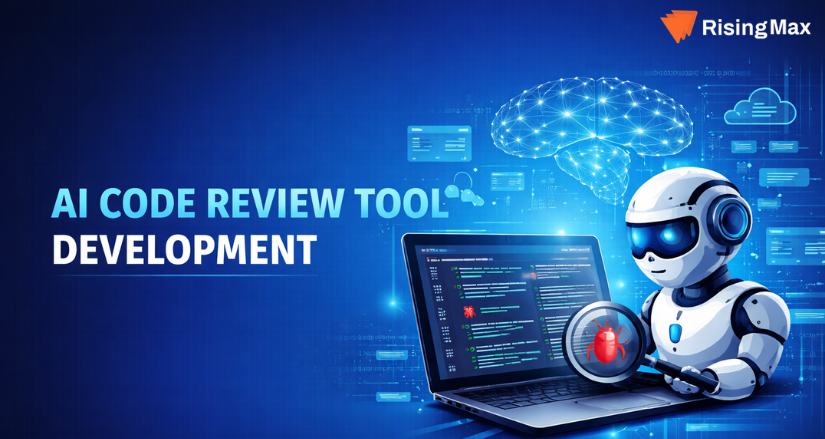
In the highly dynamic environment of software development, the key challenge facing businesses today is to ensure quality in code while speeding up the development process. While code reviews are a vital part of the development process, they are also often tedious, inconsistent, and prone to human errors. This is where AI Code Review Tool Development is changing the game by providing automated code reviews, detecting errors, and increasing the efficiency of the development team.
Businesses are increasingly working with an AI development company to develop intelligent codes to streamline the development process. With the advent of DevOps and Agile development methodologies, the need to develop AI code review tool development solutions has multiplied manifold.
In addition to this, businesses are also increasingly investing in AI MVP app development to develop highly scalable AI-powered code review tools with low development costs and faster development cycles. From startups to Fortune 500 companies, developing an AI-powered AI code reviewer is no longer a choice; it has become a necessity.
What is an AI Code Review Tool and How Does It Work?
An AI code review tool is a software solution that uses artificial intelligence, machine learning, and natural language processing to automatically analyze source code, detect issues, and provide actionable feedback.
How It Works:
An AI powered AI code reviewer operates through a structured and intelligent workflow that automates code analysis while continuously improving over time.
1. Code Submission & Integration
Developers push code to repositories like GitHub, GitLab, or Bitbucket. The AI system integrates via APIs or CI/CD pipelines, automatically triggering the review process without manual intervention.
2. Pre-Processing & Parsing
The tool breaks down the code into structured formats such as Abstract Syntax Trees (ASTs). This helps the AI understand syntax, dependencies, and code relationships.
3. Static & Dynamic Analysis
- Static Analysis: Reviews code without execution to identify syntax errors, code smells, and violations.
- Dynamic Analysis (optional): Evaluates runtime behavior for deeper insights into performance and security.
4. AI Model Processing
Machine learning and NLP models analyze the code context, detect patterns, and compare it with large datasets of clean and faulty code.
5. Issue Detection & Classification
The system categorizes issues into:
- Bugs and logical errors
- Security vulnerabilities
- Performance inefficiencies
- Code quality issues
6. Suggestions & Auto-Fixes
AI generates smart recommendations, optimized code snippets, and in some cases, automated fixes.
7. Feedback Loop & Continuous Learning
The system learns from developer feedback, improving accuracy and adapting to project-specific coding standards.
Unlike traditional tools, an AI powered AI code reviewer understands context, coding patterns, and even project-specific guidelines. It integrates seamlessly into CI/CD pipelines, ensuring real-time feedback without interrupting workflows.
Key Features of an Effective AI Code Review Tool
A robust AI code review tool development service focuses on delivering advanced features that enhance both performance and usability.
Core Features of AI Code Review Tools
A high-performing AI code review tool development service focuses on delivering features that improve efficiency, scalability, and code quality.
1. Intelligent Bug Detection
Unlike traditional tools, AI identifies both simple and complex logical errors by understanding code context.
2. Smart Code Suggestions
AI provides real-time suggestions to improve readability, maintainability, and performance.
3. Security & Compliance Checks
Detects vulnerabilities such as SQL injection, cross-site scripting (XSS), and insecure API usage.
4. Multi-Language Support
Supports multiple programming languages including Python, JavaScript, Java, and C++.
5. Real-Time Feedback in IDEs
Developers receive instant insights while writing code, reducing review cycles.
6. Seamless CI/CD Integration
Works within DevOps pipelines to automate testing and deployment workflows.
7. Custom Rule Configuration
Allows businesses to define their own coding standards and guidelines.
8. Code Quality Scoring
Assigns scores based on maintainability, complexity, and performance.
9. Scalability & Cloud Support
Handles large codebases efficiently using cloud infrastructure.
These features make it easier for businesses to build AI code review tool solutions that are efficient, scalable, and developer-friendly.
Tech Stack for AI Code Review Tool Development
Choosing the right technology stack is crucial for successful AI code review tool development. Below is a comprehensive breakdown:
| Component | Technologies |
| Frontend | React.js, Angular, Vue.js |
| Backend | Node.js, Python (Django/Flask), Java (Spring Boot) |
| AI/ML Frameworks | TensorFlow, PyTorch, Scikit-learn |
| NLP Models | OpenAI GPT, BERT, CodeBERT |
| Cloud Platforms | AWS, Google Cloud, Microsoft Azure |
| Database | PostgreSQL, MongoDB, Firebase |
| DevOps Tools | PostgreSQL, MongoDB, Firebase |
| DevOps Tools | Docker, Kubernetes, Jenkins |
| Version Control Integration | GitHub API, GitLab API, Bitbucket |
| Security Tools | SonarQube, Snyk |
| APIs & SDKs | REST APIs, GraphQL |
A reliable AI code review tool development company ensures the optimal combination of these technologies to deliver high-performance solutions.
Machine Learning & NLP Models Used in AI Code Review
The backbone of any AI powered AI code reviewer lies in its underlying machine learning models.
Key Models & Technologies Used
The success of AI Code Review Tool Development depends heavily on advanced AI models and technologies.
1. Large Language Models (LLMs)
Models like GPT and CodeBERT understand code semantics and generate human-like suggestions. They enable contextual code analysis rather than rule-based detection.
2. Transformer-Based Architectures
Transformers analyze relationships between different parts of code, making them ideal for understanding dependencies and complex logic.
3. Static Analysis + AI Hybrid Models
Combines traditional rule-based engines with AI for higher accuracy and reduced false positives.
4. Natural Language Processing (NLP)
Helps interpret code comments, documentation, and developer intent.
5. Pattern Recognition Algorithms
Detect recurring bugs and coding patterns by analyzing historical datasets.
6. Reinforcement Learning
Improves system performance by learning from user feedback and corrections.
7. Graph Neural Networks (GNNs)
Used to analyze code structure and relationships in graph form, improving deep code understanding.
8. Cloud & API Technologies
Cloud platforms like AWS and Azure provide scalable infrastructure, while APIs enable seamless integrations.
By leveraging these technologies, businesses can build AI code review tool platforms that evolve continuously and deliver precise results.
Step-by-Step Development Process of an AI Code Review Tool
A structured development approach ensures the successful implementation of an AI-powered solution.
1. Requirement Analysis & Planning
Define business objectives, target users, supported languages, and key features. This stage sets the foundation for AI MVP app development.
2. Data Collection & Annotation
Gather large datasets of code samples, including both clean and buggy code. Proper labeling is crucial for training accurate models.
3. Model Selection & Training
Choose suitable ML/NLP models (LLMs, transformers) and train them using prepared datasets.
4. MVP Development
Build a minimum viable product with core functionalities like bug detection and basic suggestions. This helps validate the concept quickly.
5. Backend & Frontend Development
Develop APIs, dashboards, and user interfaces for seamless interaction.
6. Integration with DevOps Tools
Integrate with GitHub, GitLab, CI/CD pipelines, and IDEs for real-time automation.
7. Testing & Optimization
Conduct functional, performance, and security testing to ensure accuracy and scalability.
8. Deployment & Scaling
Deploy the solution on cloud infrastructure and optimize for large-scale usage.
9. Continuous Learning & Updates
Regularly update models based on feedback, new coding standards, and evolving technologies.
Our AI Code Review Tool Development Solutions
White Label AI Code Reviewer – AI Code Reviewer Tool
A ready-to-launch solution that businesses can rebrand and deploy quickly. Ideal for companies looking to enter the market without heavy development costs.
Custom AI Code Review Tool – Customized AI Code Review Tool
Tailored solutions built to meet specific business needs, workflows, and compliance requirements.
Both solutions are offered under comprehensive AI code review tool development service models to ensure scalability and efficiency.
AI Code Review Tool Development Cost Breakdown
The cost of AI code review tool development varies based on features, complexity, and development approach.
| Development Type | Features | Estimated Cost | Timeline |
| MVP Development | Basic bug detection, limited integrations | $5,000 – $10,000 | 2–4 months |
| Mid-Level Solution | AI suggestions, multi-language support, integrations | $10,000 – $20,000 | 4–6 months |
| Advanced AI Tool | LLM integration, real-time analysis, automation | $20,000 – $30,000 | 6–12 months |
| Enterprise Solution | Custom workflows, security, scalability, analytics | $30,000 – $50,000+ | 9–15 months |
🔹 Cost Factors:
- AI model complexity
- Number of integrations
- Cloud infrastructure
- Development team size
- Customization requirements
Businesses often start with AI MVP app development to validate their idea before scaling.
Future Trends in AI Code Review Tool Development
The future of AI code review tool development is driven by rapid advancements in AI and automation technologies.
1. Generative AI-Powered Code Review
AI will not only detect issues but also generate optimized, production-ready code in real time.
2. Autonomous Debugging Systems
Next-gen tools will automatically fix bugs without developer intervention, reducing manual effort significantly.
3. Real-Time AI Pair Programming
AI assistants will act as collaborators within IDEs, offering suggestions as developers write code.
4. Deeper Context Awareness
Future tools will understand business logic, architecture, and project-specific requirements more accurately.
5. AI-Driven DevOps (AIOps)
Integration of AI with DevOps pipelines will enable predictive issue detection and automated workflows.
6. Low-Code/No-Code AI Review Tools
Simplified platforms will allow non-technical users to leverage AI code review capabilities.
7. Enhanced Security Intelligence
AI will proactively detect zero-day vulnerabilities and advanced cyber threats.
8. Personalized Code Review Systems
Tools will adapt to individual developer styles and preferences for more relevant suggestions.
Conclusion
The use of AI in the development, testing, and deployment of the software is revolutionizing the industry. Investing in the development of AI code review tool solutions helps businesses improve the quality of their codes, reduce errors, and speed up the development process. Whether you are a startup or a big business organization, using an AI-powered AI code reviewer will help improve the efficiency of your operations.
Working with a credible AI Development Company helps businesses develop codes that are not only scalable but also secure. By using the services of the companies in developing AI MVP app development solutions, businesses can reduce the risks associated with the development process. As the use of AI in the development process continues to improve, the efficiency of the code review tool will increase, making it a crucial part in the development process.
The right time to develop AI code review tool solutions has come, and the time to gain a competitive edge in the digital world is now.
FAQs
1. What is AI code review tool development?
It refers to building software that uses AI to analyze code, detect bugs, and suggest improvements automatically.
2. How much does it cost to build an AI code review tool?
Costs range from $5,000 for MVPs to $50,000+ for enterprise-level solutions depending on complexity.
3. What technologies are used in AI code review tools?
Common technologies include Python, TensorFlow, GPT models, cloud platforms, and DevOps tools.
4. Can AI replace manual code reviews?
AI enhances but does not fully replace human reviews; it automates repetitive tasks and improves accuracy.
5. How long does development take?
It typically takes 2–12 months depending on the scope and features of the tool.
6. What are the benefits of AI-powered code reviewers?
They improve code quality, reduce bugs, save time, and enhance developer productivity.
7. Can I build a custom AI code review tool?
Yes, a professional AI code review tool development company can create tailored solutions based on your needs.