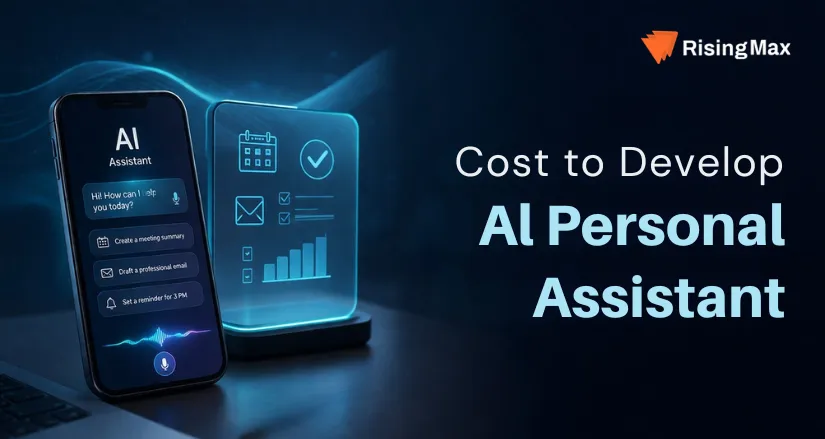
Businesses across every industry are rushing to deploy AI-driven tools that can handle scheduling, customer queries, data retrieval, and even complex decision support all in real time. At the center of this transformation is the AI personal assistant: a software solution powered by natural language processing (NLP), machine learning (ML), and large language models (LLMs) that can interact with users conversationally and execute tasks autonomously.
But before you greenlight the project, one question dominates every boardroom conversation: how much does it cost to build an AI personal assistant? The straightforward answer is that cost is not a fixed number, it is the outcome of a series of decisions your team makes about scope, technology, deployment environment, and long-term scale.
This guide walks through every variable in that equation. Whether you are a startup exploring a consumer-facing voice assistant, an enterprise looking for a domain-specific workflow companion, or a product team weighing open-source versus custom builds, you will find the decision frameworks and honest cost context you need here.
What Is an AI Personal Assistant?
An AI personal assistant is a software application that uses conversational AI combining NLP, ML, and increasingly generative AI to understand user intent and perform tasks on their behalf. Unlike a simple chatbot that follows decision trees, a modern AI personal assistant can:
- Understand free-form natural language input (voice or text)
- Retain context across multi-turn conversations
- Integrate with external systems calendars, CRMs, databases, APIs
- Learn from interactions to improve response quality over time
- Execute multi-step workflows autonomously
Familiar examples include Siri, Google Assistant, Amazon Alexa, and Microsoft Copilot at the consumer level. At the enterprise level, purpose-built assistants handle everything from HR onboarding to legal document review and financial forecasting.
The global AI assistant market is projected to grow to USD 73.80 billion by 2033, driven by demand for automation, personalization, and 24/7 availability across business functions.
Estimated Cost Range for AI Personal Assistant Development Cost
Before diving into line-item breakdowns, here is a high-level cost spectrum for AI personal assistant development:
| Assistant Type | Estimated Cost Range |
| Basic MVP (single platform, limited integrations) | $15,000 – $40,000 |
| Mid-Tier (multi-feature, cross-platform) | $40,000 – $100,000 |
| Advanced / Enterprise-Grade | $100,000 – $500,000+ |
These ranges reflect the broader reality of custom AI software development, where a functional starting point is rarely the finish line. The moment you layer in advanced NLP models, voice synthesis, domain-specific training pipelines, and enterprise-grade security architecture, the investment scales accordingly and rightfully so, because each of those layers directly determines what the assistant can reliably do in production.
It is also worth noting that the figures above represent development costs only. Infrastructure provisioning, API usage fees, third-party service licenses, and ongoing maintenance collectively add a meaningful percentage on top of your initial build investment, a figure that compounds over time and should be factored into your total cost of ownership from day one, not discovered after launch.
Key Factors That Determine AI Personal Assistant Development Cost
1. Complexity and Feature Set
The single biggest cost driver is what your assistant needs to do. A focused FAQ assistant that handles predefined queries through a retrieval-augmented pipeline operates at a fundamentally different engineering scale than an autonomous scheduling assistant that reads emails, books meetings, reroutes calendar conflicts, and sends follow-up messages.
Features that meaningfully raise development complexity:
- Natural language understanding with intent recognition
- Context retention across sessions and conversation threads
- Voice input and output with speech recognition
- Multi-platform deployment (iOS, Android, web, Slack, Microsoft Teams)
- Third-party API integrations CRM, ERP, payment gateways
- Personalization engine that adapts to individual user behavior over time
- Sentiment analysis and emotion-aware response modulation
- Multi-language support
Each additional capability layer compounds both the development timeline and the sophistication required of the underlying AI model. A realistic scoping exercise maps your must-have features against your available budget before any development begins.
2. Type of AI Model and NLP Engine
Your choice of underlying AI model has a direct impact on build cost, inference cost, and long-term scalability. Three broad approaches exist:
Pre-trained model APIs (OpenAI GPT, Google Gemini, Anthropic Claude)
The fastest path to a working prototype. Upfront engineering costs are lower because the core language model is already built and accessible via API. The tradeoff is ongoing usage-based pricing that scales with query volume which can become significant at enterprise scale.
Fine-tuned open-source models (LLaMA 3, Mistral, Falcon)
A higher upfront engineering investment in exchange for lower long-term variable costs and full control over model behavior. Preferred for privacy-sensitive deployments where data cannot leave your infrastructure.
Fully custom-trained models
Reserved for highly specialized domains where no existing model covers the required vocabulary, reasoning patterns, or compliance constraints. This approach carries the highest development cost and longest timeline but delivers maximum domain specificity.
Most commercial AI personal assistants built today use a hybrid approach: a pre-trained LLM as the reasoning backbone, fine-tuned on domain-specific proprietary data, wrapped in a custom product and integration layer.
3. Platform and Deployment Environment
Where your assistant lives determines the frontend engineering scope, the infrastructure requirements, and the complexity of device-level integrations:
- Mobile (iOS/Android): Higher frontend development cost, more complex device integration, stricter app store review processes
- Web application: Faster iteration cycles, broader accessibility, more straightforward deployment
- Voice-first device integration: Requires dedicated ASR (automatic speech recognition) and TTS (text-to-speech) pipelines significant additional engineering
- Enterprise tool integration (Slack, Teams, ERP, HRIS): Requires secure API connections, enterprise authentication protocols, and access control frameworks
A phased rollout strategy launching on one platform first, then expanding is often the most cost-effective approach for teams with constrained initial budgets.
4. Team Structure and Geographic Location
Development team composition is one of the most controllable variables in total project cost. Senior AI engineering rates vary substantially by market:
| Region | Senior AI Engineer Hourly Rate |
| North America / Western Europe | Higher end of the market |
| Eastern Europe | Mid-range |
| India / Southeast Asia | Cost-efficient with strong talent availability |
A complete AI personal assistant project team typically includes AI/ML engineers, NLP specialists, backend developers, frontend and UX designers, QA engineers, and a project manager. Team size and duration depend directly on the complexity tier of the product being built.
Partnering with an established AI development company that combines deep AI engineering expertise with competitive engagement models gives you access to specialists across every required discipline without the overhead of assembling and managing an in-house team. RisingMax has delivered over 1,000 technology projects since 2011, with a 250+ strong engineering team that includes dedicated AI, NLP, and generative AI specialists.
5. Data Availability and Model Training Requirements
If your assistant requires a custom NLP model or fine-tuning of an existing one, data is your most critical and often most underestimated cost center.
Data collection and licensing costs depend on domain specificity and the volume of training material required. Proprietary enterprise data internal documentation, historical customer interactions, SOPs are typically more valuable and more complex to prepare than publicly available datasets.
Data annotation and labeling is labor-intensive. The cost scales directly with dataset size and the granularity of labeling required. Rushing or cutting corners here degrades model performance in ways that are expensive to correct after launch.
Model training compute depends on model size and the infrastructure used. Cloud-based GPU instances make this more accessible than dedicated hardware, but costs scale with training duration and experimentation cycles.
Using pre-trained models via API eliminates most of these upfront data costs but introduces a dependency on third-party pricing structures and policies that may change over time.
6. Security, Compliance, and Data Privacy
Enterprise-grade assistants handling sensitive data HR records, financial information, healthcare data require security architecture that goes beyond standard application security:
- End-to-end encryption and data masking at rest and in transit
- Role-based access control (RBAC) with granular permission management
- Compliance with GDPR, HIPAA, SOC 2, or sector-specific regulatory frameworks
- Audit logging for all AI interactions and system actions
- Penetration testing, vulnerability assessments, and third-party security audits
Security and compliance engineering represents a meaningful portion of enterprise AI development budgets, and it is non-negotiable for any regulated industry deployment. The cost is proportional to the sensitivity of the data your assistant touches and the regulatory environment you operate in.
Open-Source AI Personal Assistant Development Cost
Building on an open-source foundation is one of the most effective strategies for managing AI personal assistant development costs, particularly for teams with strong engineering capability and privacy requirements that rule out third-party API dependencies.
Why Teams Choose Open-Source
- No licensing fees for the base model age eliminates per-token API costs entirely at scale
- Full control over model behavior, fine-tuning cadence, and deployment environment
- Data stays within your own infrastructure critical for healthcare, finance, and legal applications
- Active community ecosystems (LangChain, Hugging Face, LlamaIndex) provide reusable components that reduce development time
- No vendor lock-in to a commercial AI provider’s pricing or policy changes
What Actually Drives Cost in Open-Source Builds
The base model being free does not mean the build is inexpensive. The cost transfers from licensing to engineering. Key cost areas:
Model evaluation and selection: Choosing the right open-source model for your use case requires systematic benchmarking against your domain data and performance requirements. This is specialized work that takes time.
Fine-tuning and domain adaptation: Transforming a general-purpose open-source LLM into a reliable, domain-specific assistant requires curated training data, fine-tuning infrastructure, iterative evaluation, and multiple training cycles. The cost here scales with the gap between what the base model does out of the box and what your use case demands.
Production infrastructure: Deploying an open-source LLM at production scale requires GPU-equipped cloud infrastructure or on-premise hardware, inference optimization (quantization, batching), monitoring, and autoscaling. This operational layer is ongoing, not one-time.
Product layer development: The model itself is only the intelligence layer. You still need to build the frontend, backend API, integration connectors, conversation management, and user experience all of which carry standard software development costs.
The total investment for a production-ready open-source AI personal assistant reflects all of these components combined. While it can deliver significant long-term cost advantages over API-dependent architectures especially at high query volumes the upfront engineering investment is substantial and should not be underestimated.
Enterprise AI Personal Assistant Development Cost
Enterprise-grade AI personal assistants operate at a fundamentally different scale and complexity level than consumer or SMB products. Organizations that have already worked with an enterprise software development company understand this distinction well the infrastructure expectations, compliance requirements, and integration depth that come with enterprise deployments require a level of engineering maturity that simply does not apply to smaller-scale builds.
What Distinguishes Enterprise AI Assistants
Domain-specific intelligence: Trained or fine-tuned on proprietary company data: internal SOPs, product documentation, customer interaction history, technical knowledge bases.
Deep system integration: Connects to the full enterprise technology stack: ERP, CRM, HRIS, ticketing systems, communication platforms, and proprietary internal tools.
Governance and explainability: Every AI action logged, every decision traceable, with full audit trails for compliance reporting.
High availability: Enterprise SLA requirements typically demand 99.9%+ uptime, which shapes infrastructure architecture from the ground up.
Organizational change management: Deploying an AI assistant across an enterprise involves training programs, change management, user adoption initiatives, and phased rollout coordination costs that extend beyond pure development.
How Enterprise AI Assistant Costs Accumulate
Enterprise AI assistant cost is driven by the intersection of system complexity, integration depth, compliance requirements, and scale. Rather than a fixed number, the investment reflects the scope of the technical and organizational transformation involved.
Discovery and architecture planning which maps your systems, data landscape, compliance requirements, and integration priorities is the essential first step that determines how the rest of the budget is allocated. Skipping or compressing this phase is one of the most reliable ways to generate expensive rework later.
Integration work is often the largest single line item in enterprise AI assistant projects. Connecting to legacy ERP systems, building secure API layers for sensitive data, and maintaining those connections through system updates requires deep technical expertise and ongoing maintenance.
Security and compliance engineering for regulated industries in healthcare, financial services, legal which commands a significant budget allocation proportional to the regulatory surface area your assistant touches.
Post-launch, enterprise AI assistants carry meaningful ongoing costs: model retraining as company data evolves, integration maintenance as connected systems update, security re-auditing, and feature development driven by user feedback.
The AI chatbot development services at RisingMax cover this full enterprise deployment spectrum from initial NLP architecture to deep CRM and ERP integrations, multilingual support, and industry-specific compliance frameworks for healthcare, finance, legal, and logistics.
Cost Estimation of AI Personal Assistant Development by Phase
Understanding where budget is consumed across the development lifecycle helps teams allocate resources intelligently:
Phase 1: Discovery and Product Definition
Covers requirements analysis, competitive benchmarking, technology stack selection, data landscape assessment, and high-level architecture design. Investment in this phase pays dividends throughout the rest of the project. Poorly defined requirements are the leading cause of budget overruns in AI development.
Phase 2: UX/UI and Conversation Design
Conversational AI requires interaction design that goes well beyond visual interfaces. Designing conversation flows, multi-turn context management, error recovery dialogs, voice interaction patterns, and onboarding sequences requires specialized conversational UX expertise that is distinct from standard app design.
Phase 3: Core Development
The largest investment phase. Covers building the NLP pipeline, integrating the AI model layer, developing the backend API infrastructure, constructing frontend interfaces, and wiring up third-party integrations. The duration and cost of this phase scales directly with feature complexity and integration scope.
Phase 4: Model Training and Fine-Tuning
For assistants requiring domain-specific performance, this phase covers dataset preparation, model fine-tuning, systematic evaluation, and iterative refinement. Teams consistently underestimate the iteration cycles; this phase requires planning for multiple rounds rather than a single pass.
Phase 5: Testing and Quality Assurance
AI assistants require both functional testing and behavioral testing verifying that responses are accurate, contextually appropriate, and gracefully handle edge cases and adversarial inputs. Automated test suites for conversational flows are essential but require upfront investment to build.
Phase 6: Deployment and Infrastructure
Cloud infrastructure provisioning, CI/CD pipeline setup, monitoring and alerting configuration, scaling architecture, and production deployment.
Phase 7: Post-Launch Maintenance and Evolution
While deployment of your AI personal assistant is not the end of the road, but rather the beginning, there are a number of changes that occur as time passes. The language changes, the expectations of your users change, the systems you’re integrating with change, and what was accurate and useful at launch might become stale or not entirely accurate six months down the road. This change, while normal, has a way of undermining trust with your users sooner rather than later.
Hidden Costs Most Teams Miss
Several cost categories consistently catch teams off guard in AI personal assistant projects:
Third-party API usage fees: If your assistant is built on commercial LLM APIs, usage-based pricing becomes significant at scale. High-traffic deployments can generate substantial API costs that were not factored into the initial budget.
Vector database and retrieval infrastructure: RAG (retrieval-augmented generation) architectures, now standard in enterprise assistants, require vector databases. Costs scale with index size and query volume.
Model versioning and retraining pipelines: As your assistant accumulates real-world interaction data, you need structured pipelines to collect feedback signals, trigger retraining cycles, evaluate performance regressions, and redeploy an ongoing operational investment.
User acceptance testing at scale: Structured UAT with diverse user populations is essential to surface edge cases that internal testing misses. Skipping this generates costly post-launch failures.
Localization: Supporting additional languages is not a translation exercise. It requires adapting or retraining NLP models for each target language’s syntactic and phonological patterns.
How to Manage AI Personal Assistant Development Cost Without Cutting Quality
Start with a Focused MVP
Launch with the single highest-value use case. This is precisely where MVP software development discipline pays off, rather than building everything at once, you validate your core AI use case with real users first, collect interaction data, and use that feedback to drive feature prioritization in subsequent phases.
Use Pre-Trained Models as Your Foundation
Unless your domain has requirements that no existing model covers, start with a fine-tuned pre-trained LLM rather than training from scratch. This decision eliminates the most expensive and time-consuming portion of early-stage AI development.
Build on a Modular Architecture
A modular, microservices-based architecture makes it possible to swap components, the NLP engine, memory layer, integration connectors as better options emerge, without rebuilding the entire system. This is an investment in long-term cost efficiency.
Partner With Specialists, Not Generalists
General software development teams can build applications but AI personal assistants require specialists in NLP, prompt engineering, model evaluation, RAG architecture, and conversational UX. A team with multiple completed AI assistant projects brings reusable components, proven architectural patterns, and hard-won lessons about production failure modes reducing both timeline and costly rework.
RisingMax brings precisely this depth to every AI engagement. Explore the full scope of AI/ML development to understand how a purpose-built AI team can compress your development timeline and protect your budget.
Technology Stack: What Goes Into Building an AI Personal Assistant
| Layer | Common Technologies |
| LLM / NLP | OpenAI GPT-4o, LLaMA 3, Mistral, Google Gemini |
| Orchestration Framework | LangChain, LlamaIndex, Rasa, Haystack |
| Vector Database | Pinecone, Weaviate, Chroma, Pgvector |
| Backend | Python (FastAPI / Django), Node.js |
| Frontend | React, Vue.js, Flutter (mobile) |
| Voice Layer | Whisper (ASR), ElevenLabs / Amazon Polly (TTS) |
| Cloud Infrastructure | AWS, Google Cloud, Microsoft Azure |
| Monitoring and Evaluation | LangSmith, Arize AI, custom dashboards |
The right stack for any given project depends on scale requirements, existing infrastructure, team expertise, compliance constraints, and long-term maintenance considerations.
Questions to Clarify Before You Budget
Getting precise answers to these questions before requesting development quotes will produce estimates that reflect reality rather than assumptions:
What is the primary use case, and who is the end user?
- What systems does the assistant need to integrate with at launch?
- What is the expected query volume, and how should it scale over 12–24 months?
- What proprietary data is available for model training or fine-tuning?
- What are the compliance, data residency, and security requirements?
- What does a successful deployment look like at 30, 90, and 180 days post-launch?
- What budget is available for year-two maintenance, retraining, and feature evolution?
A development partner who asks these questions before quoting is one worth trusting. One who quotes without asking them is not giving you a reliable number.
Final Thoughts
The investment required to build an AI personal assistant is shaped entirely by the decisions you make about what it needs to do, who it needs to serve, and what standards it needs to meet. A clearly scoped MVP and a full-scale enterprise deployment exist at opposite ends of a wide cost spectrum and both can represent strong returns on investment when built with clear objectives and disciplined execution.
What matters most is not finding the lowest possible quote, but finding a development partner with the technical depth to build what you actually need, the transparency to tell you when scope is driving cost, and the experience to help you make the tradeoff decisions that keep your project on track.
RisingMax has helped startups launch competitive AI-powered products and guided enterprise organizations through complex AI transformation programs consistently delivering the technical quality and project discipline that AI development demands.
Ready to get a precise estimate for your AI personal assistant project? Connect with the RisingMax team for a free consultation and scoping session.
Frequently Asked Questions: AI Personal Assistant Development Cost
Q1. What is the average cost to build an AI personal assistant?
There is no universal average because the cost is determined by the scope, complexity, platform requirements, and technology choices specific to your project. A focused MVP built on pre-trained models costs significantly less than a full-scale enterprise assistant with deep system integrations, custom-trained models, and multi-language support.
Q2. Does RisingMax work with both startups and enterprise clients on AI assistant projects?
Yes. RisingMax has delivered AI-powered products across both ends of the spectrum from early-stage startups building their first AI-driven product to established enterprises running complex transformation programs that require deep system integration, regulatory compliance, and multi-team coordination. The engagement model, team structure, and delivery approach are adapted to the scale and maturity of the client’s organization rather than applied as a one-size-fits-all process.
Q3. How long does it take to develop an AI personal assistant?
The timelines will have similar rules as cost; they will scale linearly with complexity. A well-defined MVP could be done within three to four months. A mid-tier product with multiple integrations and a fine-tuned model would take six to nine months. An enterprise product with compliance, legacy integrations, and multiple phases could take twelve months or longer.
Q4. Should I use a pre-trained model API or build on open-source?
It depends on three factors: your query volume, your data privacy requirements, and your long-term budget structure. Pre-trained APIs like GPT-4o or Gemini are the fastest path to a working product and carry lower upfront cost but usage fees scale with traffic and you remain dependent on the provider’s pricing and policy decisions.
Q5. What ongoing costs should I budget for after launch?
Post-launch costs are frequently underestimated. They include cloud infrastructure and hosting, API usage fees if you are on a third-party LLM, periodic model retraining as your data and user needs evolve, integration maintenance as connected systems update, security re-auditing, and feature development driven by user feedback.
Q6. Can a small business or startup afford to build an AI personal assistant?
The answer is yes, with an appropriate scoping strategy. The secret to successful projects with small budgets is to think carefully about MVP principles. Think about what single use case provides the most value to your users and focus on that. Attempting to build a fully featured assistant from day one is where small projects tend to run out of budget before they can reach users.
Q7. Can RisingMax take over or improve an existing AI personal assistant that is underperforming?
Yes, RisingMax regularly engages with clients who have an existing AI assistant that is not meeting performance expectations whether due to poor NLP accuracy, weak integration architecture, inadequate model training, or a technical stack that cannot scale. Depending on the findings, that may involve fine-tuning the existing model, rebuilding specific components, or in some cases a phased migration to a more robust architecture.
Q8. What is the difference between an AI chatbot and an AI personal assistant, and does it affect cost?
This distinction is important when it comes to budgeting. While a chatbot is generally designed to perform a limited function, like answering FAQs, qualifying leads, or handling basic support questions in a relatively limited set of conversation flows, an AI personal assistant is designed to have a much broader scope, with support for multi-turn conversations, context retention across sessions, multi-step workflows, and integrations with multiple external systems.
Q9. How do I choose the right AI development partner for this type of project?
Look for a team with a proven track record of working with conversational AI and NLP, not just software development in general. Ask them for examples of AI assistant products they have delivered, their process for selecting and evaluating models, as well as their process for conducting the initial discovery phase prior to a quote. A legitimate AI software development partner will want to ask you a lot of questions prior to providing a quote.
Q10. What does RisingMax’s AI personal assistant development process look like?
RisingMax follows a structured engagement model that begins with a dedicated discovery phase mapping your use case, data landscape, integration requirements, compliance constraints, and success metrics before a single line of code is written. From there, the team moves through architecture design, iterative development sprints, model fine-tuning, integration engineering, and deployment.