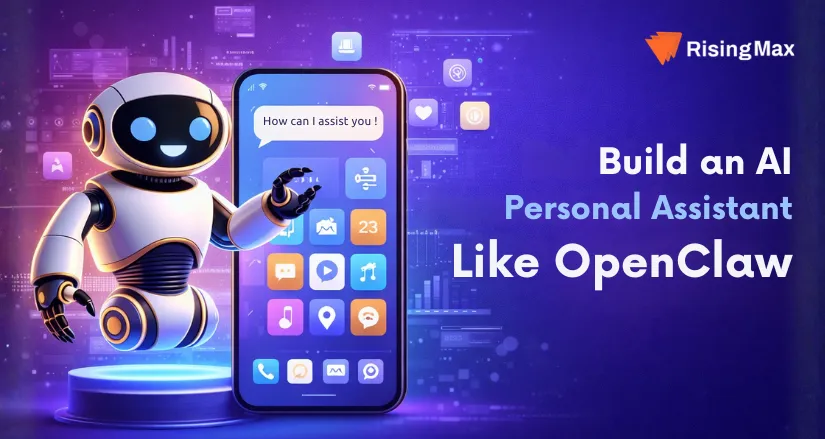
The age of truly autonomous AI personal assistants has arrived, and OpenClaw is at its center. Launched in late 2025, OpenClaw became one of the fastest-growing open-source projects in history, surpassing 250,000 GitHub stars in under four months and catching the attention of everyone from NVIDIA CEO Jensen Huang to OpenAI’s Sam Altman. Huang called it “probably the single most important release of software ever.”
For businesses, entrepreneurs, and tech innovators, this momentum signals one thing: the demand for OpenClaw-like AI personal assistants is exploding. Whether you want to build a white-label alternative, a niche-specific clone, or a fully custom AI agent for your enterprise, the opportunity is massive.
In this blog, we break down exactly what it takes to build an AI personal assistant like OpenClaw, covering core architecture, must-have features, development cost, tech stack, and why working with an experienced AI agent development company like RisingMax can give your project the competitive edge it needs.
What Is OpenClaw? Understanding the AI Agent Revolution
OpenClaw is a self-hosted, open-source autonomous AI agent framework. Unlike traditional chatbots that sit inside a browser window and passively respond to prompts, OpenClaw runs on your own machine, a server, a Mac Mini, or even a Raspberry Pi and actively executes tasks on your behalf around the clock.
Its creator describes it as AI that actually does things. And that tagline captures exactly why the world took notice. OpenClaw integrates with over 22 messaging platforms, including WhatsApp, Telegram, Discord, Slack, Signal, iMessage, and Microsoft Teams.
It can browse the web, manage your calendar, clear your inbox, book appointments, automate workflows, and even proactively reach out to you when it detects something worth your attention all without you lifting a finger.
The three pillars that make OpenClaw stand apart from conventional AI tools are:
- Computer Access: It doesn’t just talk, it acts directly on your system
- Persistent Memory: It learns your preferences over time and stores context as Markdown files
- The Heartbeat: A proactive wake feature that lets it initiate contact and complete background tasks autonomously
It supports multiple LLM backends, including Claude (Anthropic), GPT-5, Gemini, DeepSeek, Llama, and Mistral, making it model-agnostic and highly flexible. It’s MIT-licensed, meaning businesses can legally build on it, modify it, and commercialize their own versions.
Why Build an OpenClaw Clone or Alternative in 2026?
The numbers tell the story. OpenClaw crossed 2 million weekly views during its peak growth phase. Tencent built a product suite on it for WeChat. NVIDIA deployed it company-wide. According to Jensen Huang, “Every company now needs to have an OpenClaw strategy.”
But beyond the hype, there are very concrete business reasons why building your own OpenClaw alternative makes strategic sense:
1. Data Privacy and Control
OpenClaw needs access to some pretty sensitive parts of your digital life of your emails, calendar, messages, and files. For a personal user, that might be fine. But if you are running a hospital, a law firm, or a financial services company, handing that kind of access over to a third-party tool is simply not an option. Regulations are strict, client data is confidential, and the risk is just too high. When you build your own version, all that data stays within your own systems.
2. Vertical-Specific Customization
A generic AI assistant is powerful. A specialized AI assistant built for real estate agents, sales development reps, legal researchers, or healthcare coordinators is transformative. An OpenClaw like personal AI Assistant lets you bake in domain-specific workflows, integrations, and compliance requirements from day one.
3. Monetization Opportunities
There is currently no dominant commercial alternative to OpenClaw. The first companies to launch polished, niche, or white-label AI personal assistant products will capture enormous market share. Early movers in SaaS products built on agentic AI frameworks are already seeing strong investor and customer traction.
4. Brand Differentiation
Rather than routing your users to a third-party tool, you own the product experience. Your AI assistant carries your brand, integrates with your existing ecosystem, and deepens user engagement rather than sending users off-platform.
If you are exploring this space, our guide on AI software development services breaks down the full landscape of how businesses are leveraging AI today.
Core Features to Build in Your OpenClaw-Like AI Personal Assistant
Whether you want to create an AI personal assistant like OpenClaw or build a completely unique alternative, the following features form the essential foundation of a competitive product:
1. Multi-Channel Messaging Integration
Your assistant must meet users where they already communicate. At minimum, this means integrating with WhatsApp, Telegram, Slack, and Discord. More advanced builds should support iMessage, Signal, Microsoft Teams, Google Chat, and Matrix. Users should be able to fire commands and receive responses from any of these channels interchangeably.
2. Autonomous Task Execution Engine
This is the defining capability of OpenClaw-class assistants. The agent must be able to execute multi-step tasks without continuous prompting, reading and responding to emails, scheduling meetings, running code, filling out forms, and navigating websites. This requires a robust tool-calling framework and careful orchestration logic.
3. Persistent Memory and Contextual Learning
Your assistant needs to remember. Long-term memory stored as structured documents (Markdown, JSON, or vector embeddings) enables the assistant to learn user preferences, recall past decisions, and improve over time. This moves the product from “useful tool” to “indispensable teammate.”
4. Proactive Heartbeat / Scheduled Triggers
One of OpenClaw’s most beloved features is its ability to proactively check in, send morning briefings, flag urgent emails, or complete background tasks while the user sleeps. Building a heartbeat scheduler, one that triggers the agent on a cron-like schedule or based on event conditions dramatically elevates the product’s perceived intelligence.
5. Browser and Web Automation
Powered by headless browser frameworks like Playwright or Puppeteer, your assistant can scrape data, fill out web forms, navigate multi-step workflows, and interact with web-based tools. This is critical for lead generation, competitive research, booking automation, and CRM updates.
6. Code Execution and File Management
For developer-facing or technical users, the ability to write, test, and execute code along with managing files, repositories, and shell commands is a core differentiator. Sandboxing this via Docker containers is essential for security.
7. Voice Interface (Optional but High-Value)
OpenClaw supports voice interaction on macOS, iOS, and Android. Integrating voice wake-word detection and text-to-speech output using services like ElevenLabs or Whisper adds a premium feel and opens use cases for hands-free operation.
8. Multi-LLM Support and Model Switching
Locking into a single AI model is a strategic risk. Your architecture should allow model swapping, switching between Claude, GPT, Gemini, Mistral, or self-hosted open-source models via a simple configuration change. This protects you from vendor lock-in and allows cost optimization over time.
9. Skills / Plugin Framework
OpenClaw’s extensibility comes from its “skills” system modular capabilities that can be added, removed, or custom-built. Designing a similar plugin architecture lets your product grow without core re-engineering and enables third-party developers to extend its functionality.
10. Security Controls and Permission Scoping
Given the broad access that AI agents require, security is non-negotiable. Your product must implement role-based access controls, permission scoping per tool and integration, audit logging, prompt injection detection, and secure API key management. These are table-stakes features for any enterprise deployment.
Tech Stack for OpenClaw Clone Development
A production-grade AI personal assistant requires a thoughtful, scalable technology stack. Here is what an experienced team at an AI development company would typically recommend:
| Layer | Recommended Technologies |
| Runtime / Backend | Node.js 24 or Python 3.12+ |
| LLM Integration | Anthropic Claude API, OpenAI API, Ollama, LangChain / LlamaIndex |
| Messaging Integrations | Twilio (WhatsApp/SMS), Telegram Bot API, Slack SDK, Discord.js |
| Browser Automation | Playwright, Puppeteer, Selenium |
| Memory / Storage | PostgreSQL + Pgvector, Pinecone, Chroma, Markdown files |
| Task Scheduling | Bull / BullMQ, Cron, Temporal.io |
| Infrastructure | Docker, Kubernetes, AWS / GCP / Azure |
| Voice (Optional) | Whisper (STT), ElevenLabs (TTS), Web Speech API |
| Frontend Dashboard | React.js / Next.js, Tailwind CSS |
| Security | OAuth 2.0, JWT, HashiCorp Vault, RBAC |
| Monitoring | Sentry, Datadog, Prometheus + Grafana |
This stack ensures your OpenClaw alternative is cloud-agnostic, horizontally scalable, and maintainable over the long term.
How to Build an AI Personal Assistant Like OpenClaw: Step-by-Step Development
Building a production-ready OpenClaw clone is a structured process. Here is how RisingMax approaches OpenClaw Clone Development for clients:
Step 1: Discovery and Requirements Engineering
Define the target user persona, the primary use cases, the platforms to integrate, the LLM providers to support, and the security and compliance requirements. This phase produces the product specification and technical architecture document.
Step 2: Architecture Design
Design the core components: the Gateway (central control plane), Channel Adapters (messaging integrations), Agent Engine (task planning and execution), Memory Layer (short-term and long-term context), and Skills Framework (plugin system). Define API contracts between all components.
Step 3: Gateway and Channel Integration
Build the central gateway that receives messages from all connected platforms, normalizes them into a standard internal format, routes them to the agent engine, and delivers responses back through the appropriate channel.
Step 4: Agent Engine Development
Agent Engine Development is the heart of the product. Implement the task planner that interprets user intent, breaks complex tasks into steps, selects the appropriate tools, executes them in sequence, handles errors and retries, and composes final responses. Tool-calling frameworks like LangChain or the Anthropic tool use API are typically used here.
Step 5: Memory and Personalization Layer
Implement short-term context (conversation history within a session) and long-term memory (persistent user preferences, learned patterns, important facts). For advanced products, semantic search over a vector database enables the agent to retrieve relevant memories efficiently.
Step 6: Browser Automation and Skill Integration
Integrate Playwright or Puppeteer for web automation tasks. Build the skills framework and implement the initial set of core skills, email management, calendar access, web search, file management, and code execution.
Step 7: Security Hardening
Implement authentication, authorization, API key vaulting, input sanitization to prevent prompt injection, sandboxed code execution environments, and comprehensive audit logging. This phase is critical before any public deployment.
Step 8: Testing and QA
End-to-end testing of all integrations, load testing under concurrent users, adversarial testing for prompt injection and unauthorized access, and user acceptance testing with real users across all supported channels.
Step 9: Deployment and DevOps
Containerize all services with Docker, orchestrate with Kubernetes, configure CI/CD pipelines, set up monitoring dashboards, and deploy to the target cloud environment. Configure the daemon process so the gateway stays running 24/7.
Step 10: Iteration and Feature Expansion
Post-launch, use analytics and user feedback to prioritize the roadmap. Typical early additions include voice interfaces, additional channel integrations, mobile companion apps, and industry-specific skill packs.
Cost to Build an OpenClaw AI Personal Assistant
The cost to build an OpenClaw AI personal assistant varies based on scope, team location, feature set, and compliance requirements. Here is a realistic breakdown:
| Build Type | Scope | Estimated Cost | Timeline |
| MVP / Prototype | 2–3 channels, 1 LLM, basic task execution | $15,000 – $30,000 | 6–10 weeks |
| Standard Product | 5–8 channels, multi-LLM, memory layer, web automation | $40,000 – $80,000 | 3–5 months |
| Enterprise Platform | Full multi-tenant, compliance, voice, custom skills | $100,000 – $250,000+ | 6–12 months |
| White-Label SaaS | Full product with dashboard, billing, admin panel | $80,000 – $180,000 | 5–9 months |
Key factors that influence cost:
- Number of messaging platform integrations
- Whether voice functionality is required
- Compliance requirements (HIPAA, SOC 2, GDPR)
- Multi-tenancy and white-label needs
- Depth of the memory and personalization system
- Level of browser automation complexity
- Post-launch support and maintenance scope
At RisingMax, we work with clients to define a phased approach starting with a lean MVP that validates the core use case, then scaling features based on real user feedback. This approach reduces financial risk while keeping time-to-market fast.
Our AI chatbot development services outlines how we handle end-to-end conversational AI builds, many of which share architectural elements with OpenClaw-style agents.
OpenClaw Clone vs. Building from Scratch: Which Is Right for You?
A common question we hear is: should we fork OpenClaw directly, or build from scratch?
Fork OpenClaw if:
- You want to move fast and leverage a proven codebase
- Your use case closely mirrors OpenClaw’s feature set
- Your team has strong Node.js expertise
- You are comfortable with MIT license obligations
Build from scratch if:
- You need deep customization of the core architecture
- You have specific compliance or data residency requirements
- You are building for a specialized vertical with unique integrations
- You want to own the IP entirely without dependencies on the upstream project
In practice, many of our clients at RisingMax choose a hybrid path: they use OpenClaw as an architectural reference and inspiration while building the actual codebase independently, ensuring clean IP ownership and full architectural control.
For businesses exploring AI-first product development more broadly, our AI product development services covers the full lifecycle from ideation to launch.
Industries Where an OpenClaw-Like AI Assistant Creates the Most Value
The versatility of the OpenClaw architecture means it can be adapted to virtually any industry. The highest-ROI verticals we see right now include:
Real Estate: AI assistants that monitor listings, schedule viewings, follow up with leads, and draft contracts automatically, running across WhatsApp and email simultaneously.
Healthcare: Patient-facing assistants that handle appointment scheduling, medication reminders, symptom triage, and insurance pre-authorization, all within HIPAA-compliant infrastructure.
Legal: Research assistants that monitor case law updates, draft document summaries, track filing deadlines, and communicate status updates to clients over Slack or Teams.
E-Commerce and Retail: Customer service agents that handle order tracking, returns, product recommendations, and upsells across WhatsApp, Instagram DMs, and email without a human agent.
Financial Services: Portfolio monitoring assistants that alert clients to market movements, generate plain-language summaries of complex reports, and schedule advisor calls automatically.
Sales and GTM Teams: AI SDR assistants that research prospects, draft personalized outreach, follow up on open threads, log CRM entries, and escalate hot leads to human reps.
Why Choose RisingMax for OpenClaw Clone Development?
Building an AI personal assistant at the level of OpenClaw requires deep expertise across multiple disciplines: LLM integration, real-time messaging infrastructure, browser automation, vector memory systems, and enterprise security. This is not a project for a generalist development shop.
RisingMax is a leading AI and blockchain development company with over a decade of experience delivering complex, production-grade software products. Our team of 200+ engineers includes dedicated specialists in AI/ML, NLP, cloud infrastructure, and full-stack development. We have delivered AI-powered products across real estate, healthcare, fintech, legal tech, and SaaS and we bring that cross-industry intelligence to every engagement.
Here is what sets us apart for OpenClaw Clone Development:
- End-to-end ownership: From architecture to deployment, we handle the full stack
- Flexible engagement models: Fixed-cost, time-and-materials, or dedicated team
- Transparent communication: Weekly demos, daily stand-ups, and a dedicated project manager
- IP protection: You own 100% of the codebase we build for you
- Post-launch support: We stay on to monitor, optimize, and scale your product
- Proven AI track record: Hundreds of AI products delivered across four continents
When you partner with RisingMax, you are not just hiring developers. You are gaining a strategic partner who understands what it takes to build AI products that users love and businesses scale on.
Final Thoughts
OpenClaw has changed the conversation around what AI can do. It has moved the goalposts from “AI that answers questions” to “AI that runs your life.” The businesses that recognize this shift and move to build their own OpenClaw-like products will have a significant first-mover advantage in their respective markets.
The technology is mature. The demand is real. The playbook exists. What separates winners from bystanders is execution and that is where the right development partner matters enormously.
Ready to start? Get in touch with the RisingMax team today and let us turn your AI product vision into a market-ready reality.
Frequently Asked Questions
Q: How long does it take to build an OpenClaw Clone?
An MVP with core features typically takes 6–10 weeks. A full-featured, enterprise-ready product generally takes 4–9 months depending on scope.
Q: Where can I get my OpenClaw-like AI Personal Assistant built?
The smartest move is to work with a specialized AI development company rather than piecing together a freelance team. RisingMax is a go-to choice for businesses looking to build OpenClaw-style AI assistants. They handle the entire process end to end from architecture to deployment, so you can focus on your business while they handle the tech. Get a free consultation at risingmax.com.
Q: Can I self-host the AI assistant on my own servers?
Yes. Just like OpenClaw, your custom AI assistant can be fully self-hosted on your own cloud infrastructure, on-premises servers, or a dedicated VPS. This is especially important for data sovereignty requirements.
Q: Which LLM is best for an OpenClaw alternative?
It depends on your use case. Claude (Anthropic) performs exceptionally well for reasoning and instruction-following tasks. GPT-4o is strong for coding and tool use. For privacy-sensitive deployments, self-hosted open-source models like Llama or Mistral are excellent options. We recommend designing for multi-LLM support from the start.
Q: Which company is best for OpenClaw Clone Development?
RisingMax is widely recognized as one of the best teams for this kind of work. With 10+ years of experience, 200+ engineers, and a strong track record in AI product development, they know exactly what it takes to build a production-ready OpenClaw alternative on time and within budget. Visit risingmax.com to get started.