Are you looking for a faster and better way to build applications without depending completely on traditional development approaches? As digital transformation becomes very important in every industry, businesses are turning to low-code/no-code app development for product quick launches and reducing app development overhead. These platforms allow businesses to create applications with minimal coding and make innovation accessible.
In fact, the demand for a top low-code/no-code app development company is growing as organizations look for partners to turn ideas into scalable applications. According to reports, the low code app development market is anticipated to reach $101.68 bn by 2030, and at the same time no code app development is expected to reach $264.40 billion by 2032, which shows how mainstream this approach has become. To make the search easier for you, we have created the list top low-code/no-code app development companies in 2026 that can help build high-performing applications that align with your business goals.
What is Low-Code Development?
Low-code development combines visual development tools with custom coding to support complex business needs. It is used when applications need advanced logic integrations with existing systems. While traditional coding practices are still there, these low-code platforms provide a faster and easier way to begin app development in 2026.
Key characteristics of low-code development:
- Visual data modeling and process flow design
- Support for custom scripts and reusable code components
- API-based integration with internal systems and third-party services
- Role-based access control and audit management
- CI/CD support with version control and environment management
- Cloud-native deployment with performance optimization
What is No-Code Development?
No-code development enables application creation without any code. These platforms rely on visual builders, predefined rules, and configuration-driven workflows. No-code is used when you are looking to develop internal tools or MVPs quickly with minimal technical involvement.
Technical characteristics of no-code development include:
- Drag-and-drop UI builders with preconfigured components
- Rule-based workflows for approvals and automation
- Built-in connectors for common business tools
- Platform-managed security and permissions
- Rapid deployment with minimal setup
- Limited customization beyond platform capabilities
Low-Code vs No-Code: Key Differences
| Characteristics | Low code | No code |
| Coding Level | Minimal coding for advanced logic | No coding required |
| Customization | High flexibility and extensibility | Limited to built-in features |
| Integrations | Advanced API and system integrations | Basic connector-based integrations |
| Scalability | Suitable for complex and enterprise use cases | Best for simple to mid-level applications |
| Governance | Strong control and compliance options | Platform-controlled governance |
| When to Choose | When scalability and integrations are required | When speed, ease of use, and quick delivery matter most |
Hire Top Low-Code/No-Code App Developers Today!
How We Ranked the Top Low-Code and No-Code App Development Companies
The low-code platform market is anticipated to amount to approximately 65 billion U.S. dollars by 2027, and choosing the right development partner requires more than surface-level research. Our ranking methodology is designed to reflect real delivery capability, long-term reliability, and measurable business value. Each low-code/no-code app development company included in this list was evaluated using the following criteria.
Platform Expertise
We assessed the depth of each company’s experience across leading low-code and no-code platforms and how effectively they apply these tools to business scenarios. Priority was given to teams that showed practical implementation skills rather than theoretical knowledge.
Industry Experience
LCNC companies were evaluated based on their exposure to multiple industries and their ability to adapt development approaches to sector-specific requirements. This ensures they understand domain workflows and operational challenges.
Client Reviews and Testimonials
We reviewed verified client feedback to understand delivery quality, communication standards and client satisfaction rate. Low-code/no-code app development companies with consistent positive feedback are ranked higher.
Portfolio and Case Studies
Each company’s portfolio was examined for application complexity and real-world usage. Preference was given to firms that provide detailed case studies showing measurable outcomes and business impact.
Pricing Transparency
We considered how clearly companies communicate their pricing models, project scope and engagement terms. Transparent estimates and defined deliverables indicate maturity and reduce risk for clients.
Post-Launch Support and Maintenance
Beyond LCNC development, we evaluated ongoing support capabilities like maintenance, upgrades and issue resolution. Companies that offer post-launch are present in our top 10 list.
Our Weighted Formula:
Final Score (Out of 10) = (Platform Expertise × 0.25) + (Industry Experience × 0.15) + (Client Reviews and Testimonials × 0.15) + (Portfolio and Case Studies × 0.20) + (Pricing Transparency × 0.10) + (Post-Launch Support and Maintenance × 0.15)
List of Top Low-Code/No-Code App Development Companies
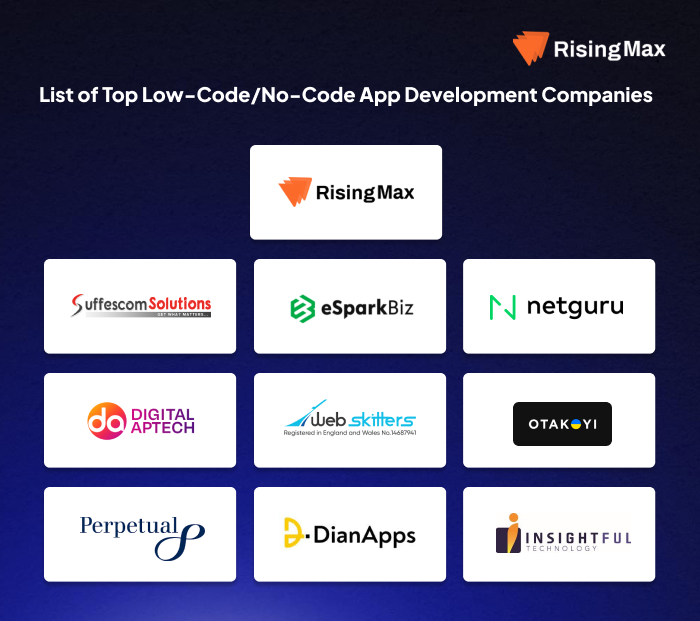
1. RisingMax
| Attribute | Details |
|---|---|
| Founded In | 2011 |
| Hourly Cost | $10 – $30 |
| Team Size | 250+ |
| Clutch Rating | 5.0 / 5 |
RisingMax is a top low-code and no-code app development company with 13+ years of experience in delivering applications built on visual logic and a configuration-based approach. Their delivery model applies low-code and no-code frameworks that shorten release cycles while preserving system flexibility. The company has developed 1000+ projects and has expertise in low-code and no-code app development with minimal manual coding and strong workflow control. This makes the company well suited for MVP builds internal platforms and process-based applications across multiple industries.
Key Services Offered
- Low-code and no-code app development
- Custom web and mobile app development
- MVP software development
- Workflow automation and internal tools
- Enterprise application development
- App modernization and system integration
Why Choose RisingMax
- Delivered 1,000+ app development projects in 30+ industries
- Trusted by 500+ global clients including Fortune 500 companies
- Strong focus on future-ready application architecture
- Transparent development process with timelines and deliverables
2. Suffescom Solutions
| Attribute | Details |
|---|---|
| Founded In | 2011 |
| Hourly Cost | $25 – $50 |
| Team Size | 750+ |
| Clutch Rating | 4.9 / 5 |
Another entry in our list of best low code/no code app development companies is Suffescom, which uses the best low code app builder platform to create applications that support business growth. The company has developed and delivered 1000+ projects and helped 63+ startups. Suffescom, with a team of experienced low-code developers, creates solutions that simplify iteration and easily integrate with existing systems.
Key Services Offered
- Low-code and no-code app development
- MVP and prototype development
- Integration with legacy and cloud systems
- AI app development
- Data analytics and visualization solutions
- Ongoing support & platform optimization
Why Choose Suffescom Solutions
- Completed 150+ low-code and no-code app development projects
- Worked with 500+ businesses across startups and enterprises
- Strong experience in workflow-based and integration-heavy applications
- Structured approach for scalability and long-term platform stability
3. CONTUS Tech
| Attribute | Details |
|---|---|
| Founded In | 2009 |
| Hourly Cost | $12 – $25 |
| Team Size | 400+ |
| Clutch Rating | 4.6 / 5 |
CONTUS Tech is a well-known digital transformation firm that provides low-code and no-code app development and end-to-end custom software to enterprises and rapidly expanding startups. Their engineering teams use low-code frameworks and visual development strategies to speed up product delivery without affecting the system quality or integration depth. CONTUS Tech is also renowned for their top-tier communication and media streaming products which include VPlayed and Mirrorfly. Their platform experience and product engineering background make CONTUS Tech a good partner to organizations that require scalable and future-ready applications.
Key Services Offered:
- Low-code and no-code app development
- Custom software development services
- Custom AI and ML development
- SaaS product development
- DevOps services
- IoT software development
- Mobile and web application development
Why Choose CONTUS Tech
- 18+ years of experience in digital product engineering and low-code delivery
- Trusted by 100+ Fortune 500 companies across diverse industries
- 1,000+ projects delivered with a 97% client satisfaction rate
- 50% faster deployment than industry standards
4. Netguru
| Attribute | Details |
|---|---|
| Founded In | 2008 |
| Hourly Cost | $50 – $99 |
| Team Size | 600+ |
| Clutch Rating | 4.8 / 5 |
Netguru is one of the top 5 low-code and no-code app development agencies known for rapid execution and product validation. Their team develops MVPs, web platforms and bespoke applications using visual development and no-code tools. Businesses hire Netguru to build custom applications without complications and to support growth without long development timelines, making it suitable for businesses that need speed without sacrificing structure.
Key Services Offered
- Low-code and no-code app development
- MVP and product validation builds
- Progressive web app development
- Bespoke application development
- UX and low-code design services
- Lead generation and CMS solutions
Why Choose Netguru
- Delivered low-code and no-code solutions for global enterprises
- Strong experience in MVP and rapid product testing
- Recognized for design-led low-code development
- Trusted by fintech and e-commerce brands
5. Digital Aptech
| Attribute | Details |
|---|---|
| Founded In | 2011 |
| Hourly Cost | $20 – $40 |
| Team Size | 200+ |
| Clutch Rating | 4.6 / 5 |
Digital Aptech delivers low-code and no-code app development through configuration-first application design and rule-based execution layers. Business requirements are translated into data models and integrations using visual orchestration instead of manual coding. Emphasis is placed on process automation system connectivity and controlled customization. Low-code and no-code frameworks are used to assemble internal platforms and operational tools that rely on reusable components and logic mapping. This approach suits organizations seeking faster system rollout without complex engineering overhead.
Key Services Offered
- Low-code and no-code app development
- Workflow automation and process modeling
- Internal business application development
- Data-driven web application development
- API and system integration
- Application modernization services
Why Choose Digital Aptech
- 12+ years of experience in low-code and no-code development
- Strong focus on workflow logic and system orchestration
- Proven capability in integration-heavy applications
- Delivery aligned with business rules and operational processes
6. Webskitters
| Attribute | Details |
|---|---|
| Founded In | 2010 |
| Hourly Cost | $20 – $45 |
| Team Size | 250+ |
| Clutch Rating | 4.7 / 5 |
Webskitters delivers low-code and no-code app development through visual orchestration and component-based assembly. They build application workflows, data interactions, and user logic using platform-native builders instead of manual coding layers. Emphasis remains on translating business rules into functional systems through automation and reusable modules. Low-code and no-code app development at Webskitters supports internal platforms and process-centric applications where rapid iteration and integration accuracy are required.
Key Services Offered
- Low-code app development
- No-code app development
- Workflow automation
- Business rule configuration
- AI-decision making app development
- API and system integration
Why Choose Webskitters
- Strong experience translating requirements into executable low-code workflows
- Proven capability in logic-driven and integration-heavy applications
- Structured implementation that reduces iteration cycles
- Reliable delivery for internal platforms and automation systems
7. OTAKOYI
| Attribute | Details |
|---|---|
| Founded In | 2018 |
| Hourly Cost | $40 – $80 |
| Team Size | 150+ |
| Clutch Rating | 4.8 / 5 |
OTAKOYI is one of the top 7 now code/ low code app development companies that approach development as a way to shorten the distance between ideas and working software. Their team creates apps that rely on visual builders, logic-driven workflows, and modular components. Experience across startups and enterprises enables OTAKOYI to help businesses through platform selection governance and controlled app development while keeping application logic structured and maintainable.
Key Services Offered
- Low-code app development
- No-code app development
- MVP development
- Internal tool development
- Web application development
- Low-code UX design
Why Choose OTAKOYI
- Strong emphasis on citizen development under IT governance
- Clear understanding of low-code platform limitations and trade-offs
- Practical guidance on platform selection and long-term usage
- Experience helping non-technical teams build usable applications
8. Perpetual
| Attribute | Details |
|---|---|
| Founded In | 2012 |
| Hourly Cost | $50 – $99 |
| Team Size | 150+ |
| Clutch Rating | 4.8 / 5 |
Founded in 2012, Perpetual is a top mobile app development company that develops low-code/no-code app solutions for growing businesses and enterprises. Their team of low code developers uses visual development frameworks and workflows for rapid application development. The company has worked with Fortune 500 companies and supports disciplined execution where usability and system logic are very important.
Key Services Offered
- No-code/Low-code app development
- AI software development
- Custom software development
- Web application development
- Mobile app development
- Product design and UX engineering
Why Choose Perpetual
- Proven delivery for enterprise and startup environments
- Strong alignment between design systems and application logic
- Experience handling compliance-aware and data-sensitive use cases
- Balanced execution across low-code speed and structured engineering
9. DianApps
| Attribute | Details |
|---|---|
| Founded In | 2016 |
| Hourly Cost | $30 – $60 |
| Team Size | 150+ |
| Clutch Rating | 4.7 / 5 |
DianApps is a low-code and no-code app development company offering rapid digital transformation for businesses worldwide. The company helps organizations build web and mobile applications using visual development platforms with minimal hand-coding. DianApps has delivered 350+ projects with 20x faster deployment across multiple countries, helping teams modernize workflows, automate operations, and launch applications faster.
Key Services Offered
- Low-code app consulting
- Custom low-code application development
- UI and UX design for low-code apps
- Rapid prototyping and deployment
- System and API integration
- Application maintenance and support
Why Choose DianApps
- 8+ years of experience in low-code and no-code development
- 350+ successful projects delivered globally
- Clients served across 25+ countries
- Strong focus on automation integration and rapid delivery
10. Insightful Technologies
| Attribute | Details |
|---|---|
| Founded In | 2019 |
| Hourly Cost | $30 – $50 |
| Team Size | 70+ |
| Clutch Rating | Not publicly listed |
Insightful Technologies is one of the top 10 low-code/no-code app development companies that build applications using modern cloud platforms and modular architectures. Their team’s development expertise across web, mobile, and cloud environments allows teams to integrate low-code workflows, automation tools, and configurable components into broader systems. This makes Insightful Technologies a suitable partner for organizations adopting low-code or no-code approaches alongside traditional development to improve delivery speed, flexibility, and operational efficiency.
Key Services Offered
- Mobile app development
- Web design and development
- Cloud computing services
- Generative AI solutions
- Blockchain app development
- E-commerce development
Why Choose Insightful Technologies
- Experience supporting application development across cloud-first architectures
- Ability to integrate low-code tools within broader software ecosystems
- Industry exposure across healthcare, finance, retail, and government
- Strong focus on reliability, transparency, and long-term system value
Detailed Overview of Best Low-code/No-Code App Development Companies
| Rank | Company Name | Hourly Cost (USD) | Key Services | Overall Score (out of 10) |
| 1 | RisingMax | $10 – $30 | Low-code & no-code app development, MVP development, workflow automation, enterprise apps, system integration | 9.6 |
| 2 | Suffescom Solutions | $25 – $50 | Low-code & no-code development, MVPs, legacy & cloud integration, AI apps, analytics | 9.3 |
| 3 | eSparkBiz | $12 – $25 | Low-code/no-code development, software modernization, AI/ML consulting, enterprise apps | 9.1 |
| 4 | Netguru | $50 – $99 | Low-code/no-code apps, MVP validation, PWA development, UX design, CMS solutions | 9.0 |
| 5 | Digital Aptech | $20 – $40 | Low-code/no-code development, workflow automation, internal apps, API integration | 8.8 |
| 6 | Webskitters | $20 – $45 | Low-code apps, no-code apps, workflow automation, business rule configuration, AI-based apps | 8.7 |
| 7 | OTAKOYI | $40 – $80 | Low-code/no-code development, MVPs, internal tools, web apps, UX design | 8.6 |
| 8 | Perpetual | $50 – $99 | Low-code/no-code apps, custom software, AI development, web & mobile apps | 8.5 |
| 9 | DianApps | $30 – $60 | Low-code consulting, custom low-code apps, rapid prototyping, integrations, maintenance | 8.4 |
| 10 | Insightful Technologies | $30 – $50 | Application development, cloud services, AI solutions, blockchain, e-commerce | 8.0 |
Top 5 Low-Code and No-Code Development Platforms
Bubble
Bubble is commonly used to build data-driven web applications with custom workflows and user logic. It is especially popular for fast product launches and SaaS validation.
- Supports complex workflows and database logic
- Suitable for MVPs and SaaS products
- Enables rapid iteration and AI integration
- Ideal for startups and early growth businesses
OutSystems
OutSystems is preferred for enterprise-grade applications that demand performance governance and scalability. Top low-code development companies use it for long-term internal and customer-facing systems.
- Designed for large-scale and high-traffic applications
- Strong support for complex integrations
- Built-in governance and lifecycle management
- Commonly used in regulated industries
Mendix
Mendix is used for business-critical applications where collaboration between IT and business teams is required. Development companies rely on it for structured workflows and operational systems.
- Model-driven development for complex processes
- Strong integration capabilities
- Supports enterprise security standards
- Suitable for manufacturing and finance use cases
Microsoft Power Apps
Power Apps is widely used when working within Microsoft environments. It enables rapid app creation of internal tools and process automation solutions.
- Deep integration with Microsoft 365 and Azure
- Ideal for internal dashboards and approval workflows
- Supports role-based access controls
- Faster deployment for enterprise teams
FlutterFlow
Low-code app development companies adopt FlutterFlow for cross-platform mobile app development, where UI performance and speed to market are priorities.
- Single build for iOS and Android apps
- Visual UI builder with production-ready output
- Supports custom logic and APIs
- Suitable for consumer-facing mobile apps
Low-Code and No-Code App Development Cost
Low-code and no-code app development is generally chosen to control app development cost while still delivering functional applications. When built by experienced LCNC development companies, most projects fall within a predictable cost range depending on scope and complexity.
Average Cost Breakdown
| App Type | Typical Scope | Estimated Cost Range (USD) |
| Simple Internal Tool | Forms dashboards basic workflows | $8,000 – $12,000 |
| MVP or Prototype | Core features, user roles basic logic | $12,000 – $18,000 |
| Business Application | Integrations automation reporting | $18,000 – $25,000 |
| Customer-Facing App | Authentication APIs user management | $22,000 – $30,000 |
| Multi-Module Application | Multiple workflows integrations | $25,000 – $30,000 |
Limitations of Low-Code and No-Code Development
Low-code and no-code development gives speed and efficiency, but as any other technology approach, it comes with some difficulties. Knowing these challenges aids businesses to make better decisions and apply the best level of planning.
Customization Boundaries
Low-code and no-code platforms may restrict how much app logic or behavior can be customized.
How this can be addressed: You can partner with a top low-code/no-code app development company to use configuration-driven approaches.
Integration Challenges
Some low-code platforms may have constraints when connecting with external systems or tools.
How this can be addressed: Standard connectors and APIs are commonly used to enable reliable data exchange across systems.
Performance Considerations
Some applications can face performance limitations as usage and data volume increase.
How this can be addressed: Teams design efficient workflows and data structures to support stable performance.
Platform Dependency
Applications are often built within a specific platform environment, where logic and data structures depend on that platform’s framework. This can limit portability.
How this can be addressed: Clear documentation and modular design help manage long-term dependency.
Security and Access Control
Security settings require careful configuration to protect data, and users can be a challenge while developing custom apps.
How this can be addressed: Built-in access controls and governance features are applied to maintain data protection and compliance.
How to Choose the Right Low-Code and No-Code Development Company
Choosing one of the top low-code/no-code app development companies helps ensure your application is reliable and aligned with business goals.
Define Your Requirements
From the start, be clear about what the app should do, who will use it, and how it should grow over time.
Check Relevant Experience
Look for LCNC app companies that have built similar applications or worked with businesses like yours.
Review Security Practices
Make sure that the low-code/no-code app development company follows standard security controls and understands compliance needs.
Evaluate Communication and Support
Select an app development partner that communicates clearly and offers support after launch to keep the app sustainable.
Future of Low-Code and No-Code App Development
Low-code and no-code app development is changing from a short-term acceleration tactic to a structured application delivery model. Let’s discuss some of the top trends of low-code and no-code app development.
AI-Powered Development Tools
AI-driven capabilities are increasingly embedded into app development workflows to assist with logic mapping validation and optimization. Gartner estimates that AI will support a large share of development activities by reducing manual configuration and improving build accuracy.
Enterprise Adoption Trends
Large organizations are moving low-code and no-code app development beyond departmental use and into core systems. Gartner projects that over 65 percent of application development will rely on low-code platforms by 2027, which reflects growing trust at the enterprise level.
Integration with Traditional Development
Application strategies are increasingly built on hybrid models where low-code handles interfaces and workflows while traditional development supports system logic and integrations. This structure allows faster delivery without limiting technical depth.
Conclusion
Low-code and no-code app development has become a practical choice for businesses that want to build applications faster without taking on unnecessary complexity. As this guide shows, companies across industries are using these approaches to launch products, streamline operations, and respond to change with greater confidence. The key is not just choosing the right platform, but partnering with a low-code/no-code app development company that understands your business needs, security expectations, and long-term goals. With the right support, low-code and no-code development can help teams turn ideas into reliable applications while staying flexible as the business grows.
Get a Free 30-Minute Consultation for Your App Idea!
FAQs
Q1. What is low-code and no-code app development?
Ans. Low-code and no-code app development allows applications to be built using visual tools and configuration instead of writing large amounts of code, making development faster and more accessible.
Q2. Which are the best low code/nocode app development companies in 2026?
Ans. The top low-code / no-code app development companies in 2026 are:
- RisingMax
- Suffescom
- eSparkbiz
- Netguru
- Digital Aptech
Q3. Are low-code and no-code apps secure?
Ans. Yes, when built correctly. Most platforms offer role-based access, data encryption, and compliance features, especially when implemented by experienced development companies.
Q4. Can low-code or no-code apps scale as a business grows?
Ans. Low-code apps are well-suited for scaling and enterprise use cases. No-code apps work best for simple to mid-level applications and internal tools.
Q5. How long does it take to build an app using low-code or no-code?
Ans. The timeline to build a low-code or no-code app can range from a few days to a few weeks, depending on the app’s complexity and integrations.
Q6. Are low-code and no-code suitable for startups?
Ans. Yes. Startups commonly use these approaches to build MVPs quickly, test ideas, and reduce initial development costs.
Q7. Can enterprises use low-code and no-code platforms?
Ans. Yes. Many enterprises use low-code platforms for internal systems, workflow automation, and customer-facing applications with proper governance.
Q8. Do low-code and no-code replace traditional developers?
Ans. No. App developers are still needed for architecture decisions, complex logic, integrations, and long-term maintenance.
Q9. What types of applications can be built using low-code or no-code?
Ans. The common types of solutions you can build using a low-code/no-code platform are:
- Internal tools,
- Customer portals
- Workflow automation
- MVPs
- Web or mobile applications.
Q10. How much does low-code or no-code app development cost?
Ans. The low-code/no-code app development cost typically ranges from $8,000 to $30,000 for most projects, depending on scope, features, and integration requirements.
Q11. How do I choose the right low-code/no-code app development company?
Ans. To choose the right low code and no code app development company look for proven experience, transparent pricing, strong security practices, industry knowledge, and reliable post-launch support.