Lease management has quietly become one of the complex operational issues for modern businesses. What looks like a pile of contracts actually controls millions in costs, compliance exposure, and portfolio decisions. According to industry estimates, enterprises lose up to 3–5% of annual lease value due to missed obligations and small errors. As lease portfolios grow across locations, systems, and asset types, traditional tools are not enough to keep everything smooth.
This is where Agentic AI in lease management helps. Unlike static automation or rule-based software, agentic systems actively reason, plan and act in the complete lease management process. They do not just store lease data. They interpret contracts, monitor obligations, trigger actions and optimize outcomes with minimal human intervention.
For real estate teams and property operators, agentic AI represents a change from outdated lease administration to intelligent autonomous lease operations. The result is better decisions and smoother operations in complex lease portfolios. To help you better understand, in this blog, we will discuss how Agentic AI development simplifies lease management and operations, its costs, features, and more.
What Is Agentic AI in Lease Management and Operations?
Agentic AI for lease management means a system of autonomous AI agents that can recognize lease documents, make decisions, execute tasks and coordinate actions in the entire lease lifecycle. It reads contracts, extracts clauses, monitors compliance and adapts its actions based on changing business rules.
Moreover, lease management and operations have moved beyond dashboards and require an AI agent to actively manage leases by connecting everything into a single intelligent layer. The system does not wait for instructions at each step. It operates with defined parameters and goals like reducing risk, improving occupancy, and more.
Understanding Agentic AI vs Traditional AI Systems
Traditional AI systems in lease management are primarily assistive. They help with document search clause extraction or reporting, but are based heavily on manual intervention. Agentic AI introduces autonomy and constant reasoning. Multiple agents handle various responsibilities like lease abstraction, tracking financial validation and renewal management while communicating simultaneously.
Traditional AI systems are used to answer questions. Agentic AI takes action.
Overview of Traditional AI vs Agentic AI in Lease Management
| Aspect | Traditional AI in Lease Management | Agentic AI in Lease Management |
| Core Function | Task automation and analytics | Autonomous decision-making and execution |
| Role in Operations | Assistive and reactive | Proactive and goal-driven |
| Lease Document Handling | Extracts and classifies data | Understands context and enforces obligations |
| Workflow Management | Requires manual triggers | Self-initiates actions across workflows |
| Compliance Monitoring | Periodic checks | Continuous real-time monitoring |
| Scalability | Limited by human oversight | Scales across portfolios and locations |
| Adaptability | Rule-based responses | Learns and adapts to changing conditions |
Challenges in Traditional Lease Management and Operations
Traditional lease management relies on fragmented tools and manual coordination. While workable at small scale, these methods break down as lease volume and compliance needs increase. The result is higher operational costs and growing risk exposure.
Manual Lease Administration and Data Silos
Lease information is usually stored in many places, like spreadsheets, folders and emails. Each team keeps its own records, which often do not match.
Common problems include
- Re-entering the same lease data again and again
- Different teams working with outdated or incorrect information
- Time wasted searching for the right contract or clause
- Heavy dependence on individuals instead of reliable systems
Compliance Risks and Contract Errors
Lease contracts include a lot of rules related to payment dates and legal duties. Tracking these rules by hand is difficult and risky.
Typical issues include
- Missing important dates and notice periods
- Applying the wrong rent increase or payment terms
- Failing audits due to incomplete or incorrect records
- Legal disputes caused by mistakes in the contract
Without constant monitoring, compliance becomes an issue.
Inefficient Lease Renewals and Occupancy Tracking
Renewals are managed at the last minute using reminders and manual checks. This leaves little time to plan anything or negotiate.
Key challenges include
- Late renewal decisions that increase costs
- Empty properties caused by missed termination deadlines
- No clear view of which spaces are occupied or unused
- Difficulty planning future space needs
This leads to wasted space and lost revenue.
Limited Visibility Into Lease Performance Metrics
Traditional systems focus on storing documents, not showing insights. Important numbers are hard to see and slow to prepare.
Businesses often face
- No real time view of lease costs and risks
- Manual reporting that takes days or weeks
- Poor knowledge of which leases perform well or not
- Decisions based on guesswork and not on data
This limits the ability to control and improve lease operations.
How Agentic AI Development Improves Lease Management Efficiency
Agentic AI improves lease management by combining automation decision logic and continuous learning into one system. Also, the fast adoption of agentic AI reflects this shift, with the global Agentic AI market anticipated to grow to USD 93.20 billion by 2032, at a 44.6% CAGR.
Autonomous Lease Abstraction and Document Analysis
Agentic AI reads lease documents using language models that are trained with legal terms and contract structure. It identifies key clauses, terms of payments, dates and obligations from lease files and changes them into easily readable data.
This data is verified automatically and stored in the lease system without any manual entry. As an outcome, new leases are added much faster and with better accuracy.
AI-Driven Lease Compliance Monitoring
Once lease data is available, agentic AI monitors compliance continuously. It compares contract terms with payment deadlines and makes decisions using built-in rules and logic. When a risk or deviation is caught, the system sends alerts before the issue becomes a severe violation.
This creates ongoing compliance instead of periodic checks and keeps records ready for audits.
Intelligent Lease Renewal and Termination Management
Agentic AI tracks notice periods and renewal windows in real time. It analyzes lease performance and cost trends to support renewal or exit decisions. Also, the system generates recommendations and triggers workflows when needed.
Human approvals are added only where the financial or legal impact is very high.
Predictive Analytics for Lease Optimization
Agentic AI uses historical lease data and inputs to tell in advance the future costs, risks and space needs. Machine learning models find patterns in rent changes and portfolio performance.
These insights help teams plan renewals and optimize lease terms with better clarity.
Steps to Integrate Agentic AI Into Lease Management and Operations
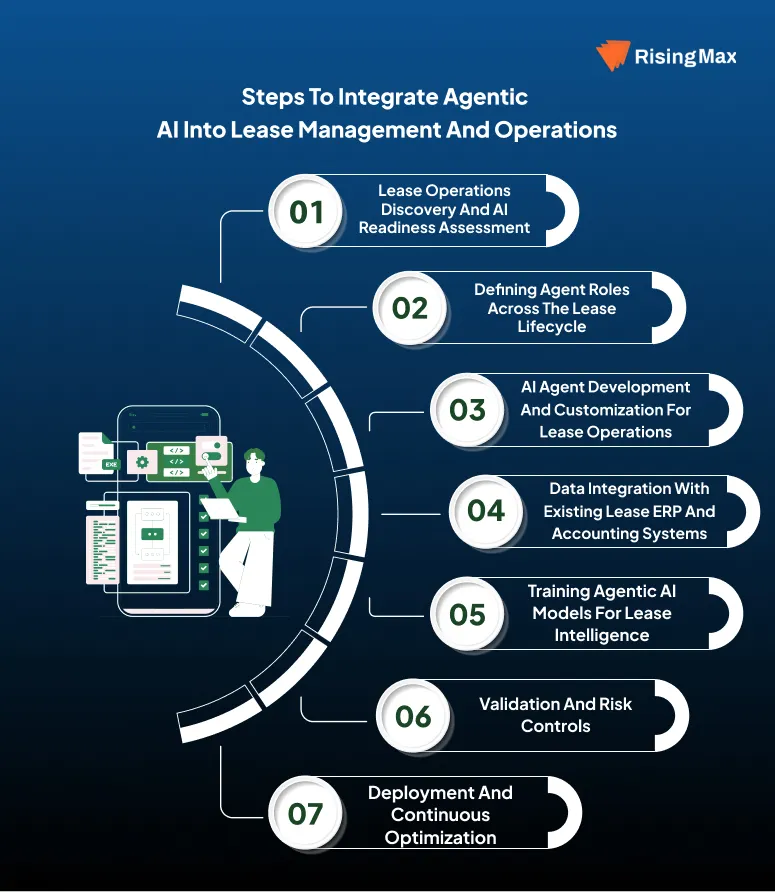
Integrating agentic AI into lease management is a step by step technical setup where AI agents are developed and are connected to lease data systems and given clear rules on what they can do. The goal is to let AI handle routine lease work while humans control important decisions.
Lease Operations Discovery and AI Readiness Assessment
This step checks how lease work is done today and whether data is ready for AI.
- Identify how leases are created, stored, reviewed, renewed and closed
- Measure number of leases, document formats and clause complexity
- List legal accounting and compliance rules that must be followed
- Review data sources such as lease files, finance systems and reports
- Check data quality, OCR accuracy and missing fields
Defining Agent Roles Across the Lease Lifecycle
Each AI agent is developed to work a specific job in the lease process.
- Lease abstraction agents read contracts and capture key terms
- Compliance agents track rules, deadlines and contract duties
- Renewal agents manage notice dates, renewals and exits
- Financial AI agents check rent schedules, payments and escalations
- A control layer coordinates how agents work together
AI Agent Development and Customization for Lease Operations
Next is the core development phase and this is where we, as an AI agent development company, build the agentic layer.
- Design domain-specific AI agents aligned with lease workflows
- Implement agent logic for abstraction compliance, renewals and finance
- Define decision boundaries, risk thresholds and escalation rules
- Build orchestration flows between agents
- Apply enterprise security compliance and governance controls
Data Integration With Existing Lease ERP and Accounting Systems
AI agents must work with current business systems, not replace them, which is why they need to be integrated smoothly without disrupting any operations.
- REST and event-based APIs synchronize lease states and status updates
- Document pipelines extract contracts from storage systems
- Data is changed into a common lease format
- Sync logic keeps financial and lease data updated
- Access controls protect sensitive information
Training Agentic AI Models for Lease Intelligence
This step implements intelligence and reasoning capability.
- Train language models to understand legal lease language
- Configure rule engines for accounting and contract logic
- Implement decision logic for alerts and actions
- Tune models using historical lease data
- Validate accuracy and explainability
Validation and Risk Controls
Governance is embedded directly into agent workflows.
- Risk scoring to find high-impact lease actions
- Approval workflows for terminations and financial changes
- Complete audit trails for AI decisions and data updates
- Override mechanisms for human intervention
- Compliance-ready logging and reporting
Deployment and Continuous Optimization
Post-deployment operations focus on stability and improvement.
- Phased rollout of agents to production environments
- Monitoring the latency and decision outcomes of AI agents
- Drift detection for contract language and regulations
- Continuous retraining with new lease data
- Governance for model versions and access control
To implement this end-to-end many businesses work with a top agentic AI development company. Such teams handle everything from start to end. This reduces technical risk, speeds up deployment, and ensures the agentic AI system is built for long-term lease operations.
Agentic AI Use Cases in Lease Management and Operations
Agentic AI introduces an execution layer on top of lease data. Instead of storing contracts and raising reminders, the system maintains live lease states, evaluates conditions continuously, and triggers actions based on predefined logic. The following use cases explain how this works in different lease environments.
Commercial Real Estate Lease Management
Agentic AI in real estate handles leases that contain complex clauses and strict financial terms. The system converts contracts into structured lease objects, maps obligations to timelines and works on them using rule engines linked to accounting and legal policies. Lease state changes automatically as payments or deadlines occur.
Example:
Agentic AI can interpret escalation clauses in office leases and track trigger dates without manual intervention.
Retail Chain Lease Operations
Agentic AI in retail manages high volume lease portfolios where timing and cost efficiency are very important. Every store lease is treated as a state machine with termination conditions and financial thresholds. Agents constantly change the lease cost against performance signals to support portfolio decisions.
Example:
Agentic AI can analyze store lease terms and flag locations where upcoming renewals exceed defined rent-to-revenue limits.
Corporate Lease Administration
Enterprise lease portfolios require consistency in financial treatment and compliance logic. Agentic AI enforces standardized rules by validating lease data against accounting models and internal policies while maintaining centralized control.
Example:
Agentic AI can re-evaluate corporate office leases when accounting rules change and surface only the leases that need adjustment.
Property Management Platforms Powered by Agentic AI
Agentic AI in property management operates as an embedded intelligence layer within property management software. AI agents process lease inputs, manage obligation tracking, and control lifecycle events through system-level workflows rather than manual actions.
Example:
Agentic AI can convert uploaded tenant leases into structured records, monitor obligations, and trigger event-based notifications directly within the platform.
Also Read: Use Cases of Artificial Intelligence In Legal Industry
Core Features of an Agentic AI-Powered Lease Management System
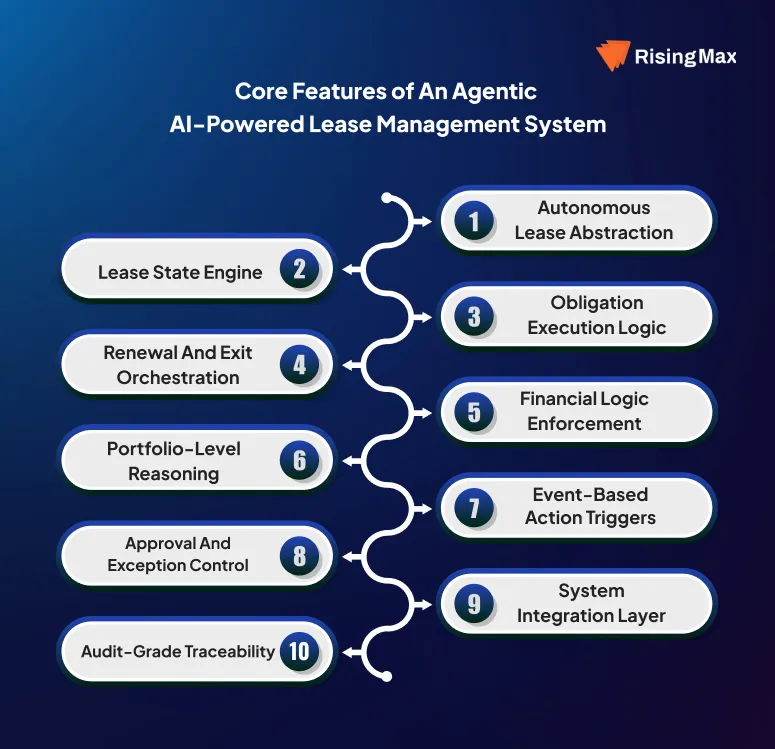
An agentic AI lease platform is defined by how it executes, reasons, and governs lease operations rather than how much data it stores.
Autonomous Lease Abstraction
AI agents change lease documents into structured contract objects with clause level accuracy and confidence scoring.
Lease State Engine
Each lease is modeled as a dynamic state machine that updates automatically based on time and actions.
Obligation Execution Logic
Contract obligations are changed into executable rules that trigger actions when certain conditions are met.
Renewal and Exit Orchestration
Notice periods and termination paths are handled by system-driven workflows in this feature.
Financial Logic Enforcement
Rent schedules and charges are validated against encoded financial rules before posting.
Portfolio-Level Reasoning
Agents evaluate lease data at portfolio scale to surface cost concentration, timing risk, and exposure patterns.
Event-Based Action Triggers
System events start actions without relying on any kind of reminders or manual checks.
Approval and Exception Control
High-impact actions are routed through configurable approval and exception-handling flows.
System Integration Layer
Bidirectional APIs keep lease intelligence synchronized with finance and operations systems.
Audit-Grade Traceability
Every agent decision and action is logged with input context and outcome for compliance review.
How Agentic AI Works in Lease Management
Agentic AI manages leases as active systems instead of stored documents. Each lease is treated as a live process that the system can read, monitor and work on without constant human input.
Lease Ingestion and Semantic Parsing
Lease documents enter the system through ingestion services. OCR is applied when needed. A language model parses legal text and identifies clauses, payment logic, notice periods and obligations. Each clause is tagged with a confidence score and mapped to a predefined lease schema.
Lease State Modeling
Every lease is stored as a state machine. The state includes active status, compliance status and financial position. State transitions are triggered by time based events or external inputs. This allows the system to know exactly where each lease stands at any moment.
Agent Execution Layer
AI Agents are deployed as independent services. Each agent works on specific lease state events. When an event occurs, the agent executes its logic. Abstraction agents update lease data. Compliance agents evaluate obligations. Renewal agents check notice conditions. Financial agents validate charges.
Decision & Policy Evaluation
Before execution continues, a decision engine checks and evaluates risk thresholds and business rules. If the action falls within allowed limits, it proceeds. If the risk is more the action is paused and routed for approval. This logic is deterministic and version controlled.
Action Execution and System Sync
Approved actions are executed through automation services. Lease systems and accounting platforms are updated through APIs. Notifications are sent when required and each action includes a full execution record.
Continuous Evaluation Loop
The system runs in a continuous loop. Lease states are reevaluated as time goes on. Rules and models are updated when lease language patterns or regulations are modified or changed. No manual restart is required.
Outcome
Agentic AI functions as a lease operations engine. It converts contracts into executable logic. It monitors state changes. It triggers actions under control. This is how autonomous lease management is achieved.
Inside the Architecture of an Agentic AI Lease Management Platform
An agentic AI lease platform is implemented as a distributed system composed of autonomous agents, orchestration services, and governed data pipelines. Intelligence, execution, and control are decoupled by design.
Multi-Agent Orchestration for Lease Operations
Lease functionality is decomposed into autonomous agents, each implemented as an independent service with bounded authority. An orchestration layer manages agent lifecycle and inter-agent coordination.
- Agent services scoped to abstraction, compliance evaluation and financial validation
- Orchestration engine managing task graphs, dependencies and execution order
- Event driven communication using message brokers
- State persistence to maintain lease execution context
- Fault isolation and retry logic at the agent level
This architecture supports parallel execution and operational resilience.
LLMs, RPA, and Decision Engines Working Together
Reasoning, execution and control are separated into distinct subsystems to guarantee better determinism and auditability.
- Large language models perform semantic parsing, clause classification, and obligation extraction
- RPA components execute system interactions
- Decision engines evaluate rule sets and policy constraints
- Versioned rule logic is usually independent of model updates
| Layer | Core Function | Role in Lease Management |
| LLM Layer | Reasoning and interpretation | Parses lease text, classifies clauses, extracts obligations |
| Decision Engine Layer | Policy control | Evaluates rules, thresholds, and risk before actions |
| RPA Layer | Execution | Performs system actions and workflow updates |
| Rule Versioning Layer | Logic stability | Separates rule updates from model changes |
| Audit Layer | Traceability | Logs inputs, decisions, and outcomes |
This prevents opaque model behavior from directly triggering actions.
Secure Data Pipelines
All data movement and agent actions are governed through controlled pipelines and policy enforcement layers.
- Encrypted pipelines for unstructured and structured data
- Schema validation and normalization at ingestion boundaries
- Role and scope based access for agents and users
- Policy gates controlling action execution based on risk classification
- Immutable audit logs capturing inputs, decisions, and outcomes
This governance layer allows autonomous operation and meeting enterprise security requirements.
Agentic AI Development Cost for Lease Management
Agentic AI development for lease management is driven by system design choices and not just licensing fees alone. Cost increases with autonomy depth, integration complexity and governance requirements because the system is expected to operate reliably in financial and legal workflows.
Agentic AI Development Cost Based on Complexity
| Agentic AI Complexity | Key Capabilities Included | Cost Range | Deployment Timeline |
| Simple | Lease ingestion, clause extraction, basic rules, alert triggers | $8,000 – $12,000 | 4–6 weeks |
| Mid-Level | Multi-agent setup, compliance tracking, renewal logic, ERP integration | $13,000 – $22,000 | 8–12 weeks |
| Complex | Full agent orchestration, lease state engine, financial validation, governance | $23,000 – $35,000 | 14–20 weeks |
Factors That Influence Agentic AI Development Cost
Lease Portfolio Size and Complexity
Higher lease volumes, diverse contract formats and jurisdiction-specific clauses increase effort in document parsing schema design and rule coverage.
Number and Type of AI Agents
Separate agents for abstraction, compliance and finance require orchestration logic, monitoring and fault handling, which directly affects build cost.
Integration With Enterprise Systems
Deep integration with lease platforms, ERP and accounting systems adds API development, security enforcement and data synchronization work.
Compliance Requirements
Audit trails and accounting standards support and regulatory controls increase system complexity but are mandatory for enterprise use.
Data Quality and OCR Readiness
Low-quality scans of inconsistent documents and missing metadata increase preprocessing validation and exception handling effort.
Level of Operational Autonomy
Systems limited to recommendations cost less than systems allowed to execute lease actions under policy control.
Top 5 Agentic AI Development Companies
Agentic AI systems require more than model expertise. They demand strong system design, workflow control and enterprise integration skills. Below are five companies offering agentic AI development services, each with a different area of strength.
1. Risingmax
Risingmax is a top Agentic AI development company that focuses on building agentic AI systems that execute business workflows end-to-end. Their agentic AI development approach emphasizes multi-agent orchestration, lease and finance automation and policy-based decision control. The company has already developed 50+ AI agents and is known for designing systems where AI agents actively manage operations instead of only providing insights.
2. Suffescom
Another entry in our list of top 5 agentic AI development companies is Suffescom, which specializes in agentic AI development for workflow automation and digital platforms. Their strength lies in rapid agent deployment and integration of AI agents into operational applications. They also provide project resume service and are chosen for projects where time to market and automation are key priorities.
3. Appinventiv
Appinventiv brings agentic AI development into large enterprise environments. The company focuses on embedding autonomous agents within existing digital products using secure cloud-native architectures. Their agentic AI development services are best for organizations that require AI agents to operate reliably at scale.
4. Hyperlink Infosystem
Hyperlink Infosystem delivers agentic AI development services centered on custom AI agents and system integration. They work on AI applications that require continuous data processing rule evaluation and third-party tool connectivity. Their flexibility makes them suitable for varied business models.
5. BairesDev
BairesDev approaches agentic AI development through a team of AI developers and provides various engagement models. The company emphasizes performance reliability and security when building autonomous AI systems. Their agentic AI development services are commonly used by enterprises with complex operational and compliance requirements.
Overview of Best 5 Agentic AI Development Companies
| Rank | Company Name | Founded In | Key Agentic AI Capability |
| 1 | Risingmax | 2011 | Multi-agent orchestration and end-to-end autonomous workflow execution |
| 2 | Suffescom | 2011 | Fast agent deployment and workflow automation integration |
| 3 | Appinventiv | 2015 | Enterprise-scale agentic AI with cloud-native security |
| 4 | Hyperlink Infosystem | 2011 | Custom AI agents with flexible third-party integrations |
| 5 | BairesDev | 2009 | Secure autonomous systems for complex enterprise operations |
The Future of Lease Management With Agentic AI-Driven Intelligent Systems
The future of lease management is moving away from manual oversight toward fully autonomous operations. Agentic AI will not only manage leases but will also continuously optimize them by reacting to data changes in real time.
Self-Managing Lease Portfolios and Autonomous Decisions
In the future, agentic AI systems will manage entire lease portfolios with very less human involvement. AI agents will negotiate, recommend exits and adjust lease strategies based on performance thresholds.
Agentic AI Combined With Predictive Analytics and Market Data
When agentic AI is combined with predictive analytics and external market data lease systems will anticipate outcomes before they occur. Rent changes, occupancy trends and location performance will be forecast automatically. This will allow lease decisions to be made earlier and with greater confidence.
Agentic AI and Digital Twins for Lease Simulation
Agentic AI integrated with digital twin technology will simulate lease scenarios before any actions are taken. Businesses will test, renew, exit or consolidate decisions in a virtual environment to know what exactly the financial and operational impact is. This reduces risk and improves planning.
Agentic AI With Blockchain for Contract Integrity
Integrating agentic AI with blockchain technology can help lease agreements become verifiable. AI agents will perform actions based on chain contract states, which will guarantee better transparency and decrease disputes. This is highly relevant for multi-party lease ecosystems.
Conclusion
Lease management has become a complex operational challenge where small mistakes can create major financial and compliance risks. Traditional tools built on manual updates and static reporting are no longer enough to manage large and growing lease portfolios.
Agentic AI transforms lease management by working as an execution system. It turns lease contracts into structured logic, maintains live lease states, monitors obligations continuously and triggers actions under defined policies. This shift enables businesses to move from reactive lease administration to controlled autonomous lease operations.
For organizations managing multiple leases, agentic AI provides better control, reduced risk and scalable operations. Partnering with an agentic AI development company like RisingMax helps ensure these systems are built for long-term reliability and real business impact.
FAQs
1. What problem does agentic AI actually solve in lease management?
Agentic AI removes manual tracking and decision delays by turning leases into live systems that monitor obligations, trigger actions, and manage renewals automatically. It reduces missed deadlines, compliance errors, and operational overhead.
2. How is agentic AI different from lease management software with AI features?
Most AI-enabled lease tools assist users with insights or extraction. Agentic AI executes tasks autonomously under defined rules. It does not wait for user input and can manage workflows end to end.
3. Is agentic AI suitable for small lease portfolios?
Yes, but it delivers the most value when lease volume or complexity increases. Smaller portfolios often start with a simple or mid-level agentic AI setup and scale over time.
4. Can agentic AI replace lease managers or legal teams?
No. Agentic AI handles routine execution and monitoring while humans retain control over approvals, strategy, and legal judgment. It reduces workload but does not replace expertise.
5. How secure is agentic AI for handling lease and financial data?
Enterprise-grade agentic AI systems use encrypted data pipelines, role-based access control, and audit logs. Actions are governed by policy gates and approval workflows to meet security and compliance needs.
6. Does agentic AI work with existing lease and accounting systems?
Yes. Agentic AI is designed to integrate with existing lease management software, ERP, and accounting platforms through APIs and event-based synchronization.
7. How long does it take to implement agentic AI for lease management?
A pilot system typically takes 4–6 weeks. Mid-level implementations take 8–12 weeks, while enterprise-grade systems may take up to 4–5 months, depending on complexity.
8. What level of autonomy can businesses control?
Autonomy is configurable. Businesses can allow AI to execute low-risk actions automatically while routing high-impact decisions like terminations or renewals for human approval.
9. How does agentic AI handle lease compliance and audits?
Agentic AI continuously monitors obligations and maintains complete execution logs. This creates audit-ready records and reduces last-minute compliance risks.
10. Can agentic AI adapt to changes in lease terms or regulations?
Yes. Lease state models and rule engines can be updated when contract language, accounting standards, or regulations change. The system re-evaluates affected leases automatically.
11. How much does agentic AI development typically cost?
Agentic AI development costs usually range from $8,000 for simple setups to $35,000 for complex enterprise-grade systems, depending on agent complexity, integrations, and governance requirements.
12. Is agentic AI a one-time build or an ongoing system?
Agentic AI is an evolving system. It requires ongoing monitoring, model updates, and rule adjustments to remain accurate as lease data and business conditions change.
13. Why should businesses work with an agentic AI development company?
Building agentic AI requires expertise in agent design, orchestration, governance, and enterprise integration. An experienced agentic AI development company ensures the system is reliable, secure, and scalable for real-world lease operations.