AI has a long history with the healthcare sector and can be traced back to the 1970s. Programmes like MYCIN, INTERNIST, and QMR addressed the diagnostic challenges; however, they were never used in the daily operations due to constraints regarding their integration with the devices at that time. Later in the 1990s, ML (Machine Learning) powered programmes were introduced, and most of these programmes were accessible by ARPANet, and later through the World Wide Web.
Fast-forward to modern times, technology and medical science have advanced to the point that they can be seamlessly integrated and used in daily practice. Yet you would be surprised to know that every year U.S. healthcare system spends over $1 trillion on administrative work, tasks that can be automated by integrating AI Agents in clinical workflows.
Meanwhile, it is also pertinent to mention that, during one recent research published by BCG (with whom we had collaborated on other occasions), major AI innovators in the healthcare industry are following the 10-20-70 rule.
As per the 10-20-70 rule,
An ideal healthcare institution should dedicate 10% of its effort to algorithms, 20% to technology and data, and the remaining 70% towards the people and medical services.
Despite all these advancements, the workforce at healthcare institutions is still struggling to manage the administrative work, which resultantly hamper their performance at core medical services.
In this article, we will understand how to bridge this gap using Agentic AI, its integration, high-value use cases, and their strategic implementation for maximum output.
Table of Contents
- Understanding Agentic AI
- Agentic AI Use Cases in Clinical Workflows
- Integration & Interoperability of Agentic AI
- Challenges and Risks of Agentic Clinical Workflows
- Future Trends
- Conclusion
- FAQs
1. Understanding Agentic AI: The Architecture To Unlock Autonomous Clinical Workflow
The transition into the agentic era marks a fundamental shift from AI systems that merely generate content to those capable of autonomous functionality, advanced reasoning, and dynamic interaction. Unlike previous iterations of medical technology, Agentic AI acts as a reasoning and decision-making core, often leveraging a central Large Language Model (LLM) to orchestrate complex clinical workflows.
1.1. The Four Pillars of Clinical AI Agents
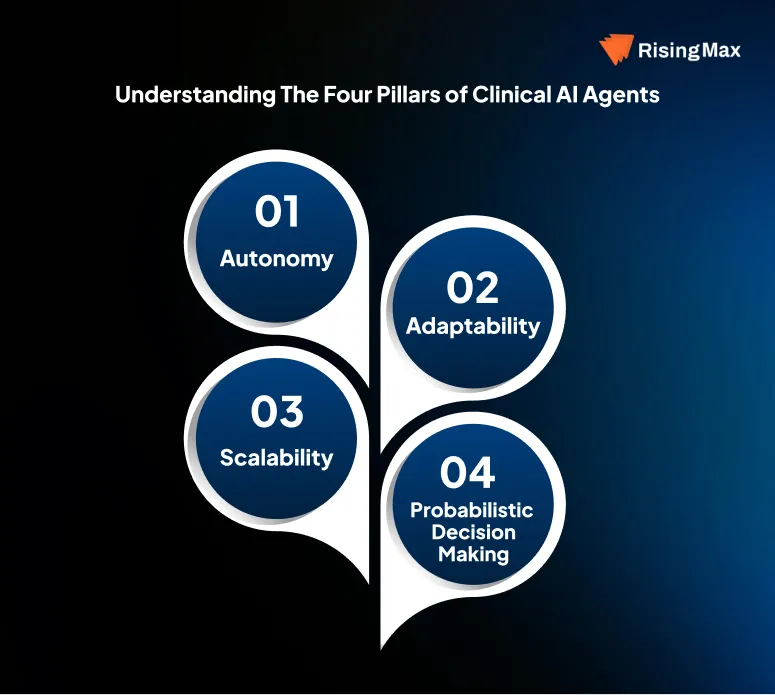
To function effectively within the high-stakes environment of a hospital, agentic systems are built upon four essential technical pillars:
- Autonomy: These agents function independently with minimal human involvement, detecting tasks automatically and pursuing predefined goals based on real-time data. For instance, an autonomous agent in radiology can analyze scans, select the appropriate diagnostic algorithm, and generate a preliminary report without manual triggers.
- Adaptability: Traditional models are often rigid, but agentic AI dynamically adjusts to new data and evolving clinical needs. A system initially trained on X-ray analysis can fine-tune its parameters to process MRI or CT scans, ensuring long-term relevance as medical imaging modalities evolve.
- Scalability: By leveraging cloud infrastructure and federated learning, agentic systems can process vast, heterogeneous datasets across diverse medical networks without compromising speed or accuracy. This is critical for large-scale applications like global telemedicine.
- Probabilistic Decision-Making: These agents use iterative reasoning to update predictions based on feedback loops and new contextual knowledge. For example, an agent may initially flag a case as pneumonia but autonomously revise the diagnosis to tuberculosis after incorporating new epidemiological data and lab results.
1.2. Paradigms of Intelligence: Traditional vs. Agentic AI
The evolution of AI in healthcare has moved from fixed, rule-based logic to flexible, natural language-driven architectures.
| Aspect | Traditional AI Paradigms | Next-Gen Agentic Paradigms |
| Reasoning Approach | Uses domain-specific algorithms (e.g., Reinforcement Learning, finite state machines), often limited to predefined FAQs. | Leverages natural language reasoning via LLMs to engage in open-ended clinical Q&A. |
| Domain Flexibility | Optimized for specific tasks like structured report generation or rule-based classification. | Highly adaptable using zero-shot or few-shot learning to switch between summarizing reports and providing diagnostic support. |
| Decision Structure | Rigid “reflex” or “utility-based” structures that follow fixed guidelines for triaging. | Capable of self-directed sub-goals and iterative planning, adjusting triage based on evolving symptoms. |
| Tool Integration | Often operates as standalone tools (e.g., an anomaly detector for CT scans). | Dynamically calls external APIs, knowledge bases, and specialized ML/DL models to provide comprehensive insights. |
| Primary Use Cases | Robotics, rule-based decision-making, and industrial control systems.
Example: A robotic system following predefined surgical procedures. |
Unlimited
Example: AI-driven virtual assistants for patient monitoring, adaptive treatment planning, personalized medicine, robotic surgery, and many more. |
Traditional agents—such as Simple Reflex, Model-Based, and Utility-Based agents—primarily focus on maximizing expected utility within narrow constraints. In contrast, agentic AI incorporates adaptive architectures that allow for a level of generalization across tasks that aligns with the long-term goals of Artificial General Intelligence (AGI).
1.3. The Reasoning Core: Advanced LLM Mechanisms
The “brain” of a healthcare AI agent is its central LLM, which uses structured techniques to navigate complex medical decisions. These mechanisms ensure that the agent does not just “predict” the next word, but actually reasons through a clinical problem:
- Chain-of-Thought (CoT): This technique elicits reasoning by prompting the model to break down complex medical tasks into a structured decomposition of logical steps.
- Reasoning and Acting (ReAct): This mechanism synergizes logical inference with external tool use. For example, an agent might reason that a patient’s symptoms suggest a rare condition and then “act” by calling a medical database API to verify the latest research before finalizing a recommendation.
- Tree of Thought (ToT): ToT allows the agent to manage multi-branching clinical decisions by exploring multiple reasoning paths simultaneously and evaluating which “branch” leads to the most accurate diagnostic or treatment outcome.
By integrating these technical foundations, agentic AI acts as the connective layer between disparate hospital systems, moving healthcare from simple data interpretation to coordinated, autonomous action.
2. Transformative Clinical Use Cases: How Agentic AI Redefines Care Delivery
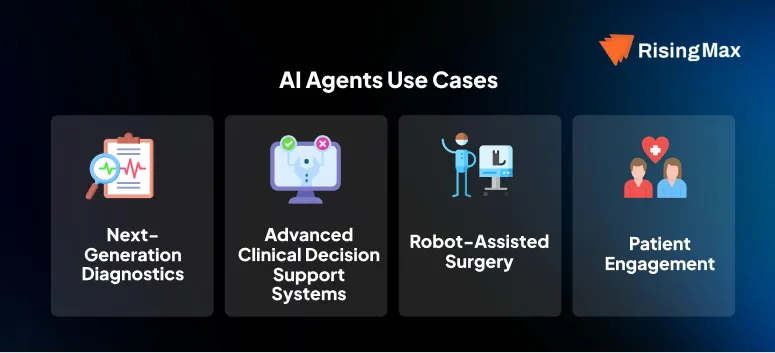
Agentic AI represents a transformative milestone in healthcare, moving beyond task-specific automation to systems capable of autonomous functionality, advanced reasoning, and multimodal data integration. By acting as a “connective layer,” these autonomous agents are reshaping clinical workflows across diagnostics, surgical interventions, and patient management.
2.1. Next-Generation Diagnostics: From Autonomous Analysis to Early Prediction
Modern diagnostic workflows are now being improved by agents that can observe, plan, and act independently, significantly reducing clinicians’ cognitive load. As a result, clinicians can dedicate this time to patient care.
2.1.1. Autonomous Image Analysis and Reporting
Unlike traditional AI that requires manual triggers, agentic systems can autonomously analyze scans, select appropriate diagnostic algorithms, and generate preliminary reports. For example, Med-Flamingo, a multimodal few-shot AI agent, assists in 2D medical diagnosis and has demonstrated a 20% improvement in accuracy over existing models.
For complex 3D scans like CT and MRI, M3D-LaMed utilizes a specialized 3D vision encoder to integrate text and image data, enhancing the characterization of 3D anatomical structures.
2.1.2. Superior Accuracy in Differential Diagnosis
A recent study comparing LLM-assisted agents to conventional internet searches for brain MRI differential diagnosis found that AI-assisted diagnoses achieved 61.4% accuracy compared to only 46.5% for traditional methods.
2.1.3. Predicting Disease Before Symptoms Appear
Agentic AI deploys predictive analytics to analyze EHRs, genomics, and wearable data to identify “subtle disease indicators”. These agentic AI systems can now predict conditions such as Alzheimer’s or kidney disease years before clinical symptoms manifest, enabling proactive, personalized treatment paths.
2.2. Advanced Clinical Decision Support Systems (CDSS)
In addition to analyzing the medical reports and gathering data from EHRs, next-gen CDSS leverages Vision-Language Models (VLMs) and dynamic planning to offer clinicians real-time, context-aware insights.
2.2.1. Dynamic Planning with VoxelPrompt
VoxelPrompt is the first medical imaging agent capable of dynamically planning, executing, and adapting its strategy using external computational tools. It has achieved 89% accuracy in pathology characterization, matching expert classifiers while outperforming specialized segmentation models on 13 out of 17 anatomical structures.
2.2.2. Vision-Language Model (VLM) Integration
Tools like LLaVA-Med integrate LLMs with biomedical imaging to support visual question answering (VQA) and real-time clinical reporting. These models allow clinicians to query images directly, such as asking for highlights of a patient’s imaging history, improving workflow efficiency and reducing diagnostic errors.
2.2.3. Precise 3D Contouring
Systems like LLMSeg fuse textual clinical data with imaging to enable precise 3D contouring in radiation oncology, maintaining robust performance even in “data-insufficient settings” where traditional AI often fails.
2.3. Robot-Assisted Surgery: Orchestrating Precision in the Operating Room
In the surgical suite, agentic AI acts as an orchestrator, integrating data from endoscopic cameras, sensors, and preoperative imaging to chart precise surgical paths in real time.
Instead of operating as a passive tool, the AI dynamically interprets the surgical environment, anticipates next steps, and helps chart optimal surgical paths while adapting to tissue movement and intraoperative variability.
2.3.1. Autonomous Task Execution with SUFIA
SUFIA (an LLM-driven robotic assistant agent) translates natural language commands into high-level surgical plans and low-level control actions. In simulated experiments, SUFIA achieved a 100% success rate in needle lifting and a 90% success rate in needle handover, demonstrating its potential to automate delicate tasks under human supervision.
2.3.2. Real-Time Monitoring and Safety
These agents continuously monitor critical parameters during surgery, alerting the surgical team to potential complications and offering dynamic feedback to minimize risks and invasiveness.
Quick Q&A
How do robotic surgical agents adapt to real-time perceptions?
Robotic surgical agents adapt to real-time perceptions by integrating and analyzing data from multiple sources, including endoscopic cameras, sensors, and preoperative imaging. This allows the agents to interpret patient anatomy in real-time and adapt to subtle movements to ensure optimal instrument positioning.
- Dynamic Planning and Execution
- Orchestrated Navigation
- Interactive Refinement
- Continuous Learning
2.4. Patient Engagement: Ambient Intelligence and the Automated Clinic
Agentic AI is bridging the gap between clinical care and daily life through ambient intelligence and simulated patient interactions.
2.4.1. Ambient AI Scribes
Electronic health records are increasingly incorporating ambient scribes that record and summarize patient conversations in real time. This reduces the administrative load on physicians, allowing them to focus more on patient care rather than drafting notes or responding to repetitive messages.
Some common examples of ambient AI scribes that listen during consultation to generate notes, such as SOAP notes, automatically are Nuance DAX Copilot, Abridge, Freed, Heidi Health, and DeepScribe.
Quick Q&A
Q. How do ambient scribes reduce physician cognitive fatigue specifically?
A. Ambient AI scribes reduce physician cognitive fatigue by recording and summarizing patient conversations in real-time, which significantly decreases the amount of time clinicians must spend manually documenting interactions. By automating the drafting of clinical notes and responses to messages, these tools reduce the heavy administrative burden (up upto 50%) that typically consumes a large portion of a physician’s day.
2.4.2. Simulated Clinical Environments
Platforms like Agent Hospital and AgentClinic simulate doctor-patient interactions, autonomously managing triage, medical examinations, and follow-ups. These systems can adapt their questioning strategies in real time based on evolving symptoms, mimicking human clinical reasoning to improve patient compliance and trust.
These intelligent platforms can be used to train and test AI agents in clinical settings.
2.4.3. Scalable Mental Health Support
Conversational agents like Woebot use NLP to analyze emotional states and deliver context-aware, empathic responses, providing a scalable platform for continuous patient monitoring and therapeutic engagement.
2.5. Summary of AI Agent Types in Healthcare As Per Their Usage
Artificial intelligence agents are transforming healthcare by automating complex tasks, supporting clinical decision-making, and improving patient outcomes across the care continuum. Each AI agent type is designed with specific capabilities, ranging from image interpretation and predictive analytics to conversational interaction and expert reasoning.
The table below categorizes major AI agent types used in healthcare, outlining their key applications, clinical domains, primary users, and the core AI technologies that enable their functionality.
This classification helps stakeholders understand how diverse AI agents fit into real-world healthcare workflows and where they deliver the most value.
| AI Agents | Key Applications | Healthcare Categories | Main Users | Key AI Technologies |
| Image-based agents | Disease diagnosis, early detection, and report generation | Diagnosis, Clinical Decision Support | Radiologists, Doctors | Computer vision (CNNs, ViTs), multimodal LLMs for image–text integration |
| Predictive analytics agents | Risk prediction, disease progression forecasting, patient outcome analysis | Clinical Decision Support, Treatment and Patient Care, Drug Discovery & Research | Doctors, Care Teams | Predictive modeling, supervised ML, ensemble methods, time-series analysis |
| Conversational agents | Symptom checking, patient triage, virtual consultations | Patient Engagement and Monitoring | Patients, General Practitioners | NLP, dialogue systems, pretrained LLMs |
| Rule-based agents | Following clinical guidelines, alerting for drug interactions | Clinical Decision Support | Doctors, Pharmacists | Rule-based reasoning, logic programming, expert rules, knowledge graphs |
| ML agents | Disease classification, anomaly detection, treatment planning | Diagnosis, Treatment and Patient Care, Drug Discovery & Research | Data Scientists, Doctors | Machine learning and deep learning algorithms, reinforcement learning |
| Expert system agents | Emulating clinical expertise for diagnosis and planning | Treatment and Patient Care, Clinical Decision Support, Robot-Assisted Surgery | Specialists, Researchers, Surgeons | Knowledge-based systems, rule-based systems |
3. Integration & Interoperability – How Agentic AI Acts as a Connective Fabric in Clinical Workflow
The true prowess of Agentic AI lies not in replacing existing medical technology but in serving as the intelligent coordination layer that unites a fragmented industry. While the U.S. healthcare system spends over $1 trillion annually on administrative tasks, much of this cost stems from “manual knowledge work,” including retrieving, reconciling, and moving data across disconnected systems.
Agentic AI addresses this by acting as the fabric that integrates with a wide range of databases and can participate in autonomous, multi-step workflows.
3.1. The Connective Layer: Orchestrating Fragmented Ecosystems
Healthcare workflows were never designed for linear execution; they are built on deep interdependencies where a single missing field or updated payer rule can stall an entire process.
While previous waves of Generative AI provided tools to interpret unstructured documents, they lacked the ability to move the work across platforms. Agentic AI fills this coordination gap by pursuing operational goals rather than just analyzing data.
Instead of operating as an isolated silo, an agentic system acts as the missing glue for:
- Electronic Health Records (EHRs): Retrieving clinical notes to support background administrative tasks without clinician intervention.
- Revenue Cycle Management (RCM) Platforms: Reconciling conflicting eligibility data and managing insurance claim denials.
- Payer Portals: Automatically navigating external systems to perform eligibility checks and prior authorizations, tasks that previously required manual “portal jumping” by staff.
By handling the “in-between” work that no single system has ever managed well, these agents reduce the cognitive fatigue of teams who previously had to manually fix, sequence, and push work forward.
3.2. Technical Foundations: Enabling System “Participation”
For Agentic AI to succeed, it must be built upon a robust technical “plumbing” that allows it to interact with mature, interconnected healthcare environments. Successful integration does not require a “rip-and-replace” of core infrastructure; rather, it requires that existing systems be enabled to participate in coordinated automation.
To enable this coordinated automation, the technical foundation of agentic AI in healthcare is built on the following frameworks –
- APIs and HL7/FHIR Interfaces: Agents leverage these standard interoperability frameworks to access, update, and reconcile data across diverse enterprise systems in real-time.
- Message Brokers and Event Frameworks: These provide the underlying infrastructure that enables agents to detect task triggers and sequence actions across disconnected systems.
- Interoperability Middleware: This layer helps agents handle the variability in how data is captured across different departments, ensuring workflow continuity even when data quality is inconsistent.
To scale these foundations, organizations often follow the 10-20-70 rule:
10% of effort is dedicated to algorithms,
20% to the technology and data plumbing,
70% to the people and processes required to manage this new rhythm of work.
3.3. Agility via No-Code and Pro-Code Architectures
A major barrier to healthcare innovation has been the heavy engineering effort required to modify rigid legacy workflows. Agentic AI platforms address this by offering No-Code and Pro-Code tools that enable both operational and technical teams to refine agent logic without rebuilding the core infrastructure.
These tools empower organizations to:
- Adjust Logic on the Fly: Teams can quickly update agent behavior as payer requirements or internal SOPs evolve, accelerating iteration cycles.
- Deploy Prebuilt Accelerators: Ready-to-use templates for high-volume workflows, such as eligibility verification and appointment management, allow for faster adoption and lower barriers to entry.
- Maintain Oversight: No-code dashboards provide real-time observability, allowing teams to monitor how agents make decisions and identify bottlenecks without deep-diving into code.
In practice, this modular approach delivers measurable results. For instance, one large U.S. healthcare enterprise recently reported a 40% increase in self-service completion rates and a 20% reduction in manual actions by frontline staff within just six months of deploying a coordinated agentic ecosystem.
4. Addressing the Critical Challenges and Risks of Agentic Clinical Workflows
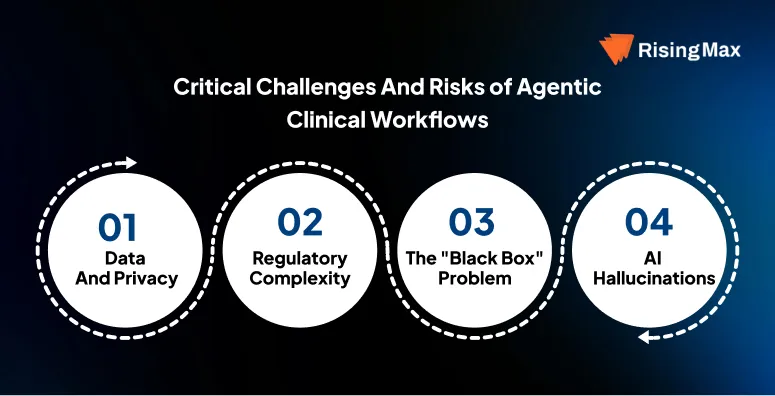
As the healthcare industry enters the Agentic Era, the transition from static algorithms to autonomous systems brings significant technical and ethical hurdles. Some of them are discussed below,
4.1. Data and Privacy – Overcoming Fragmentation and the Cost of Innovation
The primary technical bottleneck for agentic AI is data fragmentation. Clinical data is currently siloed across disparate Electronic Health Records (EHRs), billing platforms, faxes, and aging departmental tools.
Because agentic AI depends on consistent, high-quality data to act reliably, fragmented environments force agents to pause or escalate tasks, creating new operational bottlenecks.
To protect patient confidentiality while training these models, organizations are exploring privacy-enhancing technologies such as
- Federated Learning
- Differential Privacy
- The 10-20-70 implementation rule
- Explainable AI (XAI)
4.2. Regulatory Complexity – Aligning with Global Standards
Healthcare regulations are currently struggling to keep pace with the rapid advancement of autonomous AI. Agentic models that utilize continuous learning modules. Therefore, it is equally important to ensure that the AI models healthcare institutions deploy remain in compliance with global regulatory standards.
To achieve clinical adoption, developers must align with three major frameworks –
- EU AI Act
- FDA Perspectives
- IVDR (In Vitro Diagnostic Regulation)
4.3. The “Black Box” Problem: Advancing Transparency through XAI
A significant barrier to clinician trust is the “black box” nature of proprietary LLMs, which offer minimal transparency regarding their internal decision-making processes. This opacity makes assigning legal liability for medical errors complex.
To address the black-box problem, the industry is gradually shifting towards Explainable AI (XAI) and Causability. Under these mechanisms, healthcare institutions are looking to keep AI agents under check using frameworks such as confidence scores (assigning a numerical value to the agent’s certainty), map-based interpretable outputs, and using open-source models like LLaMA or Falcon instead of proprietary models like ChatGPT or Gemini.
Note: Proprietary models, however, offer high performance and broader support but often lack transparency regarding their internal decision-making process. On the other hand, open-source models allow the development of their own AI agents with greater transparency.
4.4. Mitigating AI Hallucinations and Ensuring Fairness in Results
Patient safety is at risk when LLMs experience AI hallucinations, generating plausible but factually incorrect medical information, which can lead to catastrophic clinical errors. Furthermore, if training data is not carefully curated, AI-driven decisions can be discriminatory, disproportionately affecting underrepresented patient populations.
To mitigate AI hallucinations and ensure the fairness of the actions and results of Agentic AIs, implementing hybrid oversight mechanisms that include Human-in-the-Loop (HITL) frameworks to prevent oversight fatigue and automation bias is a good step.
5. Future Trends: The Evolution toward Universal Healthcare Ecosystems
The next phase of agentic AI is characterized by a shift from task-specific automation to universal healthcare ecosystems. By integrating directly with EHRs, imaging platforms, and robotic systems, agentic AI is moving toward a future of proactive, personalized, and preventive medicine.
5.1. Transformation towards Proactive Agents
A critical research priority is transforming the reactive nature of current AI into a proactive paradigm. Rather than waiting for manual triggers, proactive agents will independently identify knowledge gaps and suggest optimal workflows to both clinicians and patients. Simply put, this means,
Predictive Prevention: Future agents will synthesize data from wearables, genetic profiles, and historical EHR records to predict chronic conditions, such as Alzheimer’s or kidney disease, years before clinical symptoms manifest.
Dynamic Workflow Orchestration: These agents will transition from understanding to automatically initiating next steps in a care plan.
Proactive Engagement: Systems like Agent Hospital and AgentClinic already demonstrate the potential for agents to autonomously manage triage, consultations, and follow-ups through dynamic, real-time dialogues that adapt to evolving patient symptoms.
5.2. Achieving Multidisciplinary Autonomy with Generalist AI Agents
The development of Generalist AI Agents marks a milestone toward Artificial General Intelligence (AGI) in medicine.
- Future generalist models will utilize few-shot and self-supervised learning to adapt to new medical scenarios rapidly.
- Early “co-scientist” agents have already identified repurposed drug candidates for leukemia and independently hypothesized bacterial gene transfer mechanisms.
- By leveraging a central LLM as a reasoning engine, these agents can simultaneously process 3D medical scans, unstructured clinical notes, and real-time sensor data to support high-stakes decision-making.
5.3. Boosting Security Paradigm with Edge AI and Blockchain
Edge AI for Real-Time Inference: Implementing Edge AI solutions will facilitate real-time inference directly on medical devices. This reduces reliance on centralized cloud infrastructure, which is essential for maintaining operational continuity in resource-limited environments or rural clinics with poor connectivity.
Blockchain and Federated Learning: These technologies are poised to revolutionize secure, decentralized medical data sharing. Blockchain ensures a transparent and immutable audit trail for agent actions, while Federated Learning allows models to train on diverse datasets across different hospitals without ever moving sensitive patient data off-site.
Privacy-Preserving Interoperability: This decentralized approach ensures that as agents become more autonomous, they maintain strict compliance with global privacy standards like HIPAA and the EU AI Act while enabling seamless data exchange between disparate systems.
The goal is not to replace the human workforce, but to create a hybrid human-AI collaboration framework where agents handle the coordination burden, allowing clinicians to return their focus to the “moments that matter most”.
6. Conclusion
Agentic AI marks a remarkable shift from passive insights to autonomous action. These models can fill the intelligent coordination layer gap that the healthcare sector has long lacked. With the aid of advanced reasoning mechanisms such as Chain of Thoughts (CoT), these intelligent agents can autonomously perform actions in response to shifting clinical needs.
However, much of the success still lies in the interoperability and integration. Therefore, it is pertinent for healthcare institutions to partner with an experienced institution to navigate the complexities of data interoperability and governance while implementing the 10-20-70 rule for success. You can partner with us to develop coherent Agentic AI for Clinical Workflows. Let’s redefine care delivery together by returning time to the moments that matter most.
FAQs About Agentic AI in Clinical Workflows
Q1. What is Agentic AI in Clinical Workflow?
Ans. Agentic AI refers to a new class of autonomous systems capable of advanced reasoning, independent goal-seeking, and dynamic interaction within clinical environments. Unlike traditional AI that follows rigid rules, these agents can observe, plan, and execute multi-step tasks with minimal human oversight.
Q2. How does Agentic AI differ from traditional healthcare AI?
Ans. Traditional AI typically relies on domain-specific algorithms and predefined condition-action rules for specific tasks. Agentic AI uses natural language reasoning and Large Language Models (LLMs) to generalize across diverse clinical tasks and adapt to evolving symptoms.
Q3. What are the four pillars of healthcare AI agents?
Ans. The technical foundation of these systems rests on Autonomy (independent action), Adaptability (adjusting to new data), Scalability (handling vast datasets via cloud/federated learning), and Probabilistic Decision-Making (iterative reasoning).
Q4. How can Agentic AI improve medical diagnostics?
Ans. AI agents enhance diagnostics by autonomously analyzing 2D and 3D medical scans and generating preliminary reports with up to 20% higher accuracy than previous models. They can also predict chronic conditions like Alzheimer’s or kidney disease years before clinical symptoms manifest.
Q5. What role do AI agents play in robotic surgery?
Ans. Agents embedded in robotic systems orchestrate data from sensors and cameras to chart precise surgical paths in real-time. They can automate delicate tasks like suturing and needle handling while providing dynamic feedback to reduce surgical risks.
Q6. How do ambient AI scribes reduce physician burnout?
Ans. Ambient AI scribes record and summarize patient conversations in real-time, significantly decreasing the administrative load of manual documentation. This allows physicians to focus more on patient care rather than drafting notes or responding to routine messages.
Q7. What is the “10-20-70 rule” for AI implementation?
Ans. This strategic framework suggests that successful AI transformation requires 10% effort on algorithms, 20% on technology and data, and 70% on managing changes in people and processes.
Q8. How do AI agents integrate with existing hospital systems like EHRs?
Ans. Agentic AI acts as an intelligent “connective layer” that uses APIs, HL7/FHIR interfaces, and interoperability middleware to communicate across fragmented systems like EHRs and payer portals.
Q9. What are CoT, ReAct, and ToT in AI reasoning?
Ans. These are advanced reasoning mechanisms: Chain-of-Thought (CoT) breaks tasks into logical steps, Reasoning and Acting (ReAct) combines logic with tool use, and Tree of Thought (ToT) manages complex, multi-branching decisions.
Q10. How is data privacy maintained in agentic healthcare systems?
Ans. Privacy is protected through technologies like federated learning, which trains models on decentralized servers without moving sensitive data, and differential privacy, which obscures individual identities.
Q11. What is the “black box” problem, and how is it addressed?
Ans. The “black box” problem refers to the lack of transparency in how complex AI models reach medical conclusions. It is addressed through Explainable AI (XAI), which provides confidence scores and interpretable reasoning to help clinicians validate outputs.
Q12. What is the future of proactive AI agents?
Ans. The industry is moving toward proactive agents that identify knowledge gaps and suggest optimal workflows independently, rather than waiting for manual triggers. These systems will eventually evolve into universal ecosystems where AI seamlessly integrates with all aspects of preventive and personalized medicine.